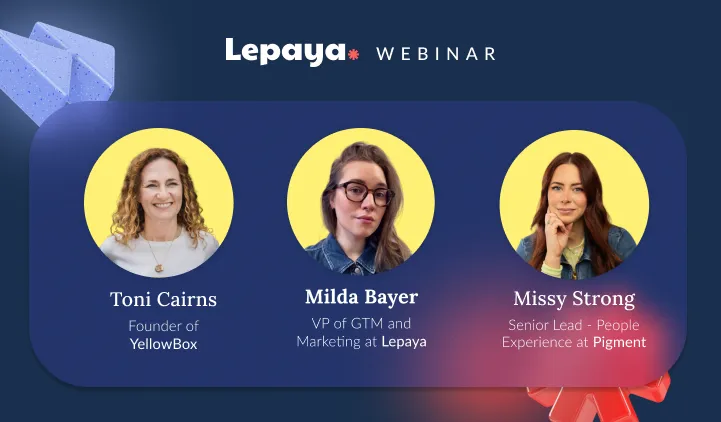
Real strategies and examples from HR and L&D leaders who are driving workforce readiness.
Register



Most organisations now have an AI strategy on paper. Fewer have worked through what it means for how the organisation actually operates: who owns decisions, who's accountable when AI gets it wrong, and how teams need to change the way they work.
Dr JooBee Yeow, Founder of Learngility and People & Org Director at Notion Capital, works with founders and HR leaders navigating the challenges of building to scale.
Her view is that AI transformation exposes the organisation underneath the technology. And in doing so, it changes where strategic HR creates value.
AI holds up a mirror. It surfaces existing issues in people, processes and decision-making, while removing the tolerance that once allowed us to say, "We'll fix that later."
"Ask John" might work when you're a team of 15. But AI requires the organisation to make things explicit. Who owns the decision? Where does reliable knowledge live? What does good look like?
If those things aren't clear, AI won't fix the system. It will amplify what's already there.
There are three connected shifts worth paying attention to:
AI relies on clear ownership, decision rights, reliable information and shared definitions of good. When those are missing, the gaps become much harder to ignore. A strong organisational operating system allows AI to create leverage. A weak one allows it to scale confusion.
AI can produce policies, frameworks and potential solutions in seconds. If HR's value comes from having the best answer, it is increasingly competing on something AI can already do well.
Founders don't always need another answer. Sometimes they're circling because the barrier isn't information. It's an uncomfortable trade-off, fear, risk or uncertainty.
This is where HR can add value: understanding what's holding the decision back, knowing when to challenge or reassure, and helping leaders reach resolution.
AI makes it possible to produce more, faster. But faster output doesn't automatically improve performance.
Without clarity and judgement, speed can create rework, inconsistent decisions and poor customer outcomes. So the question isn't simply, "Did AI make us faster?" It's whether that speed creates sustainable value for the customer and the business.
Start with the business.
Ask: How has the business decided to grow, and what needs to change for that to happen? Then identify the organisational conditions needed to deliver it.
From there, HR needs to make the causal chain visible. Don't jump from an AI initiative straight to revenue. Show how the work changes the organisational system, how that improves execution, which business lead measure it moves, and how that contributes to the wider business outcome.
A failed pilot, inconsistent output or stalled adoption can be useful signals too. They can point to an organisational issue that already needed attention.
AI has made the so-called "soft stuff" business infrastructure. Organisation design, capability, decision-making and ways of working increasingly determine whether AI creates leverage or accelerates existing weaknesses.
AI raises the bar for strategic HR because it puts more pressure on the fundamentals of how an organisation operates, while making answers easier for everyone to access.
HR's opportunity is to understand what AI reveals about the organisation, help leaders navigate the decisions AI can't resolve for them, and make the connection between organisational work and business performance visible.
The question for HR isn't simply how to help the business adopt AI. It's what AI is revealing about the organisation and what needs to get stronger as a result.

Wir bieten eine skalierbare Lösung für Mitarbeiterschulungen. Damit können Sie Ihre Mitarbeiter kontinuierlich weiterbilden.
Einen Anruf buchen




Bewertung von:
Senior leadership and boardroom teams invest heavily in commercial strategies to win market shares. Yet the most important and honest information driving strategy circulates in teams underneath, never making it to the table where decisions are made.Jeroen Kraaijenbrink, Executive Coach and Strategy Consultant at Kraaijenbrink Advisory, has spent years working on what he calls the honesty gap. We sat down with him to understand what the honesty gap actually is, where it lives in organizations, and why fixing it requires a leadership shift.How do you define the honesty gap?There's a narrow definition and a broad one. The broad one is: we have created organizations and systems where it's barely possible to be honest to yourself, about yourself, and honest to other people.Honesty isn't just lying. It's integrity, being authentically connected to other people and being aware of your own emotions and your own biases.The honesty gap, in a narrow sense, is the fact that truth and information don’t travel vertically upwards in a company. It's often hard to speak openly to your manager because it’s become rational not to. Many people have the experience: 'I've tried it once but then I was punished for it, or was ignored, so let it be, never mind.' That's the fascinating part: it's not good for people, it's not good for organizations and yet we somehow keep this system intact.Is it less about individual dishonesty and more about a collective culture?A lot of the most important information going through your company is between people and in conversations. You need to find a way to have an honest conversation, where the things that matter get on the meeting table, not just in the informal circuit. And I think that's pretty rare.A more systematic definition is that we're not using the collective intelligence of a company enough. We can radically improve it because we’ve made it rational to hide the truth and to keep things to yourself. A lot of it may not be intentional, but the very fact that someone is in a position above you automatically creates this tension: 'What do I show? What don't I show? Because my next performance appraisal is coming up.'Where does the honesty gap typically show up first, and who owns the problem?It starts with leaders. Solving it needs one leader at the top, the CEO at least, being open and reflective enough to admit that there is an honesty gap and that they are part of it. That's the self-reflection you need for any improvement and any change. Like in coaching: you need to be aware that there is stuff to improve. You don't need to be a perfect leader, but you need to be open enough to admit that there is an issue.You talk about the 'persona trap', what is that?You're stuck in a persona where you perform in a certain way within your company. You have a role, a position, a reputation, and that locks you into specific behaviors. The worse the match between who you are as a person and how you need to show up in your organization, the more inner conflict that’s created. Especially at the top, it’s a problem for many executives. They're supposed to be the people who know it all and be decisive. While if you're honest, you don't necessarily know everything, you’re uncertain and have anxieties.The inner core of the honesty gap is breaking the performance, breaking the acting you feel you must do. If you've put yourself in a role of being the strong, decisive, number-oriented leader, that's how you have to behave. But most people don't feel very comfortable in that kind of role because it's not who they are.Can you fix the honesty gap through individual coaching alone or does the system have to change?Part of it is a personal change, part of it is a system change. You can be on your own and be very authentic, but if the system doesn't change at all, you’ll struggle to break the honesty gap.What you need to do is work on the people, the culture, and the system. Ideally that has to include the top, because otherwise it stays at the level of the person being coached. If it's a team lead or a mid-manager, that person can partly create an island in the organization, a safe space for their team and their department. But still, the appraisal systems, objectives, and culture are company-wide. Why is this so hard to shift, even when leaders recognize the problem?We have normalized this idea that you have to be strategic in what you tell and what you show. You have to show up in a certain role at work. It's also the result of how we have separated work from life, which is a very unnatural thing. It's from the industrial age, because for any other species, work is life. But now there’s a split between work, with all the routines in companies, and then your private life. There's just one you, you're the same person at home as you are at work. The good news is that the honesty gap can be closed. While many companies have unintentionally created environments where people hesitate to speak openly, organizations prioritizing trust, authenticity, and psychological safety can unlock a competitive advantage. When employees feel safe to share concerns, ideas, and perspectives, collective intelligence grows, decision-making improves, and stronger relationships emerge across every level of the business.
Close skill gaps, accelerate growth, and future-proof your workforce.




HR leads AI transformation by treating it as a people strategy first and a technology strategy second. Concretely: building AI literacy across the workforce, developing manager capability for leading AI-augmented teams, redesigning roles around new AI workflows, embedding psychological safety so employees can experiment and surface mistakes, and measuring AI ROI through leading indicators (confidence, adoption, behaviour change) rather than just usage rates.
Make AI failures visible and shareable. Train managers to model "I don't know how to use this yet" rather than projecting expertise. Create dedicated channels or rituals for sharing AI experiments (both successes and failures). Tie AI training to real, daily work. Reward surfacing problems, not just successful outcomes.
AI is raising the floor on technical capability, more people can do more things with less specialist knowledge. What that does is shift the competitive differentiator toward judgment, leadership, and ownership. Lepaya's State of Skills 2026 frames it directly: AI raises the floor, but it doesn't raise performance on its own. The organizations seeing real returns from AI are building human capabilities on top of their technology investment, not assuming the tools will do the work.