

Real strategies and examples from HR and L&D leaders who are driving workforce readiness.
Register


.webp)
Most organisations now have an AI strategy on paper. Fewer have worked through what it means for how the organisation actually operates: who owns decisions, who's accountable when AI gets it wrong, and how teams need to change the way they work.
Dr JooBee Yeow, Founder of Learngility and People & Org Director at Notion Capital, works with founders and HR leaders navigating the challenges of building to scale.
Her view is that AI transformation exposes the organisation underneath the technology. And in doing so, it changes where strategic HR creates value.
AI holds up a mirror. It surfaces existing issues in people, processes and decision-making, while removing the tolerance that once allowed us to say, "We'll fix that later."
"Ask John" might work when you're a team of 15. But AI requires the organisation to make things explicit. Who owns the decision? Where does reliable knowledge live? What does good look like?
If those things aren't clear, AI won't fix the system. It will amplify what's already there.
There are three connected shifts worth paying attention to:
AI relies on clear ownership, decision rights, reliable information and shared definitions of good. When those are missing, the gaps become much harder to ignore. A strong organisational operating system allows AI to create leverage. A weak one allows it to scale confusion.
AI can produce policies, frameworks and potential solutions in seconds. If HR's value comes from having the best answer, it is increasingly competing on something AI can already do well.
Founders don't always need another answer. Sometimes they're circling because the barrier isn't information. It's an uncomfortable trade-off, fear, risk or uncertainty.
This is where HR can add value: understanding what's holding the decision back, knowing when to challenge or reassure, and helping leaders reach resolution.
AI makes it possible to produce more, faster. But faster output doesn't automatically improve performance.
Without clarity and judgement, speed can create rework, inconsistent decisions and poor customer outcomes. So the question isn't simply, "Did AI make us faster?" It's whether that speed creates sustainable value for the customer and the business.
Start with the business.
Ask: How has the business decided to grow, and what needs to change for that to happen? Then identify the organisational conditions needed to deliver it.
From there, HR needs to make the causal chain visible. Don't jump from an AI initiative straight to revenue. Show how the work changes the organisational system, how that improves execution, which business lead measure it moves, and how that contributes to the wider business outcome.
A failed pilot, inconsistent output or stalled adoption can be useful signals too. They can point to an organisational issue that already needed attention.
AI has made the so-called "soft stuff" business infrastructure. Organisation design, capability, decision-making and ways of working increasingly determine whether AI creates leverage or accelerates existing weaknesses.
AI raises the bar for strategic HR because it puts more pressure on the fundamentals of how an organisation operates, while making answers easier for everyone to access.
HR's opportunity is to understand what AI reveals about the organisation, help leaders navigate the decisions AI can't resolve for them, and make the connection between organisational work and business performance visible.
The question for HR isn't simply how to help the business adopt AI. It's what AI is revealing about the organisation and what needs to get stronger as a result.

We offer a scalable employee training solution. It lets you continuously upskill your people.
Book a call



.webp)
Review by:
Discover how Sakura Finetek Europe successfully designed and implemented a Leadership Foundation Program for new managers during organizational transformation, focusing on clear objectives, stakeholder buy-in, and measurable behavioral outcomes to secure their leadership pipeline.
Review by:
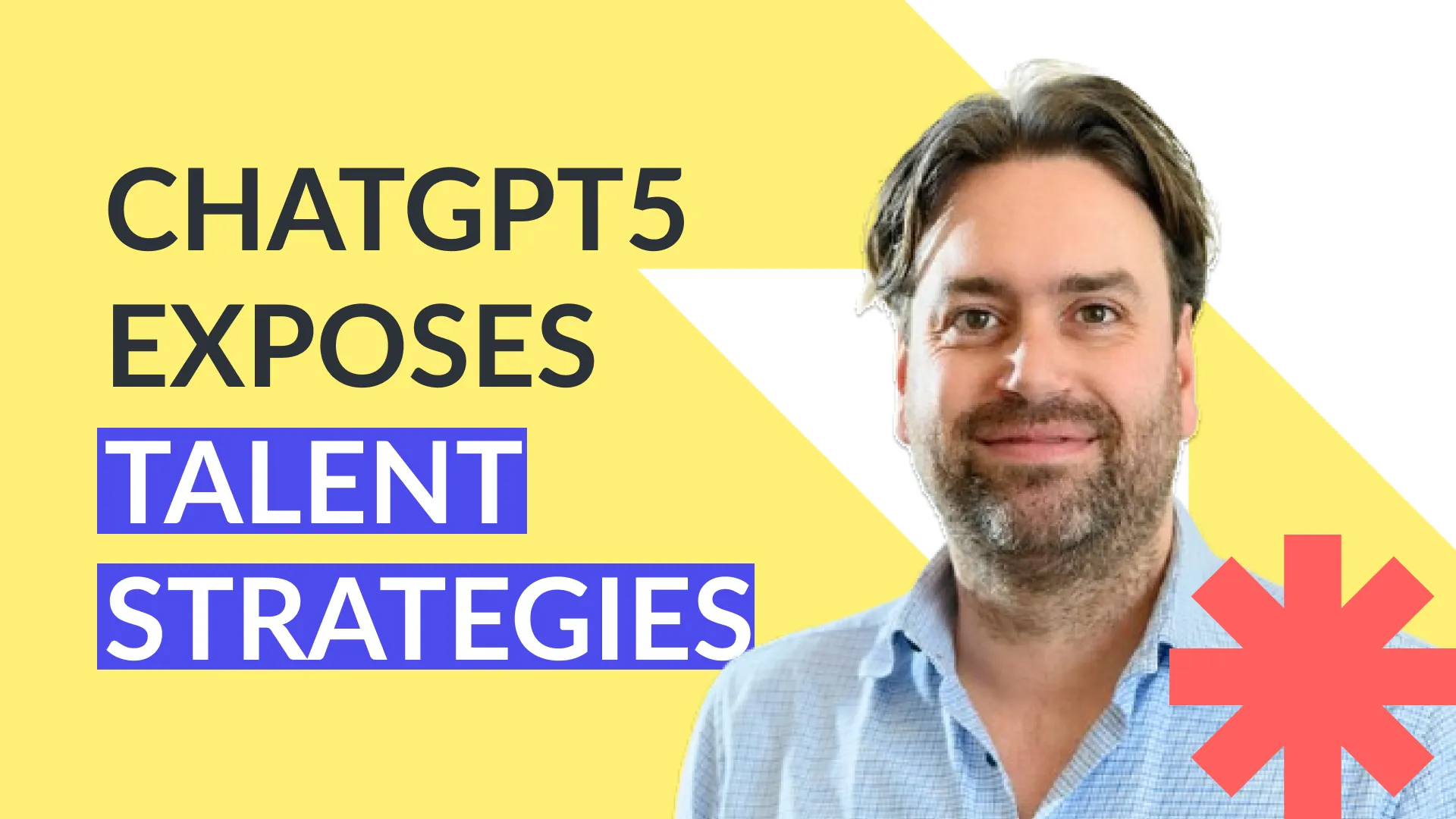
AI advances like ChatGPT-5 are transforming the workforce, but not without risks. With entry-level roles disappearing and human cognition declining through overreliance on AI, leaders must prioritize skill resilience and talent pipelines to sustain long-term performance.

Review by:
AI is making knowledge abundant. Murielle Bolsius, Head of Solutions at Lepaya, argues that's exactly why self-awareness, resilience, and judgment are becoming the real differentiator at work - and why personal development belongs at the center of it, not the edge.
Close skill gaps, accelerate growth, and future-proof your workforce.




HR leads AI transformation by treating it as a people strategy first and a technology strategy second. Concretely: building AI literacy across the workforce, developing manager capability for leading AI-augmented teams, redesigning roles around new AI workflows, embedding psychological safety so employees can experiment and surface mistakes, and measuring AI ROI through leading indicators (confidence, adoption, behaviour change) rather than just usage rates.
Make AI failures visible and shareable. Train managers to model "I don't know how to use this yet" rather than projecting expertise. Create dedicated channels or rituals for sharing AI experiments (both successes and failures). Tie AI training to real, daily work. Reward surfacing problems, not just successful outcomes.
AI is raising the floor on technical capability, more people can do more things with less specialist knowledge. What that does is shift the competitive differentiator toward judgment, leadership, and ownership. Lepaya's State of Skills 2026 frames it directly: AI raises the floor, but it doesn't raise performance on its own. The organizations seeing real returns from AI are building human capabilities on top of their technology investment, not assuming the tools will do the work.
.webp)
