



From AI adoption to human capability: What will set organisations apart in 2027?

- AI is increasing the importance of human capabilities.
- Ownership and critical thinking support better decision-making.
- Communication and collaboration turn AI outputs into business results.
- HR and L&D should embed learning into everyday work.
- Developing human capabilities will help organisations stay competitive.
AI is making it easier for organisations to automate tasks and produce information. But access to technology alone does not guarantee better performance. Critical thinking, ownership, communication and collaboration help employees turn AI-generated outputs into meaningful business results. For HR and L&D leaders, the priority for 2027 is to develop these capabilities continuously and embed them into everyday work.
From AI adoption to human capability: what will set organisations apart in 2027?
AI is changing how work gets done. Employees can now analyse information, generate content and complete routine tasks faster than ever. But as technology becomes more accessible, a new challenge emerges: how can organisations turn this increased speed into better business performance?
The answer increasingly lies in human capability.
According to Lepaya's The Capability Investment Trends 2027 report, which analysed earning investment data from 100+ client organisations in 2025 and the first half of 2026, investment is shifting towards capabilities that help people direct work, make decisions, influence others and turn learning into action.
The implications for HR and L&D are significant. When organisations have access to similar AI tools, their competitive advantage depends increasingly on how effectively their people use them.
Here are three reasons why human capabilities will matter even more in 2027.
1. AI is changing what people need to bring to work
As AI takes over more routine execution, the human contribution to work is changing.
Tasks such as gathering information, analysing inputs and producing first drafts can increasingly be supported by AI. Employees must therefore spend more time evaluating outputs, challenging assumptions, coordinating with colleagues and deciding what should happen next.
This requires a different combination of capabilities.
Technical knowledge remains important, but employees also need critical thinking, sound judgment and the ability to make decisions in context. They must understand when AI can support a task, when its outputs need further scrutiny and when human oversight is essential.
For HR and L&D leaders, this means looking beyond AI literacy alone. The goal is not simply to teach employees how to use a tool, but to help them apply AI effectively within their roles.
That requires developing the capabilities that allow people to translate technology into meaningful outcomes.
2. Ownership is becoming a business-critical capability
As work becomes faster and less predictable, employees increasingly need to take responsibility for decisions and outcomes without waiting for constant managerial direction.
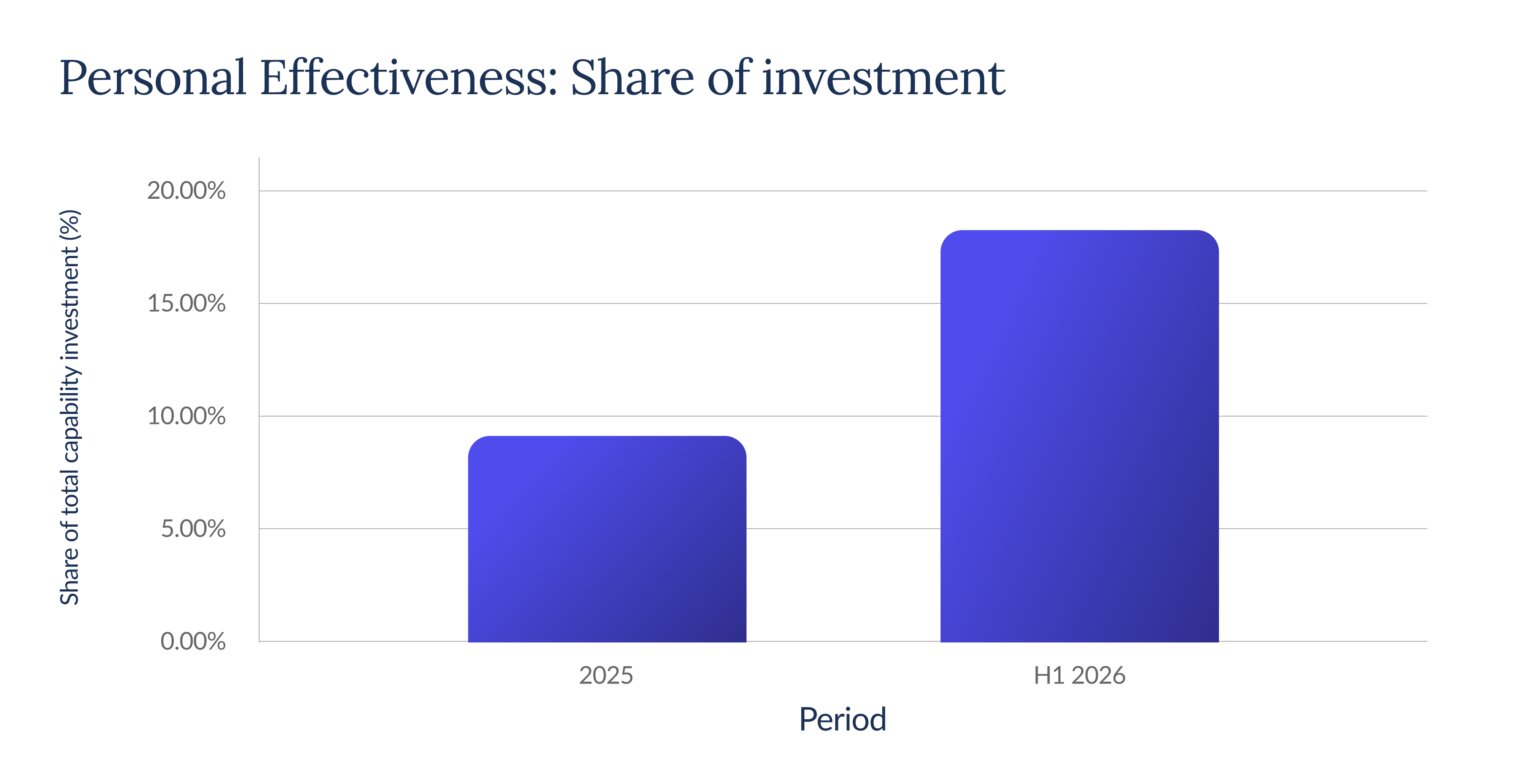
Lepaya's report highlights a clear shift in learning investment. Personal Effectiveness increased from 9.2% of total capability investment in 2025 to 17.4% in the first half of 2026, making it the fastest-growing capability in the dataset.
The Power of Ownership learning module also increased its share of total investment from approximately 0.3% to 6.4% over the same periods.
These trends reflect a changing workplace. Managers are often responsible for larger teams, priorities shift quickly, and employees are increasingly expected to make decisions independently and take responsibility for their work.
Personal Effectiveness helps people recognise what they can influence, take initiative and move work forward rather than escalating every decision.
For organisations, the benefit is greater autonomy and fewer unnecessary bottlenecks. For employees, it means being better equipped to manage priorities, take responsibility and remain effective under pressure.
HR and L&D teams can support this shift by helping employees learn how to make decisions independently, manage their workload and identify which tasks need their attention first. Managers also need to create an environment where employees understand their responsibilities and feel confident making decisions within their role.
3. Collaboration and communication turn AI output into business impact
AI can help individuals produce work faster. However, business results rarely depend on individual output alone.
Decisions still need stakeholder alignment. Teams need to agree on priorities, resolve competing perspectives and understand how their work contributes to shared objectives.
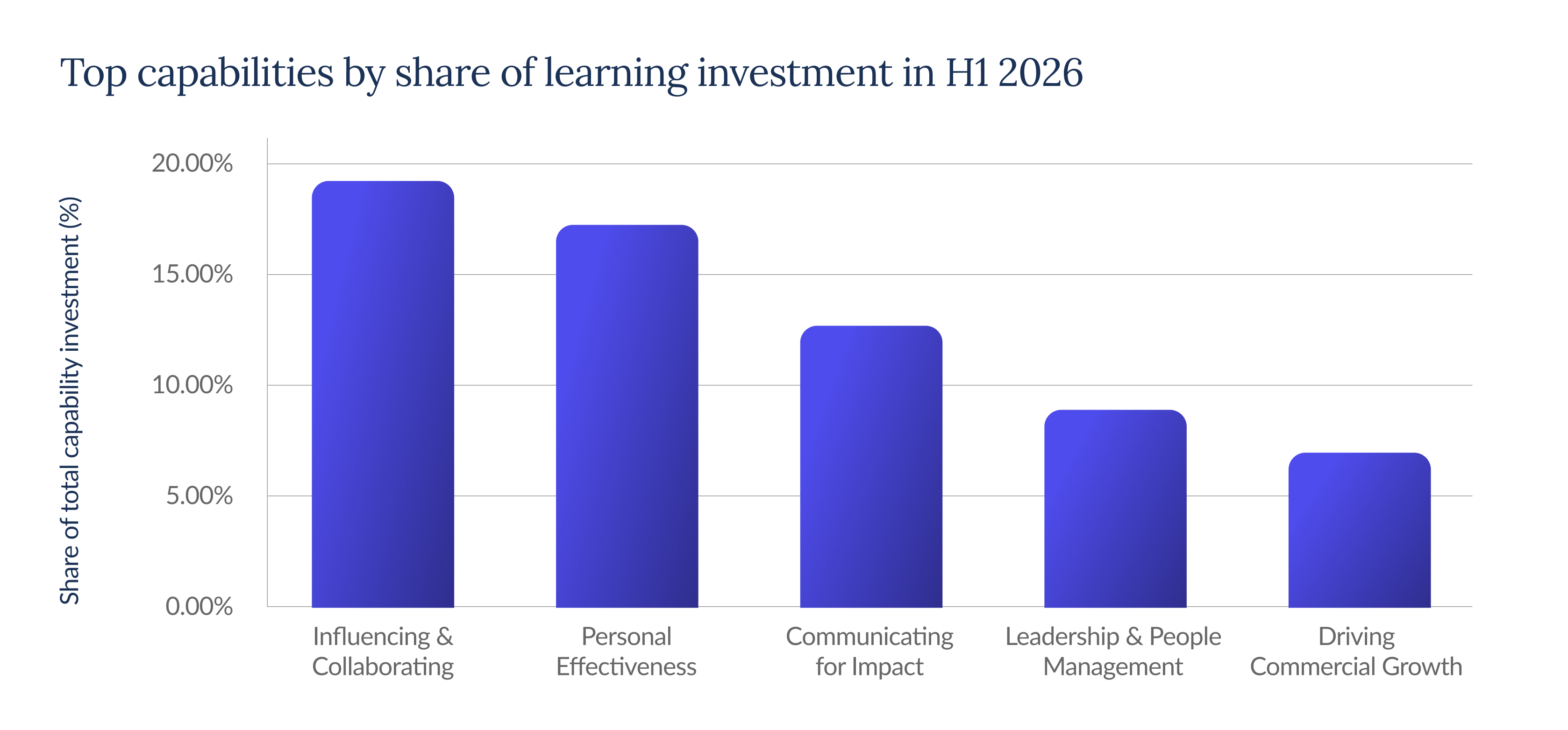
Lepaya's report shows that Influencing & Collaborating remained the largest capability area in its dataset, accounting for 24.6% of total capability investment in 2025 and 19.4% in the first half of 2026.
Communicating for Impact also increased its share of investment, from 12.5% to 13.3%.
These figures highlight the continued importance of human interaction as technology changes how work is performed.
Employees need to communicate complex ideas clearly, build trust and gain support across teams and functions. Managers need to align people around priorities and ensure that decisions translate into coordinated action.
For HR and L&D, leadership development should therefore focus not only on individual performance but also on the behaviours that help teams work effectively together.
The objective is to ensure that faster execution leads to better decisions, stronger collaboration and measurable business outcomes.
Turning AI adoption into human performance
As AI becomes more widely available, access to technology alone will no longer be a reliable source of competitive advantage. What will differentiate organisations is how effectively their people use AI alongside human capabilities such as critical thinking, decision-making, creativity, communication and collaboration.
For HR and L&D leaders, this means moving beyond traditional training programmes and connecting capability development to real business challenges. Rather than measuring success through course completion, organisations should focus on whether employees apply new skills in their daily work and whether these changes contribute to business outcomes.
To make this happen, organisations should focus on three priorities:
- Identify the capabilities behind business challenges. Determine whether issues with productivity, decision-making or AI adoption are linked to gaps in ownership, critical thinking, communication or collaboration.
- Build learning into everyday work. Give employees opportunities to practise new behaviours, receive feedback and apply what they learn in real working situations. Mentoring and supervised practice are particularly important for helping junior employees develop judgment and expertise as AI takes over tasks that previously supported their learning.
- Measure behavioural change and business outcomes. Look beyond course completion to assess whether employees work differently and whether these changes contribute to agreed business objectives.
Managers also play an important role by modelling new ways of working, encouraging experimentation and helping employees navigate uncertainty.
Ultimately, successful AI adoption in 2027 will depend not only on what technology can do, but on how effectively organisations develop their people to use it.

Wir bieten eine skalierbare Lösung für Mitarbeiterschulungen. Damit können Sie Ihre Mitarbeiter kontinuierlich weiterbilden.
Einen Anruf buchen

Related Artikel


Bewertung von:
3 Fähigkeiten, um 2026 ein strategischer L&D-Partner zu werden
Entdecken Sie die drei grundlegenden Fähigkeiten, die L&D-Führungskräfte benötigen, um Stakeholder zu beeinflussen, Lernen mit der Geschäftsstrategie in Einklang zu bringen und die Unternehmensleistung im Zeitalter der KI zu steigern.


Ready to drive impact together?
Close skill gaps, accelerate growth, and future-proof your workforce.




Häufig gestellte Fragen
How can organisations measure the impact of human capability development?
Organisations should define a business outcome, establish a baseline, assess capability development, track behavioural changes in the workplace and connect those changes to relevant business KPIs. Completion rates alone cannot demonstrate business impact.
Why is ownership important in an AI-enabled workplace?
As priorities change and managers oversee larger teams, employees increasingly need to take initiative, manage their priorities and make appropriate decisions independently. Ownership helps teams move work forward without relying on constant managerial direction.
What skills will organisations need in 2027?
Lepaya's report identifies Personal Effectiveness, Communicating for Impact, Influencing & Collaborating, Leadership & People Management, Driving Commercial Growth, Navigating Complexity and Navigating Change as seven capabilities expected to shape learning investment in 2027.
How can HR prepare employees for AI transformation?
HR and L&D teams can identify capability gaps, develop learning around real business challenges and provide opportunities for employees to practise new behaviours. Managers should reinforce those behaviours and help teams adapt their ways of working.
Why are human capabilities important in the age of AI?
AI can automate tasks and generate information, but employees still need to evaluate outputs, make decisions in context, build trust and coordinate with others. These capabilities help organisations translate technological potential into business performance.