Develop confident leaders who drive their teams’ performance and organizational success.
Discover more



.webp)
• The ROI Pyramid of Learning and Performance is a tool used to forecast and evaluate investments in Human Resources, starting with addressing a strategic challenge.
• The process involves analyzing data-driven measurements and evaluations after implementing a learning program, focusing on employee satisfaction, learning outcomes, behavior changes, organizational impact, and ROI.
• The concept of the ROI Pyramid originated in the US in the mid-1900s and has been promoted by the ROI Institute since the 1990s, with a branch in the Netherlands.
• The ROI Pyramid guides impactful learning programs, essential in our blog series for learning and performance insights.
Es ist an der Zeit, die ROI-Pyramide für Lernen und Leistung aufzubauen. Die Konstruktion von Gedanken ist etwas ungewöhnlich. Du beginnst oben, steigst dann in die unteren Regionen ab und arbeitest dich dann wieder hoch. Und das alles in zwei Minuten Lesezeit. Lass uns gehen!
Die ROI-Pyramide wird zur Prognose und Bewertung von Investitionen in die Personalabteilung, beispielsweise in L&D, verwendet. Ihre Stärke liegt in der Tatsache, dass sie eine Investition als eine Möglichkeit betrachtet, eine strategische Herausforderung zu lösen. Daher beginnt der Ausgangspunkt mit der Auseinandersetzung mit dem zu lösenden Problem. Sie werden Ihre Antwort auf diese Fragen pro CD von oben nach unten analysieren:
5. Lohnt es sich, das Problem zu untersuchen?
4. Was möchten Sie als Organisation erreichen?
3. Welches Verhalten müssen Mitarbeiter an den Tag legen, um dieses Ziel zu erreichen?
2. Welches Wissen, welche Fähigkeiten oder welche Einstellung müssen dafür erlernt werden?
1. Wie relevant ist das für die tägliche Praxis der Mitarbeiter?
Die zweite Phase ist Messung und Bewertung. Dies erfolgt nach der Investition, beispielsweise der Implementierung eines Lernprogramms. Jetzt arbeiten wir mit den gleichen Fragen, aber dieses Mal von unten nach oben und (achten Sie einen Moment darauf) datengesteuert.
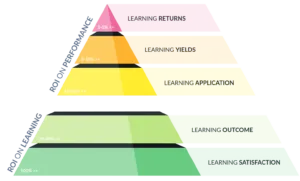
1. Wie zufrieden sind die Mitarbeiter?
2. Was haben die Mitarbeiter gelernt?
3. Welches konkrete Verhalten zeigen Mitarbeiter in der Praxis?
4. Was hat es für die Organisation erreicht?
5. War es die Investition wert?
Wir haben diese Pyramide (leider) nicht selbst erfunden. Ihre Gründung begann Mitte des 20. Jahrhunderts in den USA und wird seit den 1990er Jahren vom ROI Institute durch Forschung, Coaching und Beratung gepredigt. Es gibt auch eine Filiale in den Niederlanden, schauen Sie also unbedingt nach ihre Website wenn du interessiert bist! Obwohl in unserer Blogserie über ein wirkungsvolles Lernprogramm dieses Konzept als unser Bauplan dient, wirst du oft davon hören. Haben Sie nach dem Lesen dieses Blogs noch Fragen oder möchten Sie mit jemandem chatten, der ebenfalls daran arbeitet? Lass es uns unten wissen!

Wir bieten eine skalierbare Lösung für Mitarbeiterschulungen. Damit können Sie Ihre Mitarbeiter kontinuierlich weiterbilden.
Einen Anruf buchen.webp)


Bewertung von:
Senior leadership and boardroom teams invest heavily in commercial strategies to win market shares. Yet the most important and honest information driving strategy circulates in teams underneath, never making it to the table where decisions are made.Jeroen Kraaijenbrink, Executive Coach and Strategy Consultant at Kraaijenbrink Advisory, has spent years working on what he calls the honesty gap. We sat down with him to understand what the honesty gap actually is, where it lives in organizations, and why fixing it requires a leadership shift.How do you define the honesty gap?There's a narrow definition and a broad one. The broad one is: we have created organizations and systems where it's barely possible to be honest to yourself, about yourself, and honest to other people.Honesty isn't just lying. It's integrity, being authentically connected to other people and being aware of your own emotions and your own biases.The honesty gap, in a narrow sense, is the fact that truth and information don’t travel vertically upwards in a company. It's often hard to speak openly to your manager because it’s become rational not to. Many people have the experience: 'I've tried it once but then I was punished for it, or was ignored, so let it be, never mind.' That's the fascinating part: it's not good for people, it's not good for organizations and yet we somehow keep this system intact.Is it less about individual dishonesty and more about a collective culture?A lot of the most important information going through your company is between people and in conversations. You need to find a way to have an honest conversation, where the things that matter get on the meeting table, not just in the informal circuit. And I think that's pretty rare.A more systematic definition is that we're not using the collective intelligence of a company enough. We can radically improve it because we’ve made it rational to hide the truth and to keep things to yourself. A lot of it may not be intentional, but the very fact that someone is in a position above you automatically creates this tension: 'What do I show? What don't I show? Because my next performance appraisal is coming up.'Where does the honesty gap typically show up first, and who owns the problem?It starts with leaders. Solving it needs one leader at the top, the CEO at least, being open and reflective enough to admit that there is an honesty gap and that they are part of it. That's the self-reflection you need for any improvement and any change. Like in coaching: you need to be aware that there is stuff to improve. You don't need to be a perfect leader, but you need to be open enough to admit that there is an issue.You talk about the 'persona trap', what is that?You're stuck in a persona where you perform in a certain way within your company. You have a role, a position, a reputation, and that locks you into specific behaviors. The worse the match between who you are as a person and how you need to show up in your organization, the more inner conflict that’s created. Especially at the top, it’s a problem for many executives. They're supposed to be the people who know it all and be decisive. While if you're honest, you don't necessarily know everything, you’re uncertain and have anxieties.The inner core of the honesty gap is breaking the performance, breaking the acting you feel you must do. If you've put yourself in a role of being the strong, decisive, number-oriented leader, that's how you have to behave. But most people don't feel very comfortable in that kind of role because it's not who they are.Can you fix the honesty gap through individual coaching alone or does the system have to change?Part of it is a personal change, part of it is a system change. You can be on your own and be very authentic, but if the system doesn't change at all, you’ll struggle to break the honesty gap.What you need to do is work on the people, the culture, and the system. Ideally that has to include the top, because otherwise it stays at the level of the person being coached. If it's a team lead or a mid-manager, that person can partly create an island in the organization, a safe space for their team and their department. But still, the appraisal systems, objectives, and culture are company-wide. Why is this so hard to shift, even when leaders recognize the problem?We have normalized this idea that you have to be strategic in what you tell and what you show. You have to show up in a certain role at work. It's also the result of how we have separated work from life, which is a very unnatural thing. It's from the industrial age, because for any other species, work is life. But now there’s a split between work, with all the routines in companies, and then your private life. There's just one you, you're the same person at home as you are at work. The good news is that the honesty gap can be closed. While many companies have unintentionally created environments where people hesitate to speak openly, organizations prioritizing trust, authenticity, and psychological safety can unlock a competitive advantage. When employees feel safe to share concerns, ideas, and perspectives, collective intelligence grows, decision-making improves, and stronger relationships emerge across every level of the business.
Bewertung von:
Verstehen Sie, warum Mitarbeiterbindung stärker von menschlichen Erfahrungen als von Kennzahlen abhängt und was die Personalabteilung dagegen tun kann.
Close skill gaps, accelerate growth, and future-proof your workforce.




.webp)