Creëer goed presterende teams via The Rose Of Leary

• Building a high performance team structure is essential for success.
• Using the Rose of Leary model can help improve team performance by understanding behavior triggers.
• Dominance and affiliation axes impact team dynamics, with balance being key for collaboration.
• Being aware of specific behaviors and attitudes within the team can enhance performance.
• Criticism and balance are important for building a high performing team, promoting a 'together' mindset for success.
Het opbouwen van een organisatie met een goed presterende teamstructuur is essentieel om succesvol te zijn. Daar is niets nieuws. Maar hoe kom je eigenlijk dichter bij het bereiken van dit doel? Natuurlijk heeft het te maken met de structuur van het team. Maar dat verander je natuurlijk niet van dag tot dag. Met de huidige opzet kun je ook in die richting werken en de huidige teamleden optimaal laten presteren. Hen de tools geven om hun verhaal duidelijk te maken en anderen op een impactvolle manier te beïnvloeden van de toegevoegde waarde is een geweldige zet om de prestaties te verbeteren. Elkaar helpen en bruggen bouwen zet de toon om als team en organisatie te groeien. Het gebruik van het Rose of Leary-model helpt om in die richting te gaan.
De roos van Leary
Als je de Rose of Leary wilt toepassen om een goed presterende organisatie te laten groeien, is het essentieel om te begrijpen hoe het model werkt.
Waar het op neerkomt, is dat een bepaald soort gedrag een ander soort gedrag uitlokt. Gedrag kan over twee assen verschuiven: dominantie en verbondenheid. Door alle medewerkers hiervan bewust te maken, helpt het mensen om op een constructieve manier met elkaar om te gaan.
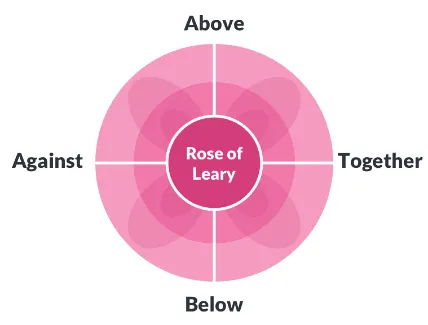
Dominantie: gedrag boven versus onder
In elk gesprek is er meestal een dominante en minder dominante persoon. En we weten allemaal dat dat niets zegt over wie de meest waardevolle inzichten heeft. Helaas is dit een heel natuurlijk contrast dat zich voordoet. Het hebben van een dominante persoon in de kamer leidt er standaard toe dat anderen een onderdanig houding aannemen. Door dominante mensen bewust te maken van hun rol en ze open te stellen voor de minder dominante mensen, ontstaat er een prettige open sfeer. Dit is waar samenwerking start en teamleden kunnen elkaar op een evenwichtige manier beïnvloeden.
Affiliatie: samen versus tegen gedrag
Naast de dominantie-as is er de affiliatie-as. De houding van teamleden heeft een grote invloed op de sfeer van het team. In tegenstelling tot de dominantie-as die tot tegengestelde houdingen leidt, heeft de affiliatie-as een natuurlijke neiging om mensen tot hetzelfde soort gedrag te beïnvloeden. Een positieve sfeer die het samenwerken als team stimuleert, zorgt er dus voor dat collega's zich hier ook voor openstellen., Teamleden hiervan bewust maken over elkaar en zichzelf zorgt weer voor balans. Succes gebeurt niet individueel. Het is een teamprestatie.
Wanneer u de prestaties van teams in uw organisatie wilt verbeteren, is het belangrijk dat u zich bewust bent van het effect van specifiek gedrag van uzelf en teamleden.
8 houdingen om op te letten
Binnen elke sectie telt de Rose of Leary ook subposities die de impact van specifiek gedrag kunnen weergeven. Dit zijn de volgende:

<
Toonaangevend: Advies geven, een weg vooruit voorstellen.
Helpen: Voortbouwend op voorstellen van anderen, blijk geven van begrip.
Inschikkelijk: Met anderen eens zijn, complimenten geven.
Afhankelijk: Goedkeuring zoeken, vragen stellen.
Ingetrokken: Afstand nemen van het gesprek, jezelf de schuld geven.
Weerstand bieden: Onderzoeken van onderwerpen waarover je het oneens bent, kritische vragen stellen.
Kritiseren: Het benadrukken van onenigheid, het bekritiseren van de ander.
Concurreren: Alternatieven bieden, verschillende acties voorstellen.
Rose of Leary als referentie om goed presterende teams samen te stellen
Om echt een goed presterend team te vormen met de huidige teamsamenstelling, draait het allemaal om mentaliteit. Het heeft natuurlijk geen zin om een team vol leiders te hebben. Het werkt ook niet als iedereen voor anderen zorgt. Maar je wilt wel dat mensen als een team samenwerken. Balans is essentieel om een goed presterend team op te bouwen. Kritiek is ook goed, want dat houdt iedereen scherp. Houd er echter rekening mee dat kritiek leidt tot andere vormen van 'tegen' gedrag aan de linkerkant van de Rose of Leary. Dus als je dit ziet gebeuren, probeer dan te begrijpen waarom ze er zijn en breng ze zo snel mogelijk naar een 'samen' georiënteerde manier van denken. Dit zal ervoor zorgen dat je team sterker wordt en beter presteert.

We bieden een schaalbare oplossing voor de opleiding van werknemers. Hiermee kun je je mensen continu bijscholen.
Boek een gesprek


Related lidwoorden

Recensie door:
Jeroen Kraaijenbrink: How organizations can overcome the honesty gap
Senior leadership and boardroom teams invest heavily in commercial strategies to win market shares. Yet the most important and honest information driving strategy circulates in teams underneath, never making it to the table where decisions are made.Jeroen Kraaijenbrink, Executive Coach and Strategy Consultant at Kraaijenbrink Advisory, has spent years working on what he calls the honesty gap. We sat down with him to understand what the honesty gap actually is, where it lives in organizations, and why fixing it requires a leadership shift.How do you define the honesty gap?There's a narrow definition and a broad one. The broad one is: we have created organizations and systems where it's barely possible to be honest to yourself, about yourself, and honest to other people.Honesty isn't just lying. It's integrity, being authentically connected to other people and being aware of your own emotions and your own biases.The honesty gap, in a narrow sense, is the fact that truth and information don’t travel vertically upwards in a company. It's often hard to speak openly to your manager because it’s become rational not to. Many people have the experience: 'I've tried it once but then I was punished for it, or was ignored, so let it be, never mind.' That's the fascinating part: it's not good for people, it's not good for organizations and yet we somehow keep this system intact.Is it less about individual dishonesty and more about a collective culture?A lot of the most important information going through your company is between people and in conversations. You need to find a way to have an honest conversation, where the things that matter get on the meeting table, not just in the informal circuit. And I think that's pretty rare.A more systematic definition is that we're not using the collective intelligence of a company enough. We can radically improve it because we’ve made it rational to hide the truth and to keep things to yourself. A lot of it may not be intentional, but the very fact that someone is in a position above you automatically creates this tension: 'What do I show? What don't I show? Because my next performance appraisal is coming up.'Where does the honesty gap typically show up first, and who owns the problem?It starts with leaders. Solving it needs one leader at the top, the CEO at least, being open and reflective enough to admit that there is an honesty gap and that they are part of it. That's the self-reflection you need for any improvement and any change. Like in coaching: you need to be aware that there is stuff to improve. You don't need to be a perfect leader, but you need to be open enough to admit that there is an issue.You talk about the 'persona trap', what is that?You're stuck in a persona where you perform in a certain way within your company. You have a role, a position, a reputation, and that locks you into specific behaviors. The worse the match between who you are as a person and how you need to show up in your organization, the more inner conflict that’s created. Especially at the top, it’s a problem for many executives. They're supposed to be the people who know it all and be decisive. While if you're honest, you don't necessarily know everything, you’re uncertain and have anxieties.The inner core of the honesty gap is breaking the performance, breaking the acting you feel you must do. If you've put yourself in a role of being the strong, decisive, number-oriented leader, that's how you have to behave. But most people don't feel very comfortable in that kind of role because it's not who they are.Can you fix the honesty gap through individual coaching alone or does the system have to change?Part of it is a personal change, part of it is a system change. You can be on your own and be very authentic, but if the system doesn't change at all, you’ll struggle to break the honesty gap.What you need to do is work on the people, the culture, and the system. Ideally that has to include the top, because otherwise it stays at the level of the person being coached. If it's a team lead or a mid-manager, that person can partly create an island in the organization, a safe space for their team and their department. But still, the appraisal systems, objectives, and culture are company-wide. Why is this so hard to shift, even when leaders recognize the problem?We have normalized this idea that you have to be strategic in what you tell and what you show. You have to show up in a certain role at work. It's also the result of how we have separated work from life, which is a very unnatural thing. It's from the industrial age, because for any other species, work is life. But now there’s a split between work, with all the routines in companies, and then your private life. There's just one you, you're the same person at home as you are at work. The good news is that the honesty gap can be closed. While many companies have unintentionally created environments where people hesitate to speak openly, organizations prioritizing trust, authenticity, and psychological safety can unlock a competitive advantage. When employees feel safe to share concerns, ideas, and perspectives, collective intelligence grows, decision-making improves, and stronger relationships emerge across every level of the business.
Ready to drive impact together?
Close skill gaps, accelerate growth, and future-proof your workforce.



.webp)
.webp)