Empower your young talent with future-proof skills to kickstart successful careers at your enterprise.
Discover now


• De aard van het werk verandert voortdurend als gevolg van technologische innovatie, waardoor aanpassing een belangrijke vaardigheid is om in de toekomst tot bloei te komen.
• Leren is essentieel voor aanpassing, zoals blijkt uit de populariteit van cursussen zoals 'Learning how to learn' op Coursera.
• Het ontwikkelen van een groeimindset, in tegenstelling tot een vaste mentaliteit, is essentieel voor continue verbetering, prestaties en het aangaan van uitdagingen.
• Lepaya gebruikt tools zoals escape rooms en gefaciliteerde discussies om individuen te helpen hun manier van denken over groei te herkennen en te veranderen.
Hoe ziet jouw baan er over vijf jaar uit? En welke capaciteiten heb je nodig om tot bloei te komen? Voor de meeste beroepen zijn deze vragen niet te beantwoorden. De aard van het werk is nooit statisch geweest, maar het huidige tempo van technologische innovatie maakt antwoorden moeilijker dan ooit. Althans zo lijkt het, want in een steeds veranderende en dubbelzinnige omgeving is aanpassing de enige cruciale vaardigheid.
Hopelijk verbaast dit inzicht je niet. Het feit dat meer dan 1,8 miljoen mensen de cursus hebben gevolgd 'Leren leren: krachtige mentale hulpmiddelen die je helpen moeilijke onderwerpen onder de knie te krijgen' op Coursera toont duidelijk een breed begrip van het belang van leren (wat de sleutel is tot aanpassing).
De cursus 'Leren leren leren' op Coursera is een geweldige manier om de leereffectiviteit te verbeteren. Het combineert op intelligente wijze neurowetenschappen en gezond verstand in praktisch advies. De cursus presenteert leertechnieken en legt de werking van de hersenen op een pragmatische manier uit. Een geweldige tweede stap om je leermogelijkheden te verbeteren.
Ja, tweede stap. Voordat je je gaat richten op de effectiviteit van leren, moet je volledig ontvankelijk zijn voor leren. Dat is wat Carol Dweck, hoogleraar psychologie aan Stanford, een groeimindset noemt. Ze onderscheidt twee soorten mindsets: een fixed mindset en een growth mindset. Iemand met een vaste mentaliteit beschouwt intelligentie als statisch, terwijl iemand met een groeimindset beschouwt het als iets om te ontwikkelen.
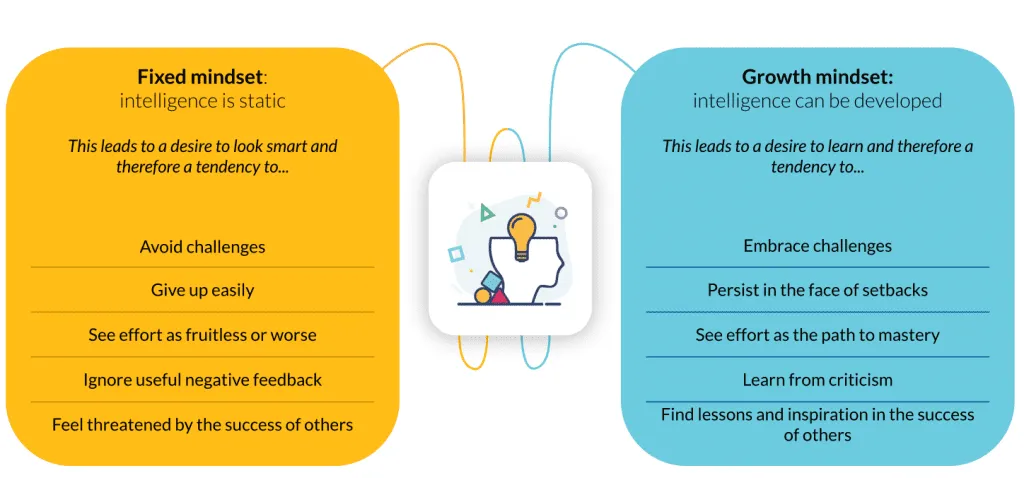
Deze denkwijzen bestaan uit onderliggende overtuigingen die resulteren in het vermijden van uitdagingen in plaats van ze te omarmen, op te geven in plaats van vol te houden, negatieve feedback te negeren in plaats van ervan te leren en zich te bedreigd voelen door het succes van anderen in plaats van er inspiratie uit te putten. Als gevolg hiervan leidt een groeimindset tot voortdurende verbetering, hogere niveaus van prestaties en een groter gevoel van vrije wil.
Daarom begint elk leertraject bij Lepaya met het bespreken van de mentaliteit. We helpen leerlingen om delen van hun persoonlijkheid en capaciteiten te herkennen die ze als vast zouden kunnen beschouwen en stimuleren hen om open te staan voor groei. Een tool die we daar graag gebruiken is een escape room. In zo'n situatie onder hoge druk wordt duidelijk wie de uitdaging aangaat en wie misschien terugdeinst uit angst om te falen. Nadien stimuleren we de deelnemers om de inzichten gezamenlijk te evalueren en te relateren aan de manier van denken.
Een tweede voorbeeldmethode om de mentaliteit te verkennen zijn gefaciliteerde discussies in kleine groepen. Deelnemers bespreken in welke situaties ze denken dat ze welke manier van denken aannemen, hoe ze kunnen profiteren van een andere manier van denken en hoe ze zich daarheen kunnen ontwikkelen. Bovendien maakt de gemengde aanpak van Lepaya het mogelijk om buiten de klas te blijven leren. Meldingen, herinneringen en indringende vragen zorgen nog steeds voor een groeimindset in de dagelijkse onrust.
Stephen Hawking, een van de meest briljante wetenschappers van onze tijd, schreef ooit: „De grootste vijand van kennis is niet onwetendheid, maar de illusie van kennis.” Dat is de groeimindset die centraal staat: je moet je behoefte om te leren omarmen. Vandaag meer dan ooit.
Vragen, opmerkingen of suggesties over geestgroei? Bezoek lepaya.com, reageer hieronder of stuur een e-mail naar info@lepaya.com.

We bieden een schaalbare oplossing voor de opleiding van werknemers. Hiermee kun je je mensen continu bijscholen.
Boek een gesprek


Recensie door:
Most AI adoption stalls long after the pilot stage, when the operating model behind it never catches up. Milica Sapic, Talent and Organisational Development Manager at Publicis Sapient, explained what's actually missing and how HR and L&D can close that gap.

Recensie door:
Ontdek waarom retentie niet gaat over het behouden van iedereen, maar over het behouden van de juiste mensen. Leer Jennifer McClure's mensgerichte strategieën voor het behouden van toptalent door middel van duidelijkheid, groei en doelgericht leiderschap.

Recensie door:
Senior leadership and boardroom teams invest heavily in commercial strategies to win market shares. Yet the most important and honest information driving strategy circulates in teams underneath, never making it to the table where decisions are made.Jeroen Kraaijenbrink, Executive Coach and Strategy Consultant at Kraaijenbrink Advisory, has spent years working on what he calls the honesty gap. We sat down with him to understand what the honesty gap actually is, where it lives in organizations, and why fixing it requires a leadership shift.How do you define the honesty gap?There's a narrow definition and a broad one. The broad one is: we have created organizations and systems where it's barely possible to be honest to yourself, about yourself, and honest to other people.Honesty isn't just lying. It's integrity, being authentically connected to other people and being aware of your own emotions and your own biases.The honesty gap, in a narrow sense, is the fact that truth and information don’t travel vertically upwards in a company. It's often hard to speak openly to your manager because it’s become rational not to. Many people have the experience: 'I've tried it once but then I was punished for it, or was ignored, so let it be, never mind.' That's the fascinating part: it's not good for people, it's not good for organizations and yet we somehow keep this system intact.Is it less about individual dishonesty and more about a collective culture?A lot of the most important information going through your company is between people and in conversations. You need to find a way to have an honest conversation, where the things that matter get on the meeting table, not just in the informal circuit. And I think that's pretty rare.A more systematic definition is that we're not using the collective intelligence of a company enough. We can radically improve it because we’ve made it rational to hide the truth and to keep things to yourself. A lot of it may not be intentional, but the very fact that someone is in a position above you automatically creates this tension: 'What do I show? What don't I show? Because my next performance appraisal is coming up.'Where does the honesty gap typically show up first, and who owns the problem?It starts with leaders. Solving it needs one leader at the top, the CEO at least, being open and reflective enough to admit that there is an honesty gap and that they are part of it. That's the self-reflection you need for any improvement and any change. Like in coaching: you need to be aware that there is stuff to improve. You don't need to be a perfect leader, but you need to be open enough to admit that there is an issue.You talk about the 'persona trap', what is that?You're stuck in a persona where you perform in a certain way within your company. You have a role, a position, a reputation, and that locks you into specific behaviors. The worse the match between who you are as a person and how you need to show up in your organization, the more inner conflict that’s created. Especially at the top, it’s a problem for many executives. They're supposed to be the people who know it all and be decisive. While if you're honest, you don't necessarily know everything, you’re uncertain and have anxieties.The inner core of the honesty gap is breaking the performance, breaking the acting you feel you must do. If you've put yourself in a role of being the strong, decisive, number-oriented leader, that's how you have to behave. But most people don't feel very comfortable in that kind of role because it's not who they are.Can you fix the honesty gap through individual coaching alone or does the system have to change?Part of it is a personal change, part of it is a system change. You can be on your own and be very authentic, but if the system doesn't change at all, you’ll struggle to break the honesty gap.What you need to do is work on the people, the culture, and the system. Ideally that has to include the top, because otherwise it stays at the level of the person being coached. If it's a team lead or a mid-manager, that person can partly create an island in the organization, a safe space for their team and their department. But still, the appraisal systems, objectives, and culture are company-wide. Why is this so hard to shift, even when leaders recognize the problem?We have normalized this idea that you have to be strategic in what you tell and what you show. You have to show up in a certain role at work. It's also the result of how we have separated work from life, which is a very unnatural thing. It's from the industrial age, because for any other species, work is life. But now there’s a split between work, with all the routines in companies, and then your private life. There's just one you, you're the same person at home as you are at work. The good news is that the honesty gap can be closed. While many companies have unintentionally created environments where people hesitate to speak openly, organizations prioritizing trust, authenticity, and psychological safety can unlock a competitive advantage. When employees feel safe to share concerns, ideas, and perspectives, collective intelligence grows, decision-making improves, and stronger relationships emerge across every level of the business.
Close skill gaps, accelerate growth, and future-proof your workforce.