

Explore the data from 196 global companies and uncover the key skills trends for the year ahead.
Download



.webp)
For years, Learning & Development has been seen as a training provider—tasked with delivering courses, upskilling employees, and ticking the compliance box. But that perception is changing.
The most effective L&D teams today aren’t just educators; they’re problem solvers, business enablers, and strategic partners who help organizations close capability gaps, improve performance, and drive real business outcomes.
So how can L&D leaders make this transition? What strategies help them shift from being seen as a service provider to a true business partner?
We spoke with Caner Akova, L&D Manager at Olympus, to learn how understanding human behavior, motivation, and decision-making helps him influence stakeholders, secure executive buy-in, and embed learning into business strategy.
To be effective, L&D must communicate in a way that resonates with business leaders. Too often, we use learning terminology that makes sense to us but doesn’t land with executives. Instead, I focus on behavioral economics and psychology—how we talk to people and ensure we’re not alienating them with L&D jargon.
We need to start with a simple question: What does the business need?
Right now, L&D has a unique opportunity. Many organizations assume that performance gaps stem solely from a lack of skills or knowledge. But in reality, capability issues are often tied to systems and environments—not just individuals.
Businesses could address many of these challenges on their own, but they often lack the time or perspective to do so. That’s where L&D plays a critical role: we step in, diagnose the problem, and do the heavy lifting—identifying not just what skills are needed but also how to create an environment where those skills can thrive automatically.
Our goal is not to disrupt business priorities but to support them in a way that drives measurable impact.
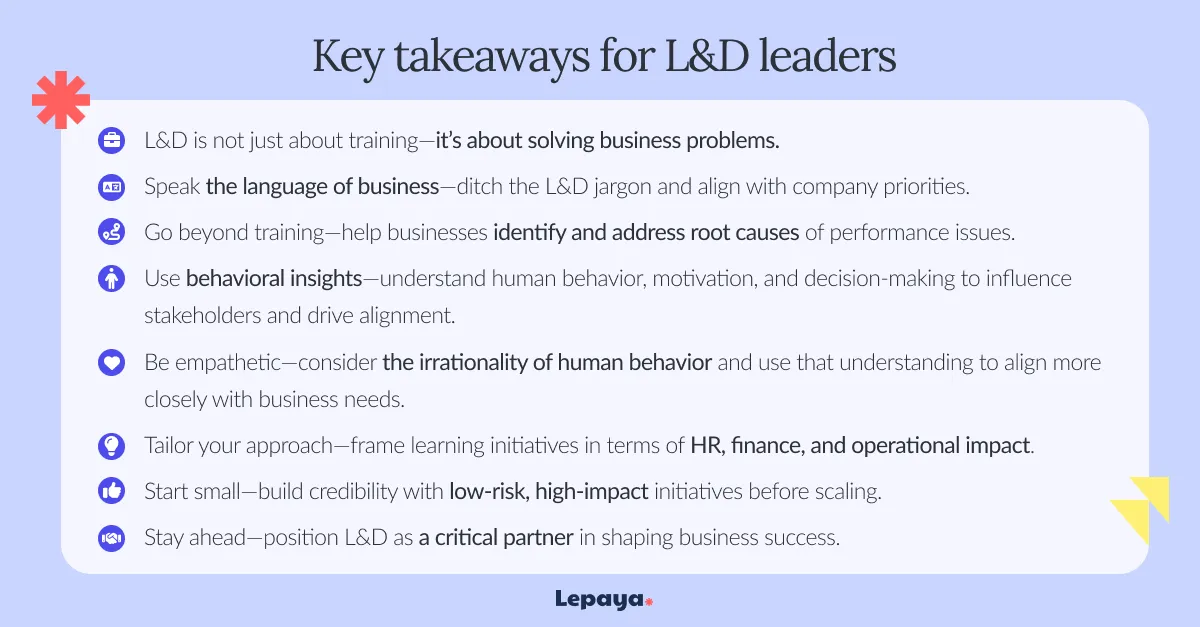
L&D is about more than just delivering training—it’s about solving business problems. Training may be one solution, but often, performance challenges stem from broader structural or environmental issues.
The best L&D leaders take a consultative approach—not just rolling out learning programs but working closely with the business to uncover the real root causes of performance gaps.
The key is understanding that different stakeholders have different priorities. Instead of trying to sell them on “learning,” we need to show them how L&D directly impacts what matters to them:
By framing L&D’s value through their lens, we move from being perceived as just a training provider to being seen as a critical business partner.
That’s also why I recommend starting small. Instead of pushing for large-scale transformation immediately, focus on small, high-impact changes—dedicating just 2-5% of time to initiatives that demonstrate value. Build credibility first, then scale.
I see two possible futures for L&D.
In the first scenario, L&D establishes itself as a problem-solving function—deeply embedded in business strategy, helping leaders identify and address capability challenges with targeted, high-impact solutions.
In the second scenario, L&D is reduced to a content-validation role, simply fact-checking AI-generated learning materials without playing a meaningful role in shaping business outcomes.
I know which future I want to be part of. The choices we make today—how we integrate into business strategy, communicate our impact, and refine our role—will determine which path we take.
L&D’s role as a business accelerator has never been more crucial. Organizations need help identifying the real reasons behind performance gaps—not just skills, but also systems, processes, and workplace environments.
By focusing on business needs, speaking the language of executives, and providing measurable solutions, L&D can secure its place as a trusted advisor, ensuring that organizations don’t just train their employees but truly enable them to succeed.
The question now is: Which future will we choose?

Nous proposons une solution évolutive de formation des employés. Elle vous permet d'améliorer en permanence les compétences de votre personnel.
Réservez un appel

.webp)
Révision par :
Les avancées de l'IA, comme ChatGPT-5, transforment le marché du travail, mais non sans risques. Avec la disparition des postes de débutants et le déclin de la cognition humaine dû à une dépendance excessive à l'IA, les dirigeants doivent prioriser la résilience des compétences et les viviers de talents pour maintenir la performance à long terme.

Révision par :
Senior leadership and boardroom teams invest heavily in commercial strategies to win market shares. Yet the most important and honest information driving strategy circulates in teams underneath, never making it to the table where decisions are made.Jeroen Kraaijenbrink, Executive Coach and Strategy Consultant at Kraaijenbrink Advisory, has spent years working on what he calls the honesty gap. We sat down with him to understand what the honesty gap actually is, where it lives in organizations, and why fixing it requires a leadership shift.How do you define the honesty gap?There's a narrow definition and a broad one. The broad one is: we have created organizations and systems where it's barely possible to be honest to yourself, about yourself, and honest to other people.Honesty isn't just lying. It's integrity, being authentically connected to other people and being aware of your own emotions and your own biases.The honesty gap, in a narrow sense, is the fact that truth and information don’t travel vertically upwards in a company. It's often hard to speak openly to your manager because it’s become rational not to. Many people have the experience: 'I've tried it once but then I was punished for it, or was ignored, so let it be, never mind.' That's the fascinating part: it's not good for people, it's not good for organizations and yet we somehow keep this system intact.Is it less about individual dishonesty and more about a collective culture?A lot of the most important information going through your company is between people and in conversations. You need to find a way to have an honest conversation, where the things that matter get on the meeting table, not just in the informal circuit. And I think that's pretty rare.A more systematic definition is that we're not using the collective intelligence of a company enough. We can radically improve it because we’ve made it rational to hide the truth and to keep things to yourself. A lot of it may not be intentional, but the very fact that someone is in a position above you automatically creates this tension: 'What do I show? What don't I show? Because my next performance appraisal is coming up.'Where does the honesty gap typically show up first, and who owns the problem?It starts with leaders. Solving it needs one leader at the top, the CEO at least, being open and reflective enough to admit that there is an honesty gap and that they are part of it. That's the self-reflection you need for any improvement and any change. Like in coaching: you need to be aware that there is stuff to improve. You don't need to be a perfect leader, but you need to be open enough to admit that there is an issue.You talk about the 'persona trap', what is that?You're stuck in a persona where you perform in a certain way within your company. You have a role, a position, a reputation, and that locks you into specific behaviors. The worse the match between who you are as a person and how you need to show up in your organization, the more inner conflict that’s created. Especially at the top, it’s a problem for many executives. They're supposed to be the people who know it all and be decisive. While if you're honest, you don't necessarily know everything, you’re uncertain and have anxieties.The inner core of the honesty gap is breaking the performance, breaking the acting you feel you must do. If you've put yourself in a role of being the strong, decisive, number-oriented leader, that's how you have to behave. But most people don't feel very comfortable in that kind of role because it's not who they are.Can you fix the honesty gap through individual coaching alone or does the system have to change?Part of it is a personal change, part of it is a system change. You can be on your own and be very authentic, but if the system doesn't change at all, you’ll struggle to break the honesty gap.What you need to do is work on the people, the culture, and the system. Ideally that has to include the top, because otherwise it stays at the level of the person being coached. If it's a team lead or a mid-manager, that person can partly create an island in the organization, a safe space for their team and their department. But still, the appraisal systems, objectives, and culture are company-wide. Why is this so hard to shift, even when leaders recognize the problem?We have normalized this idea that you have to be strategic in what you tell and what you show. You have to show up in a certain role at work. It's also the result of how we have separated work from life, which is a very unnatural thing. It's from the industrial age, because for any other species, work is life. But now there’s a split between work, with all the routines in companies, and then your private life. There's just one you, you're the same person at home as you are at work. The good news is that the honesty gap can be closed. While many companies have unintentionally created environments where people hesitate to speak openly, organizations prioritizing trust, authenticity, and psychological safety can unlock a competitive advantage. When employees feel safe to share concerns, ideas, and perspectives, collective intelligence grows, decision-making improves, and stronger relationships emerge across every level of the business.
Close skill gaps, accelerate growth, and future-proof your workforce.




.webp)
.webp)
