

Discover our new Data & AI Academy and how we can help you build the hard and soft skills needed for all stages of AI transformation across your workforce
Discover more



Artificial Intelligence has quickly moved from experimentation to executive priority. Across industries, organizations are investing in new tools, exploring use cases, and searching for ways to unlock productivity gains.
Yet as AI ambitions grow, many organizations face a challenge: who will help employees adapt?
Increasingly, that responsibility is landing with HR and Learning & Development teams.
For many people leaders, that's an uncomfortable position to be in. They are being asked to guide a transformation that is evolving in real time. New technologies emerge every month. Use cases shift constantly. And nobody, not technology leaders, consultants, or software vendors, can say with certainty what work will look like five years from now.
So how do you prepare people for a future nobody can fully predict?
We spoke with Pascal Struijk, Lepaya’s Product Lead of Blended Learning Solutions, about why this challenge is bigger than technology and why HR may be uniquely positioned to solve it.
Because AI transformation is fundamentally a people transformation.
Technology teams can deploy tools. Data teams can build models. But neither of those guarantees adoption.
Organizations are discovering that the biggest challenge isn't getting access to AI. It's helping thousands of employees understand it, trust it, experiment with it, and eventually redesign the way they work.
At the same time, there's a risk in making AI transformation feel too big or overwhelming. When people see it as a massive, all-at-once change, they often freeze. And when people freeze, they stop experimenting and learning. The organizations making the most progress are creating space for small, practical steps that build confidence and momentum over time.
That's where HR and L&D become critical. The organizations that will create value from AI won't necessarily be the ones with the best technology. They'll be the ones that build capability fastest.
That's how many organizations start. They focus on tools.
The problem is that tools don't transform organizations. People do.
We've seen companies invest heavily in AI platforms only to discover that employees don't know when to use them, don't trust the outputs, or don't feel confident enough to change established ways of working.
Technology deployment is only one part of the equation. The harder challenge is helping people adopt new behaviors, make better decisions, and embrace new ways of working.
That's not a technology challenge. That's a capability challenge.
The speed and uncertainty.
In most transformation programs, you know where you're heading. With AI, the destination is moving.
What's also different is that AI is a democratized technology. Almost everyone can access it, experiment with it, and discover new ways of working on their own. That means the pace of change is no longer driven only by leadership or technology teams. It's increasingly shaped by the ambition and creativity of people on the frontline.
Many leaders feel uncomfortable because they don't have all the answers yet. But that's true for everyone.
The organizations succeeding with AI aren't waiting for certainty. They're building the capability to learn, adapt, and evolve continuously. And because innovation can emerge from anywhere in the organization, they need to be ready to keep up with the pace set by their own people.
That requires a different mindset.
Instead of teaching people one new system, we're helping them develop the skills to navigate ongoing change.
Not on organizational redesign. That's often where leaders want to start because the potential is exciting.
But most employees aren't ready for that conversation yet.
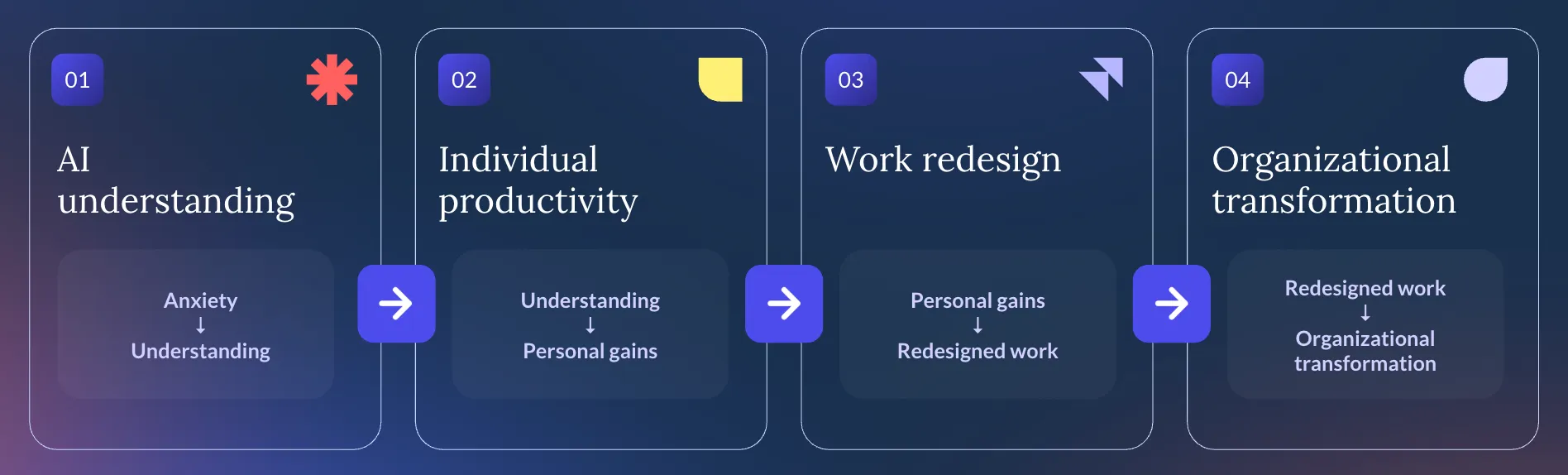
First, people need to understand AI. Then they need to have basic AI skills and become productive with it.
As confidence grows, they're much more willing to experiment, challenge assumptions, and rethink workflows.
Only then can organizations start having meaningful conversations about transforming work itself.
Think of it as a capability journey rather than a technology rollout.
They're often too focused on technical skills.
Prompting matters. Agent building matters. Data literacy matters. But if that's all you teach, you're only solving part of the problem.
People also need decision-making skills. They need critical thinking. They need to learn how to evaluate AI outputs. They need change leadership skills and personal leadership.
The future belongs to organizations that combine hard skills and human skills. That's where real transformation happens.
Because organizations are realizing that AI is only as valuable as the processes and data behind it.
Many companies initially focused only on AI. Now they're discovering that if they want to redesign workflows, automate processes, and create sustainable value, data becomes part of the conversation very quickly.
That's why we launched a Data & AI Academy rather than simply an AI Academy.
The two are increasingly inseparable.
They should welcome the question.
AI is no longer a learning initiative. It's a business transformation initiative.
Executives don't want to hear how many people completed a course.
They want to know:
Those are the metrics that matter.
The conversation must move beyond learning activity and toward business impact.
Don't feel pressure to have all the answers. Nobody does.
Your role isn't to predict exactly what AI will change.
Your role is to help the organization become ready for change.
Build understanding. Build confidence. Build capability.
If you do those three things well, your people will be far better equipped to navigate whatever comes next.
And ultimately, that's what successful AI transformation is really about.

Nous proposons une solution évolutive de formation des employés. Elle vous permet d'améliorer en permanence les compétences de votre personnel.
Réservez un appel

.webp)
Révision par :
Les avancées de l'IA, comme ChatGPT-5, transforment le marché du travail, mais non sans risques. Avec la disparition des postes de débutants et le déclin de la cognition humaine dû à une dépendance excessive à l'IA, les dirigeants doivent prioriser la résilience des compétences et les viviers de talents pour maintenir la performance à long terme.
.webp)
Révision par :
Découvrez comment l'IA autonome va révolutionner la conception organisationnelle, en mettant les gens au cœur de la technologie, et pourquoi l'éthique, la gouvernance et la responsabilité humaine sont essentielles à mesure que l'IA gagne en influence.
Close skill gaps, accelerate growth, and future-proof your workforce.




.webp)
.png)
