Apprentissage en entreprise : la nécessité d'une véritable innovation en 2018
.webp)
Dans »Les neuf bouleversements liés aux ressources humaines en 2017», publié par Deloitte il y a exactement un an, l'une des principales tendances répertoriées était « l'explosion et l'évolution continues du marché de la formation ». En résumé, il prévoit un passage des formations dispensées par des formateurs à des méthodes alternatives, une croissance massive des marchés de contenu et des fournisseurs de technologies d'apprentissage, et une intégration des solutions d'apprentissage dans les activités quotidiennes, à la fois du point de vue pratique et du point de vue technologique.
Bien que nous ne soyons en désaccord avec aucune de ces tendances, nous sommes conscients du fait qu'elles ne mènent pas nécessairement à des solutions d'apprentissage qui répondent mieux aux véritables besoins d'apprentissage sous-jacents. Tant du point de vue des employés que du point de vue de l'employeur, nous voyons trois défis dans le monde actuel de l'apprentissage en entreprise.
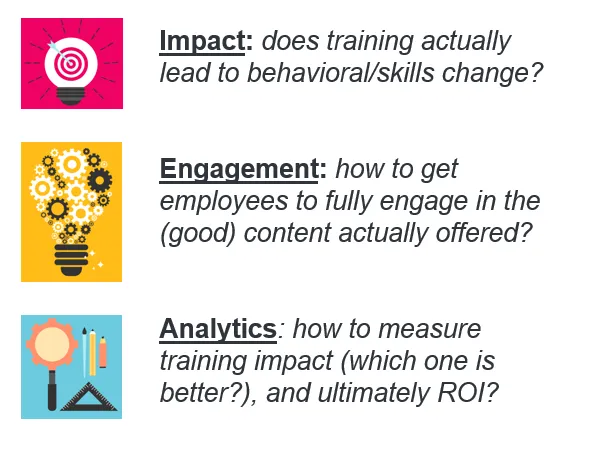
Nous pensons que toute solution fondamentalement nouvelle ou meilleure doit répondre à ces trois défis pour être couronnée de succès. Il ne doit pas simplement redéfinir le support, par exemple poursuivre le passage du mode hors ligne au mode en ligne et du poste de travail à l'application. Une véritable innovation est requise. Si nous revenons aux principales tendances prévues par Deloitte pour 2017, nous voulons souligner la nécessité d'innover comme suit :
1. Maintenez la formation hors ligne, tout en complétant les méthodes de formation dirigées par un formateur par des méthodes d'apprentissage alternatives, par exemple l'apprentissage en ligne, les examens/tests, les jeux, etc. Développez de manière cohérente des parcours d'apprentissage, dans lesquels vous complétez les sessions d'apprentissage en présentiel plus longues par un contenu de formation en ligne de petite taille et facilement accessible. Tout le contenu doit être lié au travail et aux besoins quotidiens, tout en testant en permanence sa compréhension et son impact.
2. Ne vous contentez pas de créer des places de marché contenant de grandes quantités de contenu, mais aidez les apprenants à créer et à naviguer dans un programme intégré adapté à leurs besoins de développement personnel et à leur niveau de compétence actuel. Le contenu sélectionné, personnalisé dans la mesure du possible, sera de plus en plus recherché.
3. Adoptez le point de vue de l'utilisateur lorsque vous proposez des outils d'apprentissage. Adoptez une vision intégrée de la plateforme hors ligne, en ligne, gamifiée et quantifiée afin de faciliter au maximum l'apprentissage pour l'utilisateur et, dans une moindre mesure, pour les ressources humaines. Utilisez autant que possible une plateforme intégrée, idéalement liée aux plateformes commerciales existantes (communication ou collaboration).
Ces trois éléments sont étayés par le fait que l'apprentissage n'est jamais urgent. C'est pourquoi nous pensons qu'en rendant l'apprentissage facile et amusant, l'engagement augmentera. En outre, l'apprentissage doit être intégré aux activités quotidiennes pour analyser son impact réel, et pas seulement les heures de formation ou le score de satisfaction (qui sont également importants, mais ne brossent pas un tableau complet).
Quels sont vos prévisions et vos besoins en matière d'apprentissage pour 2018 ? Des solutions nouvelles ou meilleures répondront-elles fondamentalement aux défis de l'apprentissage et de la formation et aideront-elles les adultes actifs de plus de 2 milliards à devenir encore meilleurs dans leur travail ?
Vous avez des questions, des commentaires ou des suggestions ? Rendez-vous sur www.lepaya.com, entrez ci-dessous ou contactez-nous à l'adresse info@lepaya.com

Nous proposons une solution évolutive de formation des employés. Elle vous permet d'améliorer en permanence les compétences de votre personnel.
Réservez un appel.webp)

Related articles
.webp)
Révision par :
L'essor de la formation au leadership responsabilisant : ce que cela signifie pour les stratégies de gestion des talents à l'horizon 2025
Qu'est-ce qui motive cette focalisation sur la formation au leadership et quelles sont les principales tendances en matière de développement du leadership dans l'environnement commercial complexe d'aujourd'hui ?

Révision par :
Faire face à la DEI à une époque de polarisation : comment les milieux de travail inclusifs favorisent la rétention des employés
Découvrez comment les organisations peuvent aller au-delà de la DEI performative pour créer des cultures inclusives qui favorisent la rétention et la réussite à long terme.

Révision par :
Jeroen Kraaijenbrink: How organizations can overcome the honesty gap
Senior leadership and boardroom teams invest heavily in commercial strategies to win market shares. Yet the most important and honest information driving strategy circulates in teams underneath, never making it to the table where decisions are made.Jeroen Kraaijenbrink, Executive Coach and Strategy Consultant at Kraaijenbrink Advisory, has spent years working on what he calls the honesty gap. We sat down with him to understand what the honesty gap actually is, where it lives in organizations, and why fixing it requires a leadership shift.How do you define the honesty gap?There's a narrow definition and a broad one. The broad one is: we have created organizations and systems where it's barely possible to be honest to yourself, about yourself, and honest to other people.Honesty isn't just lying. It's integrity, being authentically connected to other people and being aware of your own emotions and your own biases.The honesty gap, in a narrow sense, is the fact that truth and information don’t travel vertically upwards in a company. It's often hard to speak openly to your manager because it’s become rational not to. Many people have the experience: 'I've tried it once but then I was punished for it, or was ignored, so let it be, never mind.' That's the fascinating part: it's not good for people, it's not good for organizations and yet we somehow keep this system intact.Is it less about individual dishonesty and more about a collective culture?A lot of the most important information going through your company is between people and in conversations. You need to find a way to have an honest conversation, where the things that matter get on the meeting table, not just in the informal circuit. And I think that's pretty rare.A more systematic definition is that we're not using the collective intelligence of a company enough. We can radically improve it because we’ve made it rational to hide the truth and to keep things to yourself. A lot of it may not be intentional, but the very fact that someone is in a position above you automatically creates this tension: 'What do I show? What don't I show? Because my next performance appraisal is coming up.'Where does the honesty gap typically show up first, and who owns the problem?It starts with leaders. Solving it needs one leader at the top, the CEO at least, being open and reflective enough to admit that there is an honesty gap and that they are part of it. That's the self-reflection you need for any improvement and any change. Like in coaching: you need to be aware that there is stuff to improve. You don't need to be a perfect leader, but you need to be open enough to admit that there is an issue.You talk about the 'persona trap', what is that?You're stuck in a persona where you perform in a certain way within your company. You have a role, a position, a reputation, and that locks you into specific behaviors. The worse the match between who you are as a person and how you need to show up in your organization, the more inner conflict that’s created. Especially at the top, it’s a problem for many executives. They're supposed to be the people who know it all and be decisive. While if you're honest, you don't necessarily know everything, you’re uncertain and have anxieties.The inner core of the honesty gap is breaking the performance, breaking the acting you feel you must do. If you've put yourself in a role of being the strong, decisive, number-oriented leader, that's how you have to behave. But most people don't feel very comfortable in that kind of role because it's not who they are.Can you fix the honesty gap through individual coaching alone or does the system have to change?Part of it is a personal change, part of it is a system change. You can be on your own and be very authentic, but if the system doesn't change at all, you’ll struggle to break the honesty gap.What you need to do is work on the people, the culture, and the system. Ideally that has to include the top, because otherwise it stays at the level of the person being coached. If it's a team lead or a mid-manager, that person can partly create an island in the organization, a safe space for their team and their department. But still, the appraisal systems, objectives, and culture are company-wide. Why is this so hard to shift, even when leaders recognize the problem?We have normalized this idea that you have to be strategic in what you tell and what you show. You have to show up in a certain role at work. It's also the result of how we have separated work from life, which is a very unnatural thing. It's from the industrial age, because for any other species, work is life. But now there’s a split between work, with all the routines in companies, and then your private life. There's just one you, you're the same person at home as you are at work. The good news is that the honesty gap can be closed. While many companies have unintentionally created environments where people hesitate to speak openly, organizations prioritizing trust, authenticity, and psychological safety can unlock a competitive advantage. When employees feel safe to share concerns, ideas, and perspectives, collective intelligence grows, decision-making improves, and stronger relationships emerge across every level of the business.
Ready to drive impact together?
Close skill gaps, accelerate growth, and future-proof your workforce.



.webp)