Develop confident leaders who drive their teams’ performance and organizational success.
Discover more


Lepaya est ravie d'annoncer que le magazine Best Startup EU l'a désigné comme l'une des meilleures startups et entreprises du secteur de l'éducation aux Pays-Bas par Best Startup EU !
Lepaya a connu une croissance rapide depuis 2018 pour apporter des compétences puissantes et une formation et une éducation efficaces au premier plan des organisations aux Pays-Bas et en Europe. L'utilisation des dernières innovations et la fourniture d'un catalogue complet de formations professionnelles et de compétences ont conduit au succès de Lepaya aujourd'hui. Nous nous efforçons constamment d'améliorer nos formations et de nous assurer de répondre aux besoins éducatifs des organisations à la recherche de formations axées sur les compétences puissantes afin d'améliorer le bonheur et les performances de leurs employés. Jusqu'à présent, Lepaya a étendu ses bureaux en Suède et en Allemagne et des formations ont été organisées dans le monde entier.
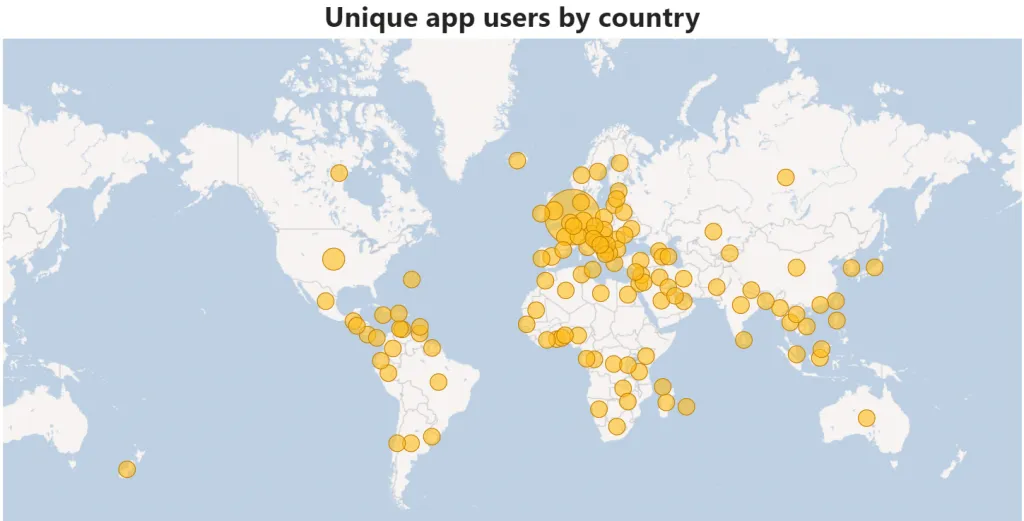
Consultez la carte ci-dessous pour voir la répartition des utilisateurs de notre application !
Lepaya utilise une méthode d'apprentissage mixte pour s'assurer que nos formations conviennent à tous les types d'apprenants.
Pour s'assurer que les apprenants reçoivent l'enseignement le plus efficace possible sans les surcharger d'informations, Lepaya propose aux apprenants des modules d'apprentissage captivants avant et après leurs sessions en classe. Ces mini-modules d'apprentissage ou « bribes » aident les apprenants à comprendre la théorie, le cadre et l'application de leur formation. Pour en savoir plus sur notre méthode d'apprentissage, jetez-y un coup d'œil pour toi !
Non seulement Lepaya combine l'apprentissage sur application et en présentiel, mais nous nous efforçons également de nous intégrer aux organisations afin de rendre notre apprentissage aussi accessible et pratique que possible pour tous les participants qui souhaitent poursuivre leurs études et leur développement personnel.
Pour en savoir plus sur l'intégration pilote de Lepaya à Microsoft Teams, consultez le bloguer.
Lepaya a été sélectionnée en raison de ses performances exceptionnelles dans l'une des catégories suivantes :
Chaque année, Best Startup EU récompense les startups les plus performantes de l'UE, avec ses listes mettant en vedette des entreprises qui repoussent les limites de l'innovation pour résoudre des problèmes et des défis critiques. Best Startup EU vise à accélérer la croissance des principales entreprises, entreprises et innovations basées dans l'UE en les promouvant auprès d'un public mondial. Cette année, Lepaya figure sur cette liste pour ses exploits dans le secteur de l'éducation.
Satisfaite et touchée par cette nouvelle reconnaissance, Lepaya est prête et désireuse de l'apporter à l'UE et à la scène mondiale.
Lire l'article complet ici.
Lepaya est un fournisseur de formations aux compétences puissantes qui combinent l'apprentissage en ligne et hors ligne. Fondée par René Janssen et Peter Kuperus en 2018 dans la perspective que la bonne formation, au bon moment, axée sur les bonnes compétences, rend les organisations plus productives, Lepaya a formé des milliers d'employés.
En tant que challenger sur un marché de la formation bondé, Lepaya répond aux besoins des entreprises technologiques les plus dynamiques d'Europe, telles que Mollie, Takeaway et Picnic, entre autres. En combinant des compétences techniques et des compétences générales, proposées ensemble sous forme de compétences puissantes, l'entreprise basée à Amsterdam se développe plus rapidement sur un marché où la demande de requalification et d'amélioration des compétences continue d'augmenter dans le monde entier.
En 2020, Lepaya a clôturé un cycle de financement de 5 millions d'euros et a procédé de manière indépendante à l'acquisition de Smartenup, une société de formation qui aide les professionnels à travailler mieux, plus rapidement et plus intelligemment avec les données. L'expansion se concentre sur les marchés néerlandais, belge, allemand et suédois et dessert ses clients dans le monde entier. Cette année, Lepaya a été sélectionnée par TechLeap.nl pour le nouveau lot du programme de croissance Rise, un programme exclusif destiné aux acteurs technologiques en pleine croissance aux Pays-Bas. Au début de l'année 2021, Lepaya a atteint Certification NRTO et est devenu membre de l'association NRTO, le conseil néerlandais pour la formation et l'éducation.
Nous connaissons mieux que quiconque quels sont les besoins de formation de votre organisation à un moment donné. Nous répondons à ces besoins de formation de manière personnalisée et en combinant apprentissage numérique et apprentissage facilité. Et nous pouvons réellement montrer l'impact de ces formations sur votre organisation de manière mesurable. Si vous souhaitez en savoir plus sur les activités de Lepaya et sur la manière dont vous pouvez bénéficier des formations proposées par Lepaya, communiquez avec nous!
Best Startup EU est une publication en ligne qui aide à promouvoir les entreprises européennes et à les placer sur la scène internationale. Ils se concentrent principalement sur les entreprises qui montrent des signes positifs de croissance, d'innovation, de gestion et qui excellent dans des domaines ayant un impact bénéfique sur la société.

Nous proposons une solution évolutive de formation des employés. Elle vous permet d'améliorer en permanence les compétences de votre personnel.
Réservez un appel

Révision par :
This article explores why many AI initiatives fail to deliver business value and explains how organizations can close workforce capability gaps through a structured, skills-first approach to AI transformation.

Révision par :
Senior leadership and boardroom teams invest heavily in commercial strategies to win market shares. Yet the most important and honest information driving strategy circulates in teams underneath, never making it to the table where decisions are made.Jeroen Kraaijenbrink, Executive Coach and Strategy Consultant at Kraaijenbrink Advisory, has spent years working on what he calls the honesty gap. We sat down with him to understand what the honesty gap actually is, where it lives in organizations, and why fixing it requires a leadership shift.How do you define the honesty gap?There's a narrow definition and a broad one. The broad one is: we have created organizations and systems where it's barely possible to be honest to yourself, about yourself, and honest to other people.Honesty isn't just lying. It's integrity, being authentically connected to other people and being aware of your own emotions and your own biases.The honesty gap, in a narrow sense, is the fact that truth and information don’t travel vertically upwards in a company. It's often hard to speak openly to your manager because it’s become rational not to. Many people have the experience: 'I've tried it once but then I was punished for it, or was ignored, so let it be, never mind.' That's the fascinating part: it's not good for people, it's not good for organizations and yet we somehow keep this system intact.Is it less about individual dishonesty and more about a collective culture?A lot of the most important information going through your company is between people and in conversations. You need to find a way to have an honest conversation, where the things that matter get on the meeting table, not just in the informal circuit. And I think that's pretty rare.A more systematic definition is that we're not using the collective intelligence of a company enough. We can radically improve it because we’ve made it rational to hide the truth and to keep things to yourself. A lot of it may not be intentional, but the very fact that someone is in a position above you automatically creates this tension: 'What do I show? What don't I show? Because my next performance appraisal is coming up.'Where does the honesty gap typically show up first, and who owns the problem?It starts with leaders. Solving it needs one leader at the top, the CEO at least, being open and reflective enough to admit that there is an honesty gap and that they are part of it. That's the self-reflection you need for any improvement and any change. Like in coaching: you need to be aware that there is stuff to improve. You don't need to be a perfect leader, but you need to be open enough to admit that there is an issue.You talk about the 'persona trap', what is that?You're stuck in a persona where you perform in a certain way within your company. You have a role, a position, a reputation, and that locks you into specific behaviors. The worse the match between who you are as a person and how you need to show up in your organization, the more inner conflict that’s created. Especially at the top, it’s a problem for many executives. They're supposed to be the people who know it all and be decisive. While if you're honest, you don't necessarily know everything, you’re uncertain and have anxieties.The inner core of the honesty gap is breaking the performance, breaking the acting you feel you must do. If you've put yourself in a role of being the strong, decisive, number-oriented leader, that's how you have to behave. But most people don't feel very comfortable in that kind of role because it's not who they are.Can you fix the honesty gap through individual coaching alone or does the system have to change?Part of it is a personal change, part of it is a system change. You can be on your own and be very authentic, but if the system doesn't change at all, you’ll struggle to break the honesty gap.What you need to do is work on the people, the culture, and the system. Ideally that has to include the top, because otherwise it stays at the level of the person being coached. If it's a team lead or a mid-manager, that person can partly create an island in the organization, a safe space for their team and their department. But still, the appraisal systems, objectives, and culture are company-wide. Why is this so hard to shift, even when leaders recognize the problem?We have normalized this idea that you have to be strategic in what you tell and what you show. You have to show up in a certain role at work. It's also the result of how we have separated work from life, which is a very unnatural thing. It's from the industrial age, because for any other species, work is life. But now there’s a split between work, with all the routines in companies, and then your private life. There's just one you, you're the same person at home as you are at work. The good news is that the honesty gap can be closed. While many companies have unintentionally created environments where people hesitate to speak openly, organizations prioritizing trust, authenticity, and psychological safety can unlock a competitive advantage. When employees feel safe to share concerns, ideas, and perspectives, collective intelligence grows, decision-making improves, and stronger relationships emerge across every level of the business.
Close skill gaps, accelerate growth, and future-proof your workforce.