
Les RH sont-elles prêtes à mener la révolution de l'IA ? 3 experts interviennent

- People-first AI strategy is critical: transformation fails without trust, transparency, and clear ownership.
- Upskilling & critical thinking turn AI from an optimizer into a strategic enabler of human potential.
- Redesigning roles & structures ensures AI augments, not replaces, work, creating a future-ready workforce.
- Test-and-learn approach with cross-functional ownership accelerates sustainable adoption.
By 2028, nearly 80% of business and IT leaders expect AI to drive significant transformation. Yet without a human-centered strategy, AI investments risk becoming expensive experiments with little lasting impact.
“Implementing AI without a people strategy is like buying a high-performance car without knowing how to drive,” Dieter Veldsman, Chief Scientist at AIHR.
HR must be more than passengers in this journey, they must take the wheel. We brought together three experts - Dieter Veldsman, Chief Scientist at AIHR, Florence Nony, Senior Advisor to the President at Videlio and Ian Strik, AI Ambassador at Lepaya to explore how HR can become a trusted guide for AI adoption across the business.
AI in organizations: Where are we today?
To begin to understand what AI adoption truly means for today’s workplaces, it’s crucial to look at it on three levels:
1. Individual level
This is where AI often enters the organization first. Employees use tools to analyze data, draft communications, and generate content, boosting day-to-day productivity. But individual use alone doesn’t equal transformation.
2. Process and practice level
The next step is integrating AI into how work actually gets done. How can AI agents run or support entire processes? How do we shift from isolated use cases to embedding AI into team workflows and core practices?
3. Enterprise level
At this scale, AI has the potential to fundamentally reshape the organization. It impacts job design, talent strategies, operating models, and even culture. This is where the workforce must be reimagined - not just augmented.
In 2025, it’s clear that AI is reshaping the skills organizations need, driving productivity, and transforming how humans contribute to work. But despite the hype, the gap between ambition and impact is stark:
- Only 25% of AI initiatives deliver expected ROI.
- Just 15% of employees say their company has a clear AI strategy.
While 78% of businesses use AI in at least one function, only 40% have successfully scaled it. Why?
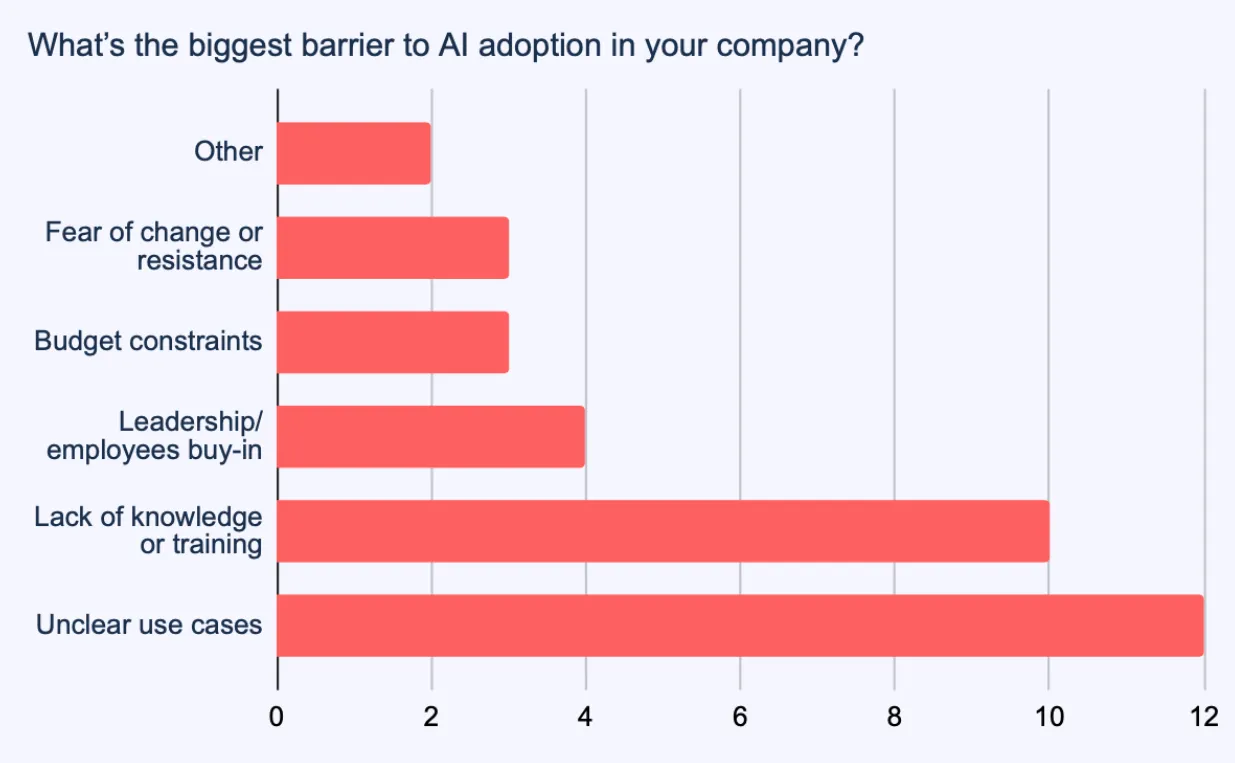
We asked over 50 HR leaders, and their answer was clear: the biggest barriers to AI adoption are unclear use cases, a lack of knowledge or training, and limited buy-in from both leadership and employees. It’s a strong reminder that AI isn’t just a technology challenge, it’s a people-centered transformation. That makes HR not just stakeholders, but key drivers of successful AI adoption.
How is AI reshaping the role of HR?
When it comes to AI, HR has a dual responsibility:
1. Guiding the organization through AI-driven transformation
HR must help the organization interpret what AI disruption means and guide the transition to becoming an AI-enabled enterprise. Leading organizations are forming multidisciplinary, cross-functional teams to navigate this shift. HR should be at the forefront of that effort.
“HR’s role is to lead, not follow. We must anticipate and manage change, upskill and reskill our teams, democratize AI through training, address fears, measure impact - and we must start now.” Florence Nony, Senior Advisor to the President at Videlio
2. Defining what AI means for HR itself
AI presents a unique opportunity for HR to fulfill its long-standing promise of becoming a true strategic partner to the business. With the technology now available to elevate HR’s contribution, the question becomes: How do we prepare our own teams to adapt AI in a sustainable, value-driven way?
What skills do HR leaders need to lead AI transformation?
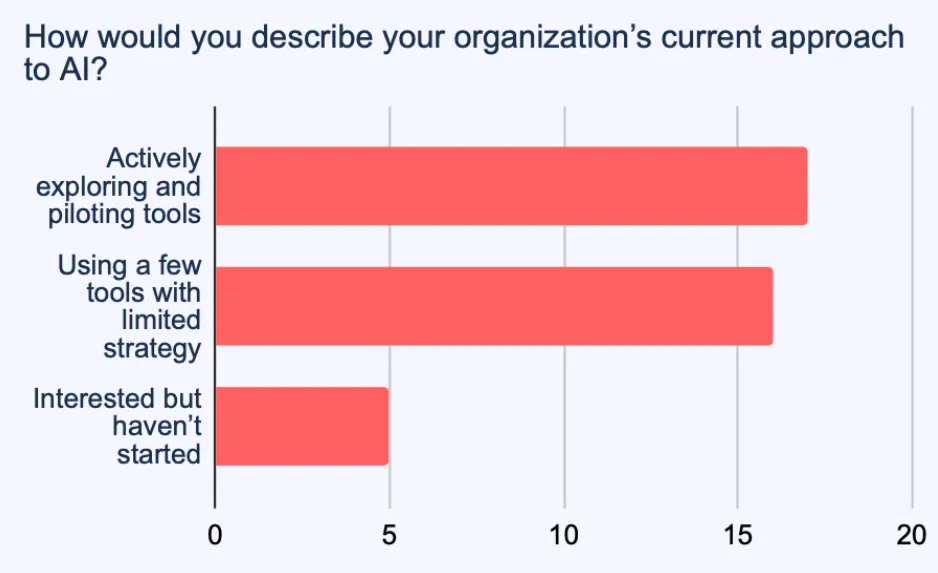
When we asked HR leaders about their AI journey, most described it as still in the early stages - “exploring and piloting tools with limited strategy.”
But successful AI adoption won’t come from waiting for a budget or a top-down directive. It requires HR to lead by example - by learning how to prompt effectively, experimenting with tools, and role-modeling adoption across the organization.
This is especially urgent when we consider inclusion: studies show that women are 16–20% less likely to use tools like ChatGPT - even in the same roles. In HR, where 70% of professionals are women, this usage gap could risk leaving a majority of the workforce behind.
That’s why HR needs to build the skills - not just to adopt AI, but to lead with it.
“Curiosity, discipline, and a willingness to learn are the three main competencies HR leaders need.” — Florence Nony, Senior Advisor to the President at Videlio
There are four steps HR leaders can take:
- Educate yourself on what AI is and what it isn’t. Confront the fear with facts.
- Play with the tools to understand their capabilities and boundaries.
- Join structured experiments and learn from how others are applying AI.
- Go beyond your own workflow to explore how AI can enhance collaboration across teams.
“Start experimenting now. Dedicate at least 10 hours to hands-on work with AI to develop an intuitive sense of what it is, where it performs best, and where it still fundamentally depends on us—humans. Because ultimately, it's our role to lead.” — Ian Strik, AI Ambassador at Lepaya
Key elements of successful AI adoption
“Buying licenses is not a strategy.” Dieter Veldsman, Chief Scientist at AIHR
Successful AI adoption requires more than enthusiasm or experimentation - it demands purpose, leadership, and a people-first approach. Here are the key elements:
1. Define the purpose behind AI adoption
Many organizations rushed into AI with a reactive mindset, fueled by hype rather than intention. But as the novelty fades, a more important question arises: Why are we adopting AI?
“Some things are fun to do, but they’re not helpful. You need to be able to differentiate.” Dieter Veldsman, Chief Scientist at AIHR
Not every use case creates value. HR leaders must guide teams to distinguish between novelty and strategic necessity, ensuring AI serves business goals.
2. Drive adoption from the top
The absence of clear leadership creates confusion and slows progress. Issues like data privacy, appropriate toolsets, and ethical use require a strong, unified message.
“Adoption needs to be driven from the very top. CEOs and the executive committee are primarily responsible for setting the vision, mission, and narrative for AI transformation in the company.” Florence Nony, Senior Advisor to the President at Videlio
3. Start before it’s perfect
A common pitfall is waiting for the “ideal” tool before taking action. In reality, early experimentation is critical to building momentum and confidence. Don’t aim for perfect - aim for progress. Pilot, learn, iterate.
4. Build AI-ready skills across the workforce
Employees need more than access, they need capability. That means investing in four core areas:
- AI tool literacy – Understanding what tools are available and how to use them.
- Practical skills – Prompt engineering and task design; knowing how to ask the right questions.
- Critical and ethical thinking – Recognizing bias, applying AI responsibly, and knowing when human judgment matters most.
- Collaboration entre l'homme et l'IA — Apprendre à travailler avec L'IA, pas contre.
« Incarnez ces compétences aux gens, et ils découvriront le reste. » Dieter Veldsman, Scientifique en chef à l'AIHR
Conclusion : créer un environnement de travail du futur centré sur l'humain et axé sur l'IA
Le coût caché d'une IA mal gérée ? Un chiffre d'affaires élevé, des biais cachés et un ralentissement de l'innovation. Des études montrent que le remplacement d'un employé technique peut coûter cher 100 à 150 % de leur salaire, mais les perturbations provoquées par l'IA sans un soutien personnel approprié peuvent entraîner une attrition tout aussi rapidement.
Duolingo a licencié un nombre important de sous-traitants après avoir transféré la création de contenu à l'IA, pour faire face à la réaction négative des clients, à une presse négative et à une vague de suppressions d'applications. Klarna a remplacé 700 agents du service client par l'IA, mais a été contraint de faire marche arrière en raison d'une baisse notable de la qualité de service.
Ces faux pas mettent en lumière une vérité cruciale : l'IA peut améliorer l'efficacité, mais sans empathie humaine, sans apprentissage continu et sans gouvernance transparente, elle risque d'éroder la confiance et la valeur à long terme.
Les responsables des ressources humaines sont particulièrement bien placés pour guider cette évolution technologique, en veillant à ce que l'IA soit intégrée de manière à amplifier le potentiel humain, à favoriser l'innovation et à préparer les organisations à une main-d'œuvre plus résiliente et prête pour l'avenir.

Nous proposons une solution évolutive de formation des employés. Elle vous permet d'améliorer en permanence les compétences de votre personnel.
Réservez un appel
.webp)
Related articles
.webp)


Révision par :
The Human Premium: What AI can't learn for you
AI is making knowledge abundant. Murielle Bolsius, Head of Solutions at Lepaya, argues that's exactly why self-awareness, resilience, and judgment are becoming the real differentiator at work - and why personal development belongs at the center of it, not the edge.
Ready to drive impact together?
Close skill gaps, accelerate growth, and future-proof your workforce.