

Discover our new AI leadership training program and how it is built for organizations ready to move beyond AI awareness into real, measurable transformation.
Discover more


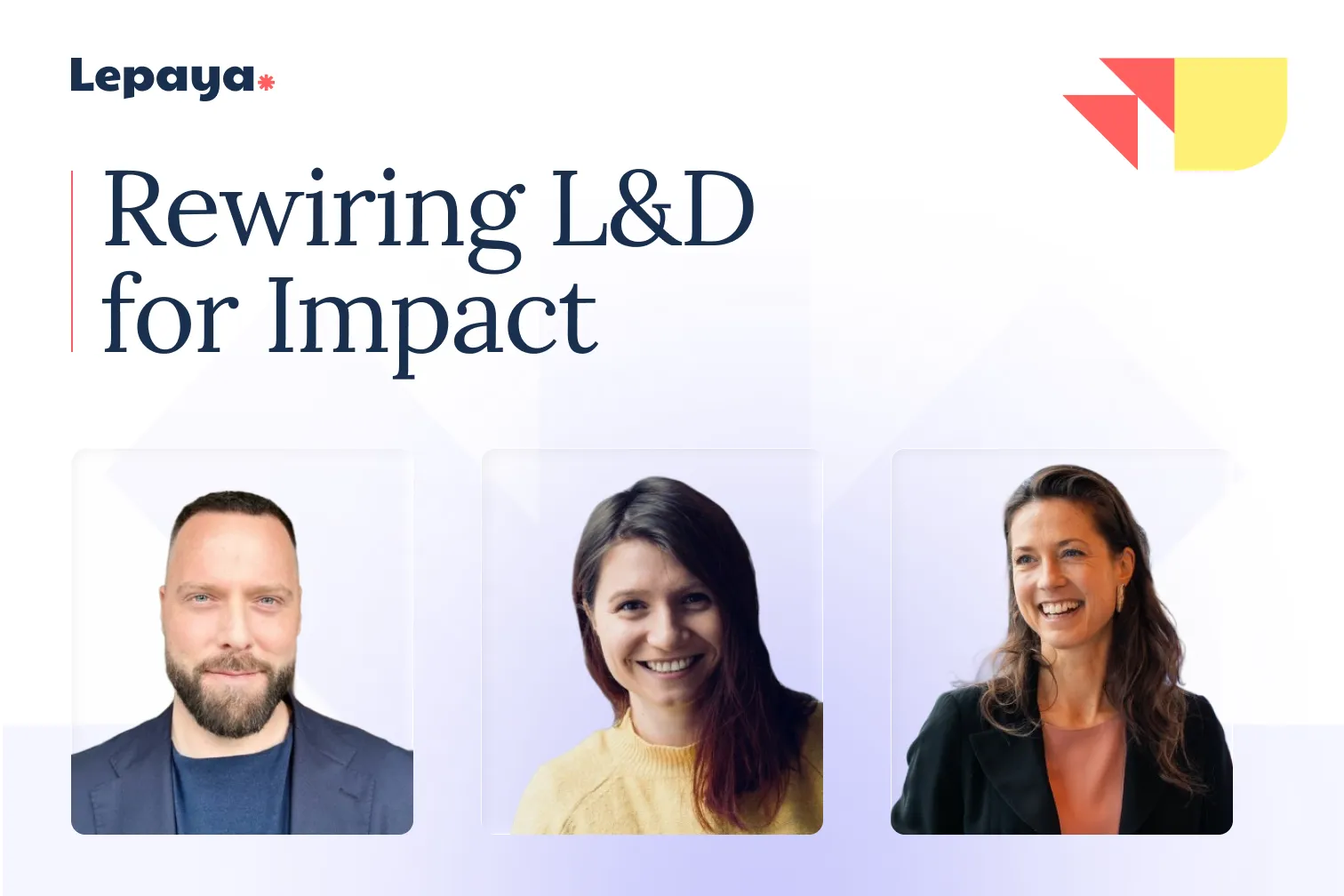
The question of what L&D professionals should be doing has a new urgency. As AI accelerates the pace of change, skills gaps are getting wider, and training-on-request is no longer enough. But rewiring your L&D strategy is easier said than done.
On May 12th, Juliëtte Plantenga, Senior L&D Consultant at Lepaya, hosted a panel discussion with Lavinia Mehedințu, Co-founder of Offbeat, and Aleks Tosovic, Director of Workforce Consulting at SThree, to examine what it means to move from training delivery to performance consulting, and what it takes in practice.
Here are the key takeaways from the discussion.
One of the first questions put to the panel was a pointed one: if anyone can find anything online or ask an AI assistant, what does L&D bring to the table?
Aleks’s answer was direct: “Knowledge on tap isn't entirely new. We've had Google and YouTube for years. Yet most people don't route themselves toward learning; they chose Despacito. Second most-watched video on YouTube in 2025, right after Baby Shark. I checked.”
His point: access to information has never been the bottleneck. The role of L&D remains to curate the right learning for where the organization is trying to go. Practically, that means two things:
“Learning agility is the mega skill of the coming years,” Aleks said. “L&D has a real role to play in cutting through the noise, but to do that, L&D has to put its own mask on first. We need to be at the forefront of this change ourselves.”
Lavinia pointed to a different angle: the transfer problem. The gap between what people learn in a training session and what they actually do back at their desk has always been L&D's hardest problem to solve.
“Josh Bersin coined 'learning in the flow of work' back in 2018. It sounded good, but we just didn't have the technology to make it practical. The knowledge in most companies was too spread out, too hard to surface at the right moment.”
AI changes that. L&D teams can now build copilots, checklists, and assistants that sit close to where people actually work. But doing it well requires a different operating model, one that’s closer to a product manager than a content designer:
“AI doesn't have deep knowledge of learning science,” Lavinia noted. “That's what we bring.”
Alongside all of this, both speakers agreed on one more thing: L&D's role in bringing people together hasn't gone away; it's just shifted.
The training sessions that matter most going forward will be less about delivering content and more about facilitating conversations: defining problems, sharing knowledge across teams, improving processes, and creating strategy.
When the conversation turned to practice, the panel shared the practical strategies that can make the shift possible, in process, mindset, and how L&D shows up to the business.
The most underused tool in L&D isn't a new methodology or an AI platform. It's a good set of questions asked before any design work starts.
Most L&D professionals got into the field because they want to help, and that impulse often works against them. Saying yes to every request, regardless of whether training is actually the right answer, keeps L&D busy but not effective.
Lavinia suggested that a better intake process can simply start with a short form of four or five questions that stakeholders complete before any design work starts:
The goal isn't to create a bureaucratic hurdle. It's to surface whether training is even the right intervention, and to align L&D and the stakeholders on the problem before either one starts thinking about solutions. A follow-up conversation can go deeper, but by the end of the process, both sides should be fully agreed on what they're trying to change and how they'll know if it worked.
“If someone isn't willing to take ten minutes to think through these questions, I'd personally wonder how urgent their problem really is, and what their commitment would be in helping us solve it,” Lavinia noted.
L&D teams often spend weeks or months designing a solution under the assumption that it's the right one, when they don't actually know yet. A feedback training program might not improve feedback sharing. A carefully designed onboarding process might not improve onboarding time. You find out when it's too late to change course.
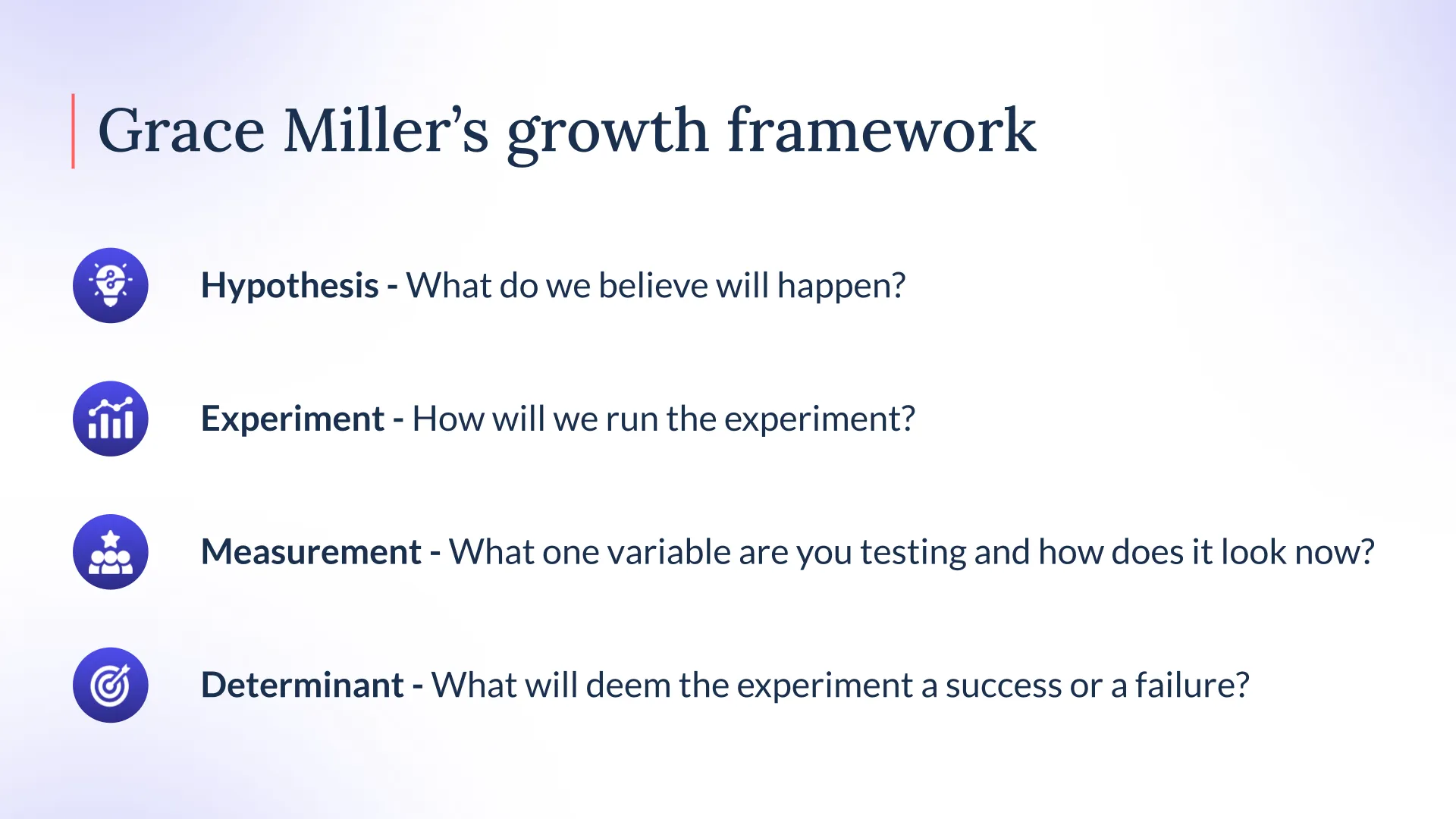
Lavinia suggested treating L&D work more like experimentation: define a hypothesis, test something small, measure one variable, set a clear threshold for success or failure, and adjust. This approach requires less certainty upfront, but produces better results over time.
Before building anything, L&D needs to know who it's actually building for and why those groups are the priority.
In practice, that means mapping the priority groups in the organization and aligning with stakeholders on what success looks like for each before any program is scoped.
.webp)
One habit that worked well for Aleks: getting into strategy planning sessions early, not as a note-taker but as a facilitator. Hearing the real business conversations, where the organization is trying to go, what's missing, what's changing, is what lets L&D build a learning strategy that's actually connected to direction rather than retrofitted to it.
From there, the move is to identify a small number of priority competencies per group, not work from a sprawling framework where everything matters equally.
.webp)
The most common reason L&D efforts don't land isn't the quality of the training; it's that the rest of the organization isn't set up to support the behavior change.
Aleks referenced the Galbraith Star model as a way of thinking through what that means in practice: strategy, structure, processes, incentives, and people all need to be pointing in the same direction. If only one of them is - say, the training program - the others will cancel it out.
.webp)
This logic applies directly to AI adoption. A generic AI-for-everyone program rarely sticks because different teams have completely different starting points and use cases. What actually moves organizations from AI-aware to AI-enabled involves several things working together:
“Don't launch a generic AI program. Build for the function, not the entire organization,” Aleks noted.
All of the strategies above require something that doesn't always show up in L&D frameworks: courage.
Lavinia pointed out that the knowledge of what to do isn't what's missing for most L&D professionals. What's missing is the courage to act on it, to treat a stakeholder conversation as a research process rather than an intake form for a training order, to test something unconventional, to say that a six-month design process is probably the wrong approach.
Without that, the practical tools discussed here stay theoretical.
The session closed with each speaker offering one piece of advice for anyone trying to start rewiring their function.
Aleks pointed to purpose before action: “There's a lot of noise around AI right now. CEOs are treating it like a quick fix. L&D teams end up scrambling to build enablement programs without being clear on what they're actually trying to solve. Is it efficiency? Process automation? A culture of experimentation? Those are three different jobs with three different success metrics. Get clear on that first.”
Lavinia's advice was more personal: “Join a community. One that talks about organizational development, behavioral science, experience design, and that shares real case studies and real struggles. These disciplines are all directly relevant to what we do. And the people doing this work well aren't figuring it out alone.”

We bieden een schaalbare oplossing voor de opleiding van werknemers. Hiermee kun je je mensen continu bijscholen.
Boek een gesprek


Recensie door:
AI is making knowledge abundant. Murielle Bolsius, Head of Solutions at Lepaya, argues that's exactly why self-awareness, resilience, and judgment are becoming the real differentiator at work - and why personal development belongs at the center of it, not the edge.
Close skill gaps, accelerate growth, and future-proof your workforce.




.webp)

.webp)
.png)