

From AI-aware to AI-enabled: The middle manager's role in driving adoption
As organizations accelerate their investments in AI, one thing is becoming increasingly clear: the real challenge isn't the technology, it's how we lead with it and encourage teams to integrate it into their daily workflows.
That's exactly why Lepaya developed “Taking the Lead with AI,” a new learning module designed for the people who sit at the center of that challenge: middle managers.
On April 9th, Sophie Baltus, Learning Solutions Advisor, and Pascal Struijk, Product Lead, walked a live audience through the thinking behind the program, what it covers, and why the usual approach to AI training isn't working.
Why AI adoption fails without strong leadership
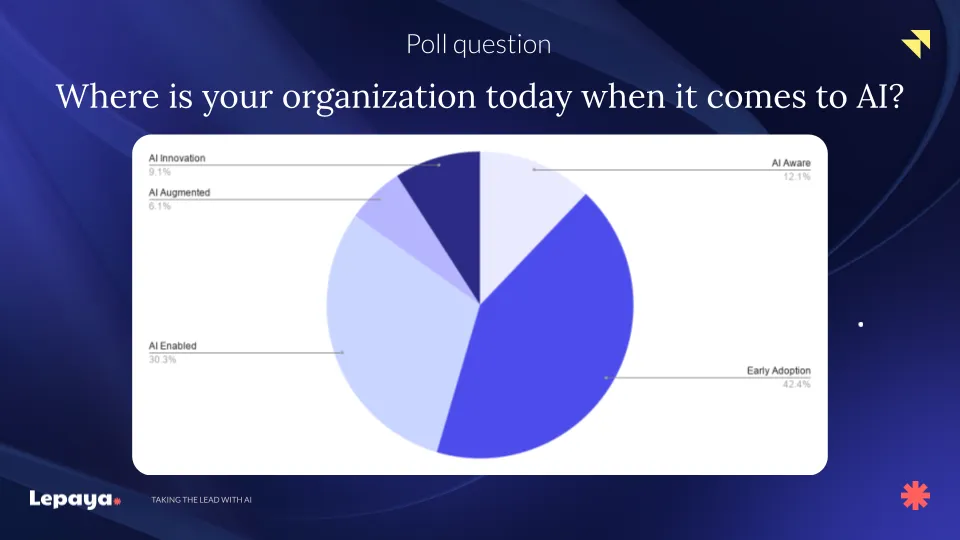
Across industries, companies are actively experimenting with AI. New tools, platforms, and capabilities are emerging at a rapid pace, creating a sense of urgency to adopt and implement. Yet despite this momentum, many organizations struggle to translate AI investments into tangible business impact. Most remain stuck in early stages of adoption, hovering around awareness and initial experimentation, without achieving widespread, structural integration into daily work.
Research by MIT backs this up: despite significant investment, very little real impact has been achieved so far. And the data points to a clear reason why: At companies that drove successful AI implementations, over 60% of their success levers are related to leadership and cultural elements, and less than 25% is related to the right tooling and systems.
In other words, the gap isn't technical. It's human.
The importance of middle managers
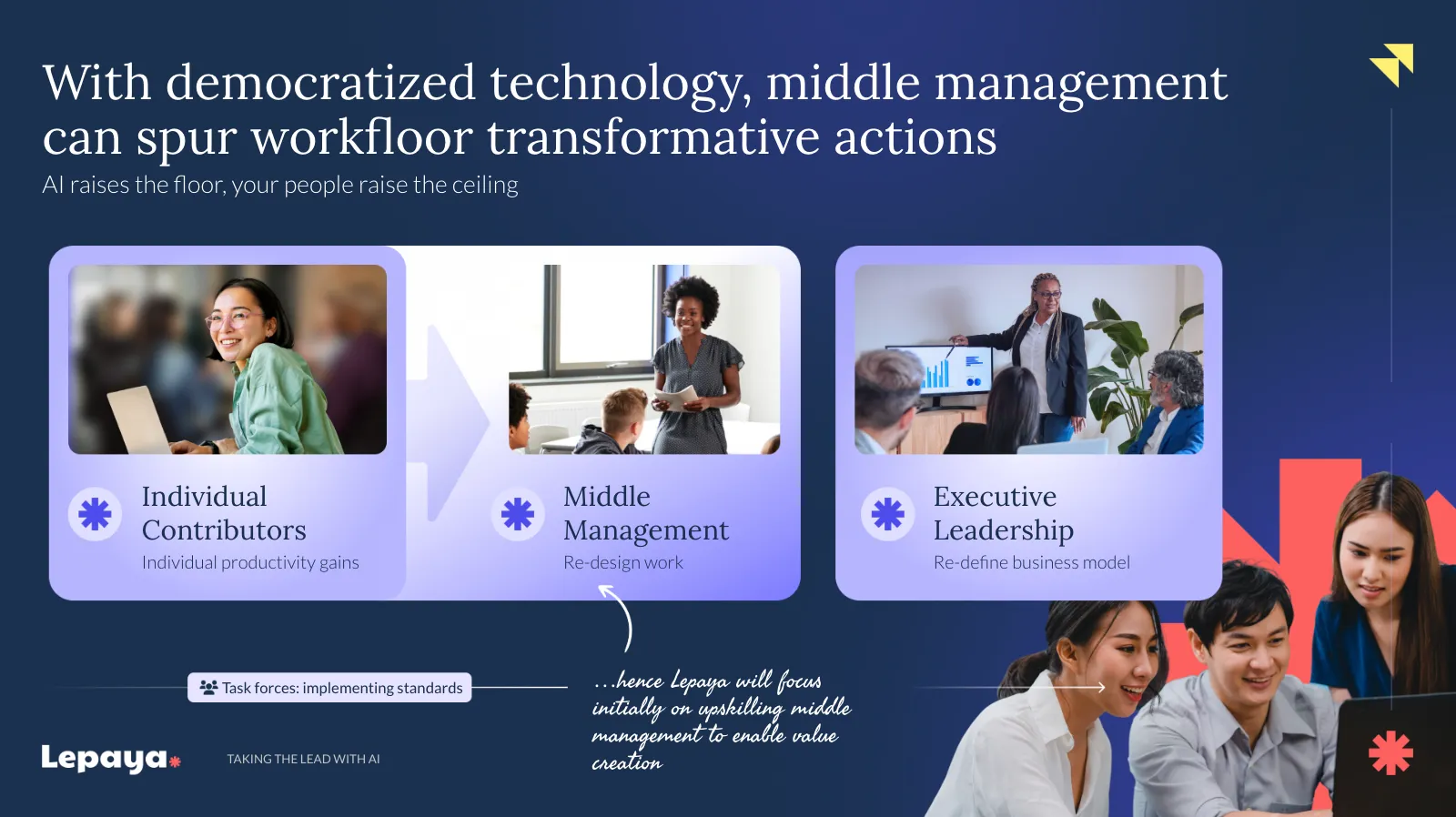
At the center of this transformation are middle managers, the critical link between strategy and execution. They are the ones shaping day-to-day behaviors, translating organizational strategy into concrete actions, and supporting their teams through change. But right now, most report feeling underprepared, without the tools, training, or clarity to play that role effectively.
Since summer 2025, Pascal and the Lepaya team have been speaking to clients and prospects to understand exactly where the pressure points are. Four recurring challenges kept surfacing:
- Defining their role in an AI-driven environment
- Leading without being the technical expert
- Balancing innovation with risk management
- Supporting teams with varying levels of AI readiness
“The most common thing we hear is: what is actually my role in this equation?” Pascal explained.
“There are experts, there's executive management, there are individual contributors. But where does the middle manager come in?”
How does Lepaya encourage leaders to “Take the Lead with AI”?
“Taking the Lead with AI” is a blended learning journey that combines self-paced learning with interactive sessions, AI-powered role plays, and real-time feedback, designed to create real behavior change on the job. It's built around four core building blocks:
.webp)
1. New leadership skills: The program introduces capabilities that typically don't appear in leadership development, including ethical decision-making and product thinking. Leaders will work through case studies, like deciding whether to deploy a human-sounding AI agent, to build a moral compass, not just compliance.
2. New AI literacy skills: The e-learning component works across three levels of AI literacy, covering prompt engineering, deep research, AI agents, and data security, so leaders can engage confidently with tools and use cases without needing to become technical experts.
3. Existing leadership skills in new context: Coaching and storytelling aren't new to leadership programs, but coaching an innovator who knows more than you do, or building a change narrative that actually activates your team, requires those skills applied differently. The module creates practice space for exactly that.
4. New didactical approach: AI-powered role plays and in-classroom avatars will give managers a safe space to practice difficult conversations and sharpen their change narratives in real time. These are paired with facilitators who are deliberately chosen for being both AI-literate and strong leadership trainers.
By the end of the program, managers will have a clearer sense of their role in the AI transformation, the confidence to lead without being the expert, and the practical tools to guide their teams through experimentation and change.
The future of AI-leadership
As AI continues to evolve, so will the demands placed on leaders. New challenges are already emerging, such as managing hybrid teams of humans and AI agents, and navigating increasingly complex questions around data governance and ethics.
“We shouldn't treat AI as a technology shift,” Sophie summarized. “It really is a people shift, in which middle managers play a critical role.”
Organizations that proactively equip their leaders with the skills and mindset to adapt will be the ones that move from AI-aware to AI-enabled, unlocking potential and increased ROI.

We offer a scalable employee training solution. It lets you continuously upskill your people.
Book a call
.webp)
Related articles
.webp)

.webp)
.webp)
Ready to drive impact together?
Close skill gaps, accelerate growth, and future-proof your workforce.