Discover how Europe's fastest growing companies are preparing for AI adoption.
Download now



.webp)
Lepaya analysed hiring activity across 110 high-growth companies in finance, professional services, and technology. The pattern for the future of work is consistent across all three sectors: technical skills are opening doors, but human skills are deciding who gets hired. Entry-level hiring has shrunk dramatically with just 12% of consulting openings and 18% of tech openings as AI absorbs routine work. Mid-level professionals who can combine technical depth with strategic influence, ethical judgment, and cross-functional collaboration are the most-hired group across every industry studied.
The finance sector is solving two problems at once. Regulatory demands are tightening. Legacy infrastructure is being modernised with AI. The hiring data reflects both pressures simultaneously.
(Percentages overlap because some roles count in multiple categories; e.g., a senior AI compliance director appears in both "senior-level" and "AI-linked" buckets.)
The skill profile finance is hiring for has shifted. The traditional domain specialist, deep in regulation but light on technology, or strong in data but unfamiliar with compliance no longer matches the job description.
What's now expected:
The hiring pattern reveals something most workforce planning conversations miss: finance is no longer hiring for technical specialisation. It's hiring for the ability to operate at the boundary between technical systems, regulatory environments, and senior stakeholder conversations.
The consulting industry has undergone the most visible shift in talent demand of any sector studied.
The 12% entry-level number is the most striking. For decades, consulting's economic model was built around large pyramids of junior analysts doing the bulk of the research, modelling, and slide production. AI has compressed that work to near-zero marginal cost. The pyramid is flattening.
What firms are now hiring for:
The traditional grunt work: market research, SWOT analyses, slide production, is no longer the path into consulting. The new path requires showing up with experience, judgment, and the ability to deliver outcomes that AI can't produce on its own.
This is the broader pattern likely to reshape every knowledge-work industry: the entry-level rung gets shorter, the mid-level expands, and the skill bar to clear the first hire rises significantly.
Even in the most technical industry studied, hiring priorities reach well beyond engineering skills.
Two patterns stand out.
First, technical depth is necessary but not sufficient. The hiring data shows a clear demand for engineers and product managers who can connect technical work to business outcomes. Pure technical specialists without communication, collaboration, or strategic context are losing out to candidates who combine both.
Second, product management is being hired more aggressively than its volume suggests. 22% of roles in a heavily engineering-led industry going to product managers is high. The reason: AI raises the value of the people who can translate technical capability into something customers will pay for. Building AI is now table stakes. Productising AI is the differentiator.
The three sectors look different on the surface but share the same underlying logic. Across all 110 companies, the same dual requirement emerges:
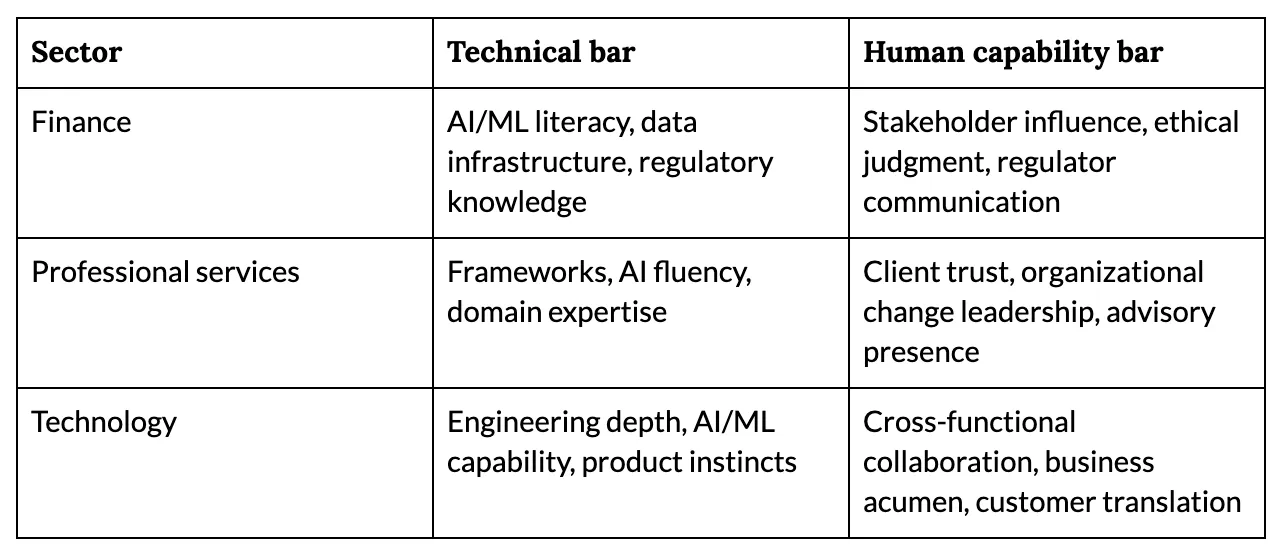
The traditional binary, technical or human, hard or soft, STEM or non-STEM, is breaking down. Across every sector studied, companies aren't choosing between the two. They're demanding both.
Looking at the job descriptions in the 110-company dataset, four capabilities show up consistently across sectors and seniority levels.
The ability to translate complexity for non-technical stakeholders and drive alignment across functions. In every sector, the people getting hired are the ones who can take dense technical or regulatory information and shape it into decisions executives can act on.
The ability to make decisions where data provides guidance but not answers. As AI takes over more pattern-matching work, the remaining decisions tend to be the ones where the data is incomplete, the trade-offs are real, and human judgment is non-negotiable. Companies are hiring for the people who can navigate that territory.
The ability to bridge teams with competing priorities and different expertise. AI-augmented organizations need people who can pull engineering, product, compliance, sales, and customer success into aligned execution. The collaboration skill is no longer "nice to have", it's the throughput constraint on most growth initiatives.
The ability to understand how technology serves broader organizational goals. The engineers who get hired aren't only the best engineers, they're the ones who can articulate why their work matters to the business. Same pattern in every other function.
The hiring data has hard implications for how organizations should be designing capability strategies right now.
The narrative that AI is replacing knowledge work is partially right and largely misleading. AI is replacing the routine layer of knowledge work: the analyses, the synthesis, the drafting, the formatting. What's left is the work that requires judgment, influence, and cross-functional integration.
Companies are hiring for that work aggressively. They're paying for it. And they're competing for the people who can do it well.
The strategic question for HR leaders is not whether AI will reshape hiring. The data shows it already has. The question is whether your workforce strategy is preparing people for the jobs that exist now, or for the jobs that existed five years ago.

We offer a scalable employee training solution. It lets you continuously upskill your people.
Book a call
"Resilience in this era is about combining artificial and human intelligence to create new opportunities for people and economic growth."


Close skill gaps, accelerate growth, and future-proof your workforce.




Across 110 high-growth companies in finance, consulting, and technology, hiring is consistently focused on candidates who combine technical capability (AI/ML literacy, data fluency, domain expertise) with four human capabilities: strategic influence, ethical judgment, cross-functional collaboration, and business acumen. Technical skills open the door. Human skills decide who gets hired.
Entry-level hiring has shrunk significantly in knowledge-work sectors. Just 12% of consulting openings and 18% of technology openings target entry-level candidates. The routine work that traditionally filled entry-level roles — research, synthesis, formatting, basic analysis — is now largely automated. The work that remains requires more experience and judgment than entry-level candidates typically have.
Consulting has compressed entry-level hiring to 12% of openings as AI absorbs the research, synthesis, and slide production that historically filled junior roles. Mid-level (Associate/Manager) hiring now accounts for 55% of openings, with 28% senior. Firms are hiring experienced professionals who can lead organizational change, build C-suite credibility, and translate AI capability into client outcomes — work AI cannot do.
Finance is hiring for roles that combine technical AI capability with regulatory and stakeholder skills. 60% of roles focus on AI-linked risk management, compliance, and data infrastructure. The traditional domain specialist — strong in regulation or data but not both — is no longer enough. Today's hires are expected to operate at the intersection of technical systems, regulatory environments, and senior stakeholder conversations.
Tech hiring spans engineering depth (32% of roles target AI/ML engineers and data scientists) and business translation (22% target product managers who turn AI capability into customer value). Across all roles, the consistent requirement is technical depth paired with cross-functional collaboration, problem-solving, and the ability to connect technical work to business impact.
Technical skills are domain-specific capabilities like programming, AI/ML, financial modelling, or regulatory knowledge. Human skills include strategic influence, ethical judgment, cross-functional collaboration, and business acumen. The hiring data from 110 companies shows employers are no longer choosing between them. Technical skills qualify candidates for consideration. Human skills determine who actually gets hired.
Mid-level roles dominate hiring across all three sectors studied (50% in finance, 55% in consulting, 52% in technology) because they sit where AI augmentation produces the most leverage. Mid-level professionals execute the work, lead small teams, and translate strategy into delivery. They are also the population most exposed to AI-driven workflow change, making them the highest-priority investment for capability development.
Four moves matter most: stop investing in entry-level pipelines designed for the old work; over-invest in mid-level capability building (where hiring is most concentrated and AI exposure is highest); design integrated programs that develop technical and human skills together rather than separately; and track the four cross-sector capabilities (influence, judgment, collaboration, business acumen) as deliberately as technical skills.
.webp)
%2520(1).webp)

.webp)