

Discover practical frameworks for creating hybrid human-AI teams, flattening hierarchies, and building roles that bridge human creativity with AI capabilities.
Download


.webp)
AI rollouts look impressive in the executive demo. Then they hit the frontline and quietly stall. The numbers describe a structural problem most leadership teams are still not addressing:
This is the silicon ceiling. Frontline workers are hitting a wall between the AI tools their companies are buying and the AI capability those tools are supposed to deliver. The wall isn't built by technology. It's built by how organizations are deploying it.
The default approach is recognisable: select a powerful AI tool, train people on its features, and expect workers to figure out how to fit it into the work they're already doing. The work wasn't designed for AI. The AI wasn't designed for work. The result is friction, resistance, and adoption metrics that look like the 50% non-usage data above.
The frontline is harder than knowledge work in ways most AI strategies underestimate.
These conditions break the standard AI rollout playbook. What works for a marketing team using ChatGPT does not work for an overnight stocker using a workflow tool. The strategy has to change.
Walmart's approach is the most instructive case study in frontline AI deployment to date. The strategic shift was not which tools they bought. It was how they thought about the deployment.
Walmart's design team operated against three explicit principles:
These principles sound simple. They invert the standard AI deployment logic, which optimises for tool capability rather than user friction.
Rather than deploying one generic AI platform, Walmart built a suite of specialised AI tools for specific frontline workflow challenges:
The pattern is the inverse of the typical enterprise approach. Most companies buy one expensive horizontal AI platform and expect workers to make it fit every workflow. Walmart bought (or built) multiple specialised tools matched to specific workflows, and integrated them into a single access point for associates.
The results show what workflow-first AI design produces:
The 90-minutes-to-30-minutes number is the one to focus on. It's not a productivity stat. It's a workforce experience stat. Team leads now spend an hour less every shift on coordination work. That hour goes back into coaching, customer service, problem-solving: the work AI can't do.
The most important conceptual takeaway from Walmart's approach is the inversion of the standard AI deployment sequence.
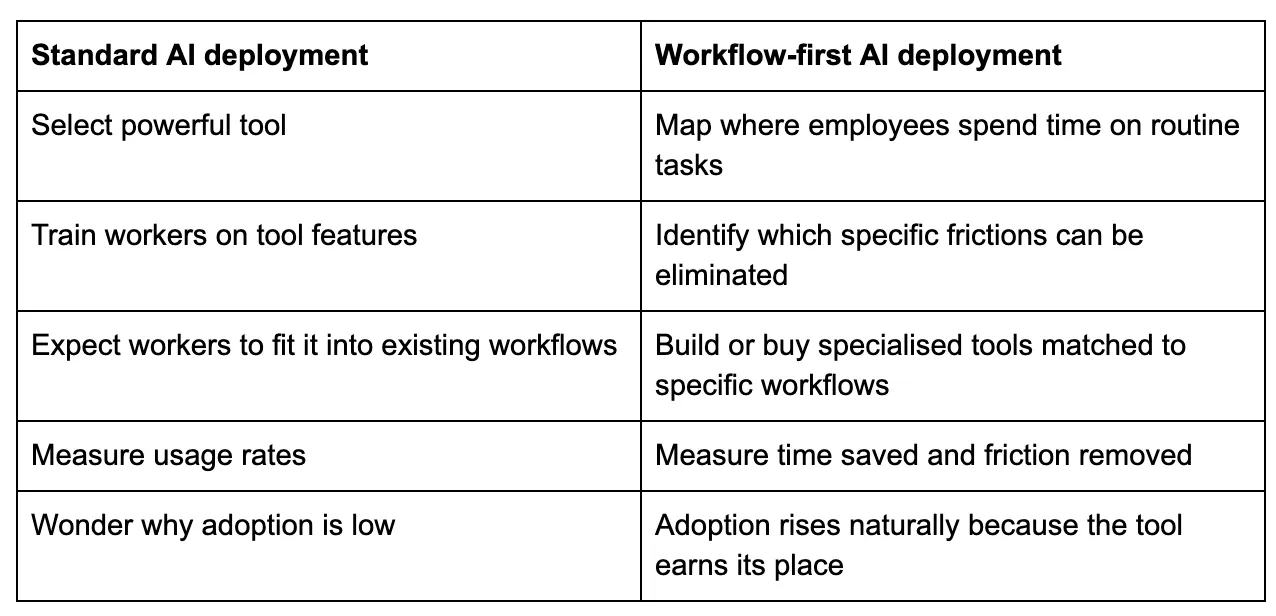
The second column requires more upfront work. It also produces dramatically different outcomes. The companies that skip this step end up with the 50% adoption rates and 1% maturity rates the broader data describes.
The Walmart playbook applies far beyond retail. Any organization with frontline or operational workforces (manufacturing, hospitality, logistics, customer service, healthcare), faces the same silicon ceiling. The principles transfer.
Before evaluating any AI tool, map where frontline employees actually spend their time on routine, repetitive, or coordination-heavy work. The map is the buying spec. Without it, every tool sounds impressive in the demo.
Specialised AI tools matched to specific workflows consistently outperform generic AI platforms on the frontline. Generic platforms require workers to discover use cases. Specialised tools deliver the use case at the moment of need.
Frontline workers can't take afternoons off for AI training. The training has to happen in the workflow; Through in-app guidance, peer coaching, brief huddles, micro-learning in the moments between shifts. L&D programs that try to apply knowledge-worker training models to frontline populations consistently underperform.
The right metrics at the frontline are concrete and observable: time saved on specific tasks, reduction in friction at specific workflow points, improvement in service quality, drop in errors. Usage rates measure activity. Time savings measure value.
The associates who know the workflow best are the ones doing it every day. Walmart's tools were not designed in a head office and pushed down. They were designed with input from the people doing the work. The companies that skip this co-design step typically build tools nobody uses.
Most AI rollout failures at the frontline trace back to the same root cause: the organization tried to add AI to existing work instead of redesigning the work around AI. The silicon ceiling is not a technology problem. It's a design problem.
The companies breaking through that ceiling are doing the harder work of mapping workflows, identifying specific frictions, and matching specialised AI tools to specific operational realities. The result is not just better adoption. It's better work.
For HR and L&D leaders, the implication is clear. AI strategy for frontline populations is a workforce design exercise as much as a technology selection exercise. The function that owns capability building, workflow analysis, and change management: L&D, should be central to it, not downstream of it.

We offer a scalable employee training solution. It lets you continuously upskill your people.
Book a call
"AI is a key enabler in improving how we work, and we believe its full potential is unlocked only when paired with the strengths of our people."


Close skill gaps, accelerate growth, and future-proof your workforce.




Frontline AI pilots typically fail because organizations select powerful AI tools and expect workers to fit them into existing workflows that weren't designed for AI. Frontline conditions like shift-based work, diverse language profiles, operational time constraints, and skepticism from prior tech rollouts break the standard "deploy tool, train workers" approach. Successful frontline AI requires redesigning workflows around AI, not adding AI to existing workflows.
The silicon ceiling is the wall AI hits when it moves from executive demos to frontline operational reality. Despite 92% of companies increasing AI investment, only about half of frontline workers regularly use AI tools, and just 21% receive the training they need. The ceiling isn't built by technology, it's built by how organizations deploy AI without redesigning the workflows it needs to support.
Knowledge worker AI typically augments tasks performed at a desk over hours: drafting, research, synthesis, analysis. Frontline AI must integrate into shift-based, time-constrained, physically active work where there's no opportunity to pause for training or experimentation. Frontline AI must work in 30 seconds or less, accommodate multilingual users, and respect the operational rhythm of the work. Most enterprise AI tools are not designed for these constraints.
Workflow-first AI design starts by mapping where employees actually spend their time on routine or friction-heavy work, then matches specialised AI tools to specific workflow challenges. It inverts the standard "select tool, then expect workers to adapt" approach. Walmart's tools are the most visible example: specialized, embedded in existing apps, matched to specific operational realities like task prioritisation or multilingual customer interaction.
Build training into the work, not adjacent to it. Use in-app guidance, peer coaching, brief shift huddles, and micro-learning in the moments between tasks. The classroom or LMS-driven training models built for knowledge workers consistently underperform on frontline populations. Pair training with workflow redesign so the AI tool reduces friction the moment it's introduced instead of after a multi-week training rollout.
Roughly half of frontline workers regularly use AI tools, and only 21% receive the AI training they need to use them effectively. This is significantly below knowledge worker adoption rates and represents one of the largest workforce capability gaps in AI deployment today.
Walmart deployed a suite of specialised AI tools for 1.5 million associates, including an AI-directed workflow tool that prioritises and recommends tasks, a real-time translation feature working in 44 languages across text and speech, and other workflow-specific tools accessible through the associate app. Shift planning for overnight stocking dropped from 90 minutes to 30 minutes after deployment.
.webp)


.webp)
.webp)