

Learn how HR can lead the charge in creating a strategic approach to AI integration, ensuring organizations drive innovation without losing sight of their people.
Download now



.webp)
80% of business leaders expect AI to transform their organizations. Only 12% of workers have been trained on it. Just 7% of CHROs have a reskilling strategy in place. The companies racing fastest into AI are mostly skipping the people work that decides whether the technology actually delivers. Three cases show what's at stake: IBM automated its own HR function, Duolingo went "AI-first" and had to backtrack publicly within weeks, and Coralogix grew its upskilling budget rather than its layoff list. The pattern is clear. AI strategy without a people strategy is just shopping.
Executive ambition and workforce readiness are pointing in opposite directions, and the gap is widening.
93% of the leaders best positioned to prepare workforces for AI are not doing so at strategic scale. Meanwhile, AI deployments are happening anyway. Tools are being bought, integrated, and rolled out at companies whose people are not equipped to use them.
This is the gap where most AI initiatives quietly stall, and where some blow up publicly.
IBM made headlines when its CEO publicly described using AI to replace hundreds of employees. The detail that received less attention was which function got automated: HR.
IBM now automates 94% of routine HR tasks, including vacation requests, pay statements, and similar transactional work. The freed-up budget was redirected toward hiring more programmers, salespeople, and roles requiring critical thinking.
The strategic risk in this approach is structural. HR is the function best positioned to lead AI transformation across the rest of the workforce. Removing it as the first move means the company is now pursuing AI rollouts without the strategic capability to manage the human impact. Short-term efficiency, longer-term capability gap.
This is the trade-off most rarely articulated: cutting HR to fund tech investment looks rational on a spreadsheet, but it removes the function responsible for making the tech investment pay off across everyone else.
Coralogix took a different path. Rather than treating AI as a headcount-reduction tool, the company used it as a workforce redesign tool.
The mechanics: Coralogix reduced planned hires for repetitive roles while redeploying existing staff into customer success and analytics positions. Their upskilling budget grew rather than shrank because, in Rantser's framing, "redeploying people is cheaper, and kinder, than replacing them."
This is the model most AI strategy decks miss. AI automating routine work doesn't require shedding the people doing it. It frees them up for higher-value work, provided the company invests in the upskilling that makes the transition possible. Without that investment, the choice becomes binary: cut or stagnate. With it, a third option opens: reallocate.
Duolingo's experience is the most instructive of the three, partly because the failure mode was so public.
The company announced it would become "AI-first," replacing contractors with AI and requiring teams to justify human hires. The internal logic was probably sound at a budget level. The external reception was not.
Users threatened boycotts. Social media filled with criticism. Within weeks, the company publicly backtracked. CEO Luis von Ahn clarified that he doesn't "see AI as replacing what our employees do" but rather as "a tool to accelerate what we do."
The lesson sits in the speed of the reversal. The company didn't just lose a marketing cycle. It demonstrated, in real time, what happens when AI strategy is announced without the people strategy and customer trust frameworks in place. Customers do not separate "AI automation" from "loss of human touch" and brands that signal the former without managing the latter pay an immediate reputation cost.
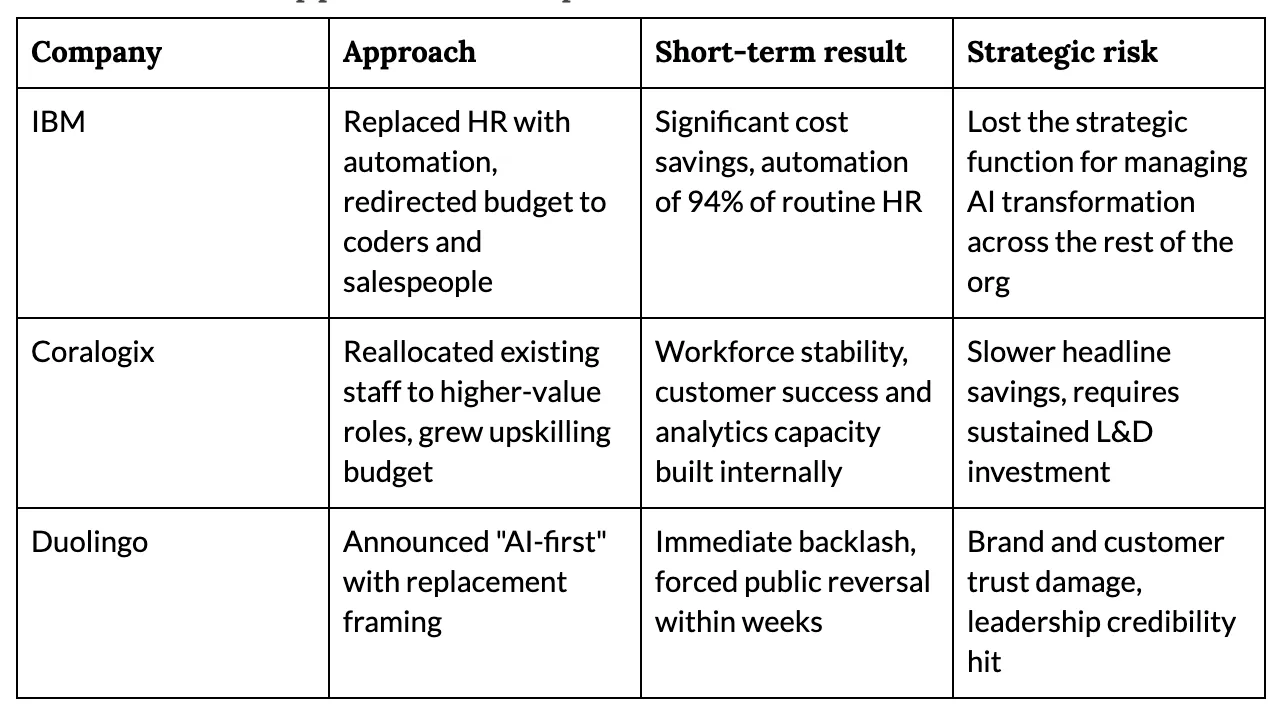
Three different bets. Three different outcomes. The variable that explains the difference is not technology choice. It's how each company handled the human side.
Looking at the contrast between Coralogix and the other two, four principles stand out.
The framing that produces durable AI adoption is "AI augments our people" not "AI replaces our people." The framing matters before the implementation does, because every downstream decision (training investment, role design, communication) flows from the framing.
The companies winning quietly on AI are usually those whose CEOs talk about AI as enabling work, not eliminating workers. Even when the underlying math is similar, the strategic effect is different.
The 12.2% AI training stat is the single biggest red flag in this space. Companies are buying AI tools at speed and training the people who use them at speed-zero.
The Coralogix model "upskilling budgets grew, not shrank" is the only sustainable one. Without proportional investment in capability, AI tools land in the hands of people who can't use them well, the productivity gains never materialise, and the rollout becomes the kind of failed pilot that shows up in the 95% failure rate research.
The Duolingo backlash is a leadership warning, not just a marketing one. Employees and customers read AI announcements the same way: as a signal about how the company values humans relative to technology.
Companies that lead AI rollouts with trust-building (transparency about what changes, what stays, what's being invested in) tend to land them. Companies that lead with mandates ("AI-first," "justify human hires") tend to face exactly the backlash Duolingo experienced.
IBM's approach removed the strategic capability for managing AI transformation across the rest of the workforce. Whatever the spreadsheet logic, the structural cost is real.
The pattern across companies that successfully scale AI internally: HR and L&D are treated as central to the strategy, not peripheral to it. Often it's the HR function leading the change management, the manager training, the redesign of jobs, and the workforce data analysis that makes the rollout actually work.
The data tells a hard story. 7% of CHROs have a reskilling strategy for AI-exposed jobs. AI investment is being approved by boards faster than people strategies are being built to absorb it. Most companies will spend the next two years discovering the gap the data already shows.
The HR leaders who get ahead of this don't need to outpace IBM on automation or out-spend Duolingo on AI announcements. They need to build the workforce capability that makes the technology investments actually pay off. Upskilling at scale. Manager AI development. Trust-building around adoption. Role redesign that creates new value rather than just eliminating old roles.
The companies winning the AI transition will be the ones whose HR functions led it. Not the ones whose HR functions got automated first.

We offer a scalable employee training solution. It lets you continuously upskill your people.
Book a call
"Rather than head-count cuts, we reallocate."


Review by:
This article explores why many AI initiatives fail to deliver business value and explains how organizations can close workforce capability gaps through a structured, skills-first approach to AI transformation.
Close skill gaps, accelerate growth, and future-proof your workforce.




Duolingo announced an AI-first strategy that included replacing contractors with AI and requiring teams to justify human hires. Within weeks, users threatened boycotts and the company faced significant social media backlash. CEO Luis von Ahn publicly reframed AI as "a tool to accelerate what we do" rather than "replacing what our employees do." The reversal showed how quickly AI replacement framing can damage brand and customer trust.
Only 12.2% of workers received AI training in the past year, even as 78% of leaders plan to increase AI spending. This training gap is the single biggest indicator of why AI rollouts stall: tools are being deployed faster than capability is being built, leaving employees unable to use them effectively.
AI replacement removes employees whose tasks are automated. AI reallocation redeploys those employees into higher-value roles, supported by upskilling investment. Coralogix's VP HR Talia Rantser describes reallocation as "cheaper, and kinder, than replacing them." Reallocation requires sustained L&D investment but preserves institutional knowledge, customer relationships, and workforce trust.
The data points strongly toward reskill. Replacement creates immediate cost savings but produces long-term capability gaps, knowledge loss, and trust damage. Reskilling and reallocation preserve workforce capability and tend to produce better adoption outcomes — though they require sustained investment in L&D. The most successful AI adopters grow their upskilling budgets alongside their AI budgets, not in opposition.
HR leads AI transformation by treating it as a people strategy first and a technology strategy second. Concretely: building AI literacy across the workforce, developing manager capability for leading AI-augmented teams, redesigning roles around new AI workflows, embedding psychological safety so employees can experiment and surface mistakes, and measuring AI ROI through leading indicators (confidence, adoption, behaviour change) rather than just usage rates.
Lead with trust before mandates. Communicate what AI will change and what stays human. Invest in upskilling proportional to AI tool investment. Frame AI as augmenting work rather than replacing workers. Involve HR and managers in scoping AI deployments, not just IT. Companies that announce AI-first strategies without these foundations often face the kind of public backlash Duolingo experienced.
The most common AI adoption mistakes are: implementing AI tools without training the workforce to use them (only 12% of employees have received AI training while 78% of leaders are increasing AI spend), positioning AI as headcount reduction rather than workforce redesign, automating HR or L&D functions before deploying AI elsewhere (removing the function meant to lead transformation), and announcing AI strategies publicly before building employee and customer trust frameworks.
.webp)

.webp)