

Use Lepaya's skills gap analysis tool to uncover the critical skills your teams require.
Start now



.webp)
• The 9-box talent grid is a popular tool used by companies to measure employee performance and identify leadership potential.
• The grid categorizes employees based on their performance and potential, helping organizations make strategic talent management decisions.
• The 9-box assessment template contains nine categories that assess both current performance and future potential.
• The model provides benefits such as easy visualization, talent identification, and support for employee development.
• However, limitations include reliance on traditional performance management, potential bias, and slow talent identification processes.
Today, driven by labor shortages and the fierce competition to find and retain the right people, many companies feel the need to step up their game when it comes to their talent management programmes. Identifying and assessing talent pools is part of this. One way to get the job done is by using the 9-box talent grid. This well-known HR tool is used to measure employee performance and identify leadership potential. In this article, we’ll define the nine-box talent review and take a look at its benefits. However, although the 9 box grid provides a clear way of managing talent and performance, it’s not undisputed. Let’s dive in.
The 9-box grid or matrix is a popular talent management model that enables companies to measure employee performance and identify people with various levels of potential in a standardized way. The nine-box matrix (or in short: HR 9 box) divides staff members into nine groups, based on how they perform and what their future potential is within the organization. Part of the popularity of the 9-box assessment is that it can be used to make important, strategic, and financial decisions. For instance: by inventorizing talent and quantifying talent gaps, HR executives can improve their talent management programs and work together with L&D to make sure people get the right training, coaching, and mentoring they need to succeed. This people analytics model also helps identify potential risks, pinpoint and empower leaders in the organization, which is useful for succession planning and internal mobility. Finally, it can play an essential role in formulating or fine-tuning the internal and external talent recruitment strategy.
Using a grid or matrix to back up investments and define business strategy is nothing new. In 1968, the Boston Consultancy Group (BCG) developed the growth share mix, a portfolio management framework that helped companies decide how to prioritize their different businesses. Anybody who has ever paid a bit of attention during economy class in school is probably familiar with the terms ‘cash cow, ‘star’ and ‘dog,’ that derive from that model. Not long after that, General Electric asked its consultant McKinsey to create a similar matrix to identify key investments and compare different business units. The process later evolved into an HR tool to assess employee performance and potential within the company using a 9-box rating system. The use of this 9-box employee evaluation became internationally known because of the legendary Jack Welch of General Electric. In his role as CEO, he put a strong emphasis on increasing performance by attracting and retaining the right people, but also on ruthlessly saying goodbye to those who did not fit into the organization.
Nowadays, as the world of work is rapidly evolving and the talent shortage is getting worse, organizations not only need to rethink the way they recruit, retain, and reskill their people, but also how they analyze performance potential. They need to take a critical look at their talent investment decisions, succession planning, and talent management programmes in order to keep their employees happy and engaged – a key for future business success.
The 9-box assessment template contains nine categories (boxes) that are arranged in a three-by-three matrix. The horizontal axis indicates an employee’s current performance level and the vertical axis indicates someone’s potential from low, to medium to high. The nine different boxes each have their own characteristics and attributes. Using this template, the names of individual staff members can then be put in the grid during their performance appraisal. Future potential can be measured by asking a number of 9-box assessment questions, that evolve around the following KPIs:
The higher a person falls in a box, the more growth potential they have; the further they fall to the right, the better their performance ratings. Those who end up at the low side of the grid have less potential; and the further to the left they fall, the worse their performance ratings.
In other words, with the 9-box analysis, the value of each staff member can be mapped out at a glance. Often, organizations use custom shapes, colors, and names for the different boxes. This way, they can better define what each performance and potential level means to them. Here’s a box planning example that is commonly used by HR, talent management professionals, and succession planners:
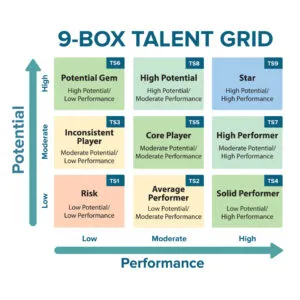
So what do the different categories of the 9-box review mean exactly? And more importantly, how do you manage them and take action? Let’s take a look.
Employees who fall into this category are also referred to as ‘risk’ or even less elegantly, ‘bad hires.’ They rarely meet expectations, fail to produce the right quality of work, and are not likely to ever exceed their current work level.
Take action: an employee who falls into this box requires a lot of attention and training to improve their performance. It’s probably not very smart to invest much time and money in them. They either need to be let go or reassigned to another role or department to improve their performance and boost overall morale in the company. It may also be necessary to take a critical look at talent recruitment and hiring procedures when more and more staff fall into this box.
These types of employees, often called ‘backups’ or ‘average performers’, lack some essential skills and hardly show any potential for future growth, but do an average job.
Take action: this group needs some extra support from their managers. They can help to identify their weaknesses and points of improvement through a personal development plan, but only up to a certain level. If there’s no progress, then it’s no use in overinvesting in them. In that case, it’s better to create an exit plan and help them find a job that better matches their skills and ambitions.
Also called ‘workhorses’ or ‘specialists’, these employees (usually somewhat older generations) are great in performing their jobs, but probably reached the limit of their career or leadership potential – and are quite comfortable with that.
Take action: these people are not keen on promotions or extra responsibilities, so it’s not necessary to push them in that direction. They are happy where they are, but it might be necessary for HR to analyze how their work will change in the future and help them prepare for that. After all, to be a future-proof organization, it is vital to continuously improve the knowledge and skills of employees.
This group is also referred to as ‘inconsistent performers.’ They are able to deliver satisfactory results and show the potential to lead, but not in a consistent way (yet).
Take action: to improve their performance and leadership skills, this group requires extra training and coaching.
As they are right in the middle of the 9-box grid, these people are considered ‘core players.’ They are quite capable of doing a reliable job and have demonstrated their desire for growth, but might encounter some issues in developing their full potential.
Take action: this group will benefit from additional coaching and mentoring, for instance by their managers or peers who can help them reach the next level.
Also named ‘high performers’ or ‘toppers’, these talents are already in a good place, but can still make some steps in terms of their leadership skills.
Take action: the key is to keep this group happy, motivated and enable their growth with peer coaching by for instance high potentials or ‘stars’ within the company.
Employees in this category can still perform better at their job but show high potential. That’s why they’re considered ‘potential gems’ or ‘dysfunctional geniuses’. They are usually starters or management trainees, are eager to learn, and can considerably contribute to a company’s future success.
Take action: this is a very interesting group as it contains a lot of talent. They just need more practice and experience, which can be provided with training and one-on-one coaching. Communicating clear expectations is vital.
These so-called ‘high potentials’ or ‘future stars’ perform well enough in their current role, but still, have the potential to do better and grow to the next level.
Take action: assign them with challenging tasks and assignments to help them reach their maximum potential and stay sharp. However, also appreciate that high performers not necessarily desire a promotion or even more responsibility – and that’s fine too, as they are already valuable assets to the company.
These ‘stars’ perform consistently in a variety of roles and projects, are able to solve problems independently and usually are very ambitious. They too are valuable employees that could be up for succession and can be a part of the company’s higher management in the future.
Take action: it pays off to invest considerable time and money in these talents. Check-in with them on a regular basis to evaluate if they’re still happy and engaged, as these people are likely to be chased by recruiters and competitors.
When used correctly, the 9 box grid for talent management can help companies determine where and how to invest in talent, with the right data to back it up. It helps senior management and leaders to better understand employee performance, and who to keep an eye on for succession planning. With a comprehensive overview of the organization’s talent, the 9 box talent review gives companies a holistic view of talent development needs. Other significant benefits include the following:
Would you like to help your employees develop? Lepaya provides impactful training and upskills your workforce to its full potential!
Although the 9 box talent management grid provides a clear way of analyzing a company’s talent pool, it also has some potential pitfalls.
The talent management process tends to be very slow. If your main way to identify talent is by talking to the senior managers in the organization, you will have to spend a lot of time collecting and calibrating the data.
Fortunately, talent identification can be supported by clever technology today, which makes you less dependent on the subjective and biased views of managers.
Tom Haak, HR Trend Institute
The 9 box method can be a useful tool to develop and cultivate talent in a straightforward way. Having a clear and transparent overview of talents and potential leaders within the company can help build a sustainable, competitive advantage and improve processes that involve succession planning, talent management and overall performance. But labeling people should not be the intention of this method, and that is where the risk lies. It is therefore important to constantly evaluate performance methods and communicate transparently about the question if they still fit within the organization.

We offer a scalable employee training solution. It lets you continuously upskill your people.
Book a call
.webp)


Review by:
This article explores why many AI initiatives fail to deliver business value and explains how organizations can close workforce capability gaps through a structured, skills-first approach to AI transformation.
Close skill gaps, accelerate growth, and future-proof your workforce.




.webp)
.webp)

.webp)