Quel est le nom Lepaya ?
.webp)
The history of a name
A name can have a very direct meaning, like Volkswagen, which is literally a car for the people. Alternatively, it can have a derived meaning, like Google. As a purposeful misspelling of googol, which stands for a 1 with 100 zero’s, Google symbolizes the huge quantities of data its founders aimed to make available to everyone. Lastly, there are names that just sound great. One of the most famous examples is Alibaba. During a New York visit Alibaba’s founder Jack Ma realized Alibaba is a name everyone is familiar with, and it has a great ring to it. At the very least, the Sesame Open reference resonated with shoppers, who opened their purse to the tune of more than 25B dollars during last Singles’ Day alone.
Why the name Lepaya?
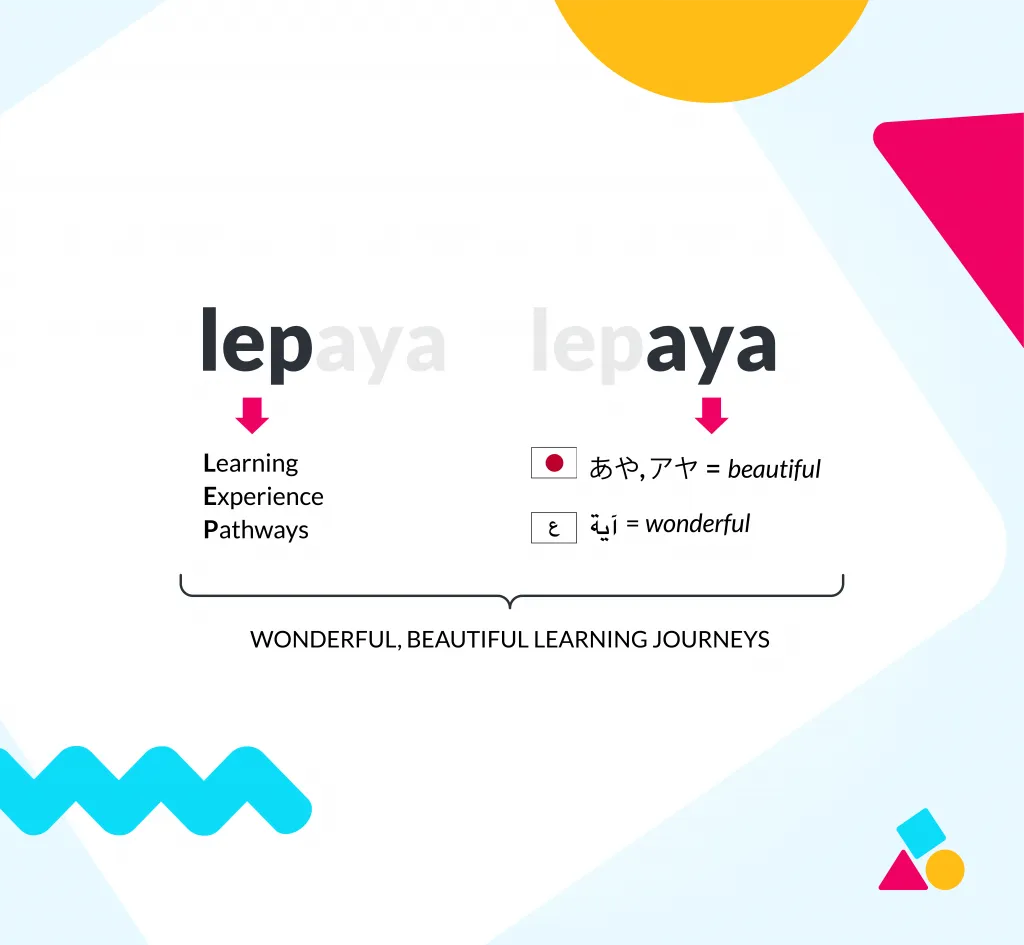
Mid-2017 the time had come to name the venture we had been working on. This being 2017, we started with the need for an available dot-com registration, already disqualifying a staggering 130M+ more (and less) common names. Secondly, never settling for anything less than great, we wanted a name that had significance as well as a catchy sound! For the first part we chose for LEP which stands for Learning Experience Pathways.
To create a name with a nice ring to it, we added aya to LEP. In Japanese aya is a female name meaning beautiful (あや, アヤ), and in Arabic it means wonderful ( آية ). Adding the two up gives Lepaya: wonderful, beautiful learning journeys!
As soon as we had our name, we realized that just a name isn’t enough. Even a start-up without business cards and (at that point in time) without a website, needs a logo. Our philosophy for Lepaya and all Lepaya products and materials is based on three simple characteristics:
1) Fun — because learning is always important but never urgent. Making learning fun will increase engagement.
2) Analytical — because any learning solution needs to actually be pedagogically sound and teach relevant content, ideally while maximizing learning with minimum effort.
3) Easy to use — because spending time and effort learning how to use a learning solution seems counterintuitive and therefore should be avoided at all costs.
When thinking about fun, analytical and easy to use a toddlers’ box jumped to mind, with its multi-shaped holes on all sides through which small and colorful shapes need to fit. An impactful learning game, living up to all our three characteristics. The box itself gave way in the design process, resulting in a beautiful, clean logo.
Questions, comments or suggestions? Visit lepaya.com, enter below, or email us at info@lepaya.com.

Nous proposons une solution évolutive de formation des employés. Elle vous permet d'améliorer en permanence les compétences de votre personnel.
Réservez un appelRelated articles

.webp)
Révision par :
Comment les RH peuvent mesurer l'impact : Wendy van Tol, PwC, à propos de la « théorie du changement »
Wendy van Tol explique comment les responsables des ressources humaines peuvent utiliser le cadre de la théorie du changement pour traduire les initiatives en ressources humaines en une valeur commerciale mesurable.
.webp)
Révision par :
Réflexions sur Unleash : Comment les organisations préparent-elles leurs employés à l'IA ?
L'IA modifie la main-d'œuvre, mais pas sans risques. Alors que les postes d'entrée de gamme disparaissent et que la cognition humaine décline en raison d'une dépendance excessive à l'égard de l'IA, les dirigeants doivent trouver un équilibre entre le perfectionnement des talents et la résilience des compétences.

Révision par :
Jeroen Kraaijenbrink: How organizations can overcome the honesty gap
Senior leadership and boardroom teams invest heavily in commercial strategies to win market shares. Yet the most important and honest information driving strategy circulates in teams underneath, never making it to the table where decisions are made.Jeroen Kraaijenbrink, Executive Coach and Strategy Consultant at Kraaijenbrink Advisory, has spent years working on what he calls the honesty gap. We sat down with him to understand what the honesty gap actually is, where it lives in organizations, and why fixing it requires a leadership shift.How do you define the honesty gap?There's a narrow definition and a broad one. The broad one is: we have created organizations and systems where it's barely possible to be honest to yourself, about yourself, and honest to other people.Honesty isn't just lying. It's integrity, being authentically connected to other people and being aware of your own emotions and your own biases.The honesty gap, in a narrow sense, is the fact that truth and information don’t travel vertically upwards in a company. It's often hard to speak openly to your manager because it’s become rational not to. Many people have the experience: 'I've tried it once but then I was punished for it, or was ignored, so let it be, never mind.' That's the fascinating part: it's not good for people, it's not good for organizations and yet we somehow keep this system intact.Is it less about individual dishonesty and more about a collective culture?A lot of the most important information going through your company is between people and in conversations. You need to find a way to have an honest conversation, where the things that matter get on the meeting table, not just in the informal circuit. And I think that's pretty rare.A more systematic definition is that we're not using the collective intelligence of a company enough. We can radically improve it because we’ve made it rational to hide the truth and to keep things to yourself. A lot of it may not be intentional, but the very fact that someone is in a position above you automatically creates this tension: 'What do I show? What don't I show? Because my next performance appraisal is coming up.'Where does the honesty gap typically show up first, and who owns the problem?It starts with leaders. Solving it needs one leader at the top, the CEO at least, being open and reflective enough to admit that there is an honesty gap and that they are part of it. That's the self-reflection you need for any improvement and any change. Like in coaching: you need to be aware that there is stuff to improve. You don't need to be a perfect leader, but you need to be open enough to admit that there is an issue.You talk about the 'persona trap', what is that?You're stuck in a persona where you perform in a certain way within your company. You have a role, a position, a reputation, and that locks you into specific behaviors. The worse the match between who you are as a person and how you need to show up in your organization, the more inner conflict that’s created. Especially at the top, it’s a problem for many executives. They're supposed to be the people who know it all and be decisive. While if you're honest, you don't necessarily know everything, you’re uncertain and have anxieties.The inner core of the honesty gap is breaking the performance, breaking the acting you feel you must do. If you've put yourself in a role of being the strong, decisive, number-oriented leader, that's how you have to behave. But most people don't feel very comfortable in that kind of role because it's not who they are.Can you fix the honesty gap through individual coaching alone or does the system have to change?Part of it is a personal change, part of it is a system change. You can be on your own and be very authentic, but if the system doesn't change at all, you’ll struggle to break the honesty gap.What you need to do is work on the people, the culture, and the system. Ideally that has to include the top, because otherwise it stays at the level of the person being coached. If it's a team lead or a mid-manager, that person can partly create an island in the organization, a safe space for their team and their department. But still, the appraisal systems, objectives, and culture are company-wide. Why is this so hard to shift, even when leaders recognize the problem?We have normalized this idea that you have to be strategic in what you tell and what you show. You have to show up in a certain role at work. It's also the result of how we have separated work from life, which is a very unnatural thing. It's from the industrial age, because for any other species, work is life. But now there’s a split between work, with all the routines in companies, and then your private life. There's just one you, you're the same person at home as you are at work. The good news is that the honesty gap can be closed. While many companies have unintentionally created environments where people hesitate to speak openly, organizations prioritizing trust, authenticity, and psychological safety can unlock a competitive advantage. When employees feel safe to share concerns, ideas, and perspectives, collective intelligence grows, decision-making improves, and stronger relationships emerge across every level of the business.
Ready to drive impact together?
Close skill gaps, accelerate growth, and future-proof your workforce.




.webp)