

Discover our new AI leadership training program and how it is built for organizations ready to move beyond AI awareness into real, measurable transformation.
Discover more



As AI adoption accelerates and economic pressures intensify, companies face a pressing question: which human capabilities actually matter when the nature of work itself is changing?
To uncover the answer, Lepaya's annual State of Skills report analyzed upskilling data from 196 global enterprises and nearly 28,000 learners, revealing significant changes in where organizations are concentrating their training investments, and what they're leaving behind.
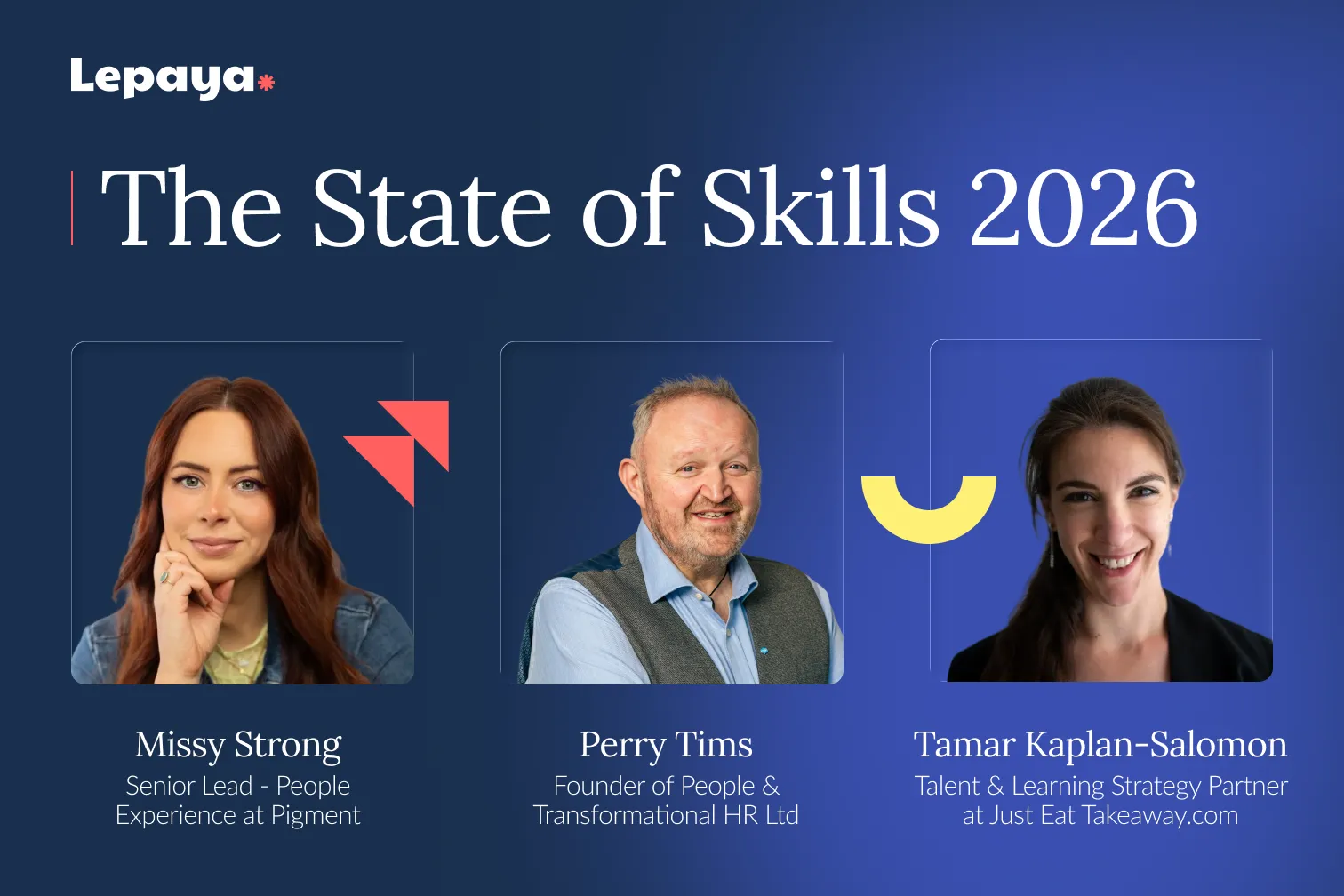
In a recent panel discussion, Tamar Kaplan-Salomon, Talent & Learning Strategy Partner at Just Eat Takeaway.com, Missy Strong, Senior Lead - People Experience at Pigment; and Perry Timms, Founder of People & Transformational HR Ltd., dived into the report's key findings and discussed what they mean for building competitive advantage in 2026 and beyond. Here's what emerged from the conversation.
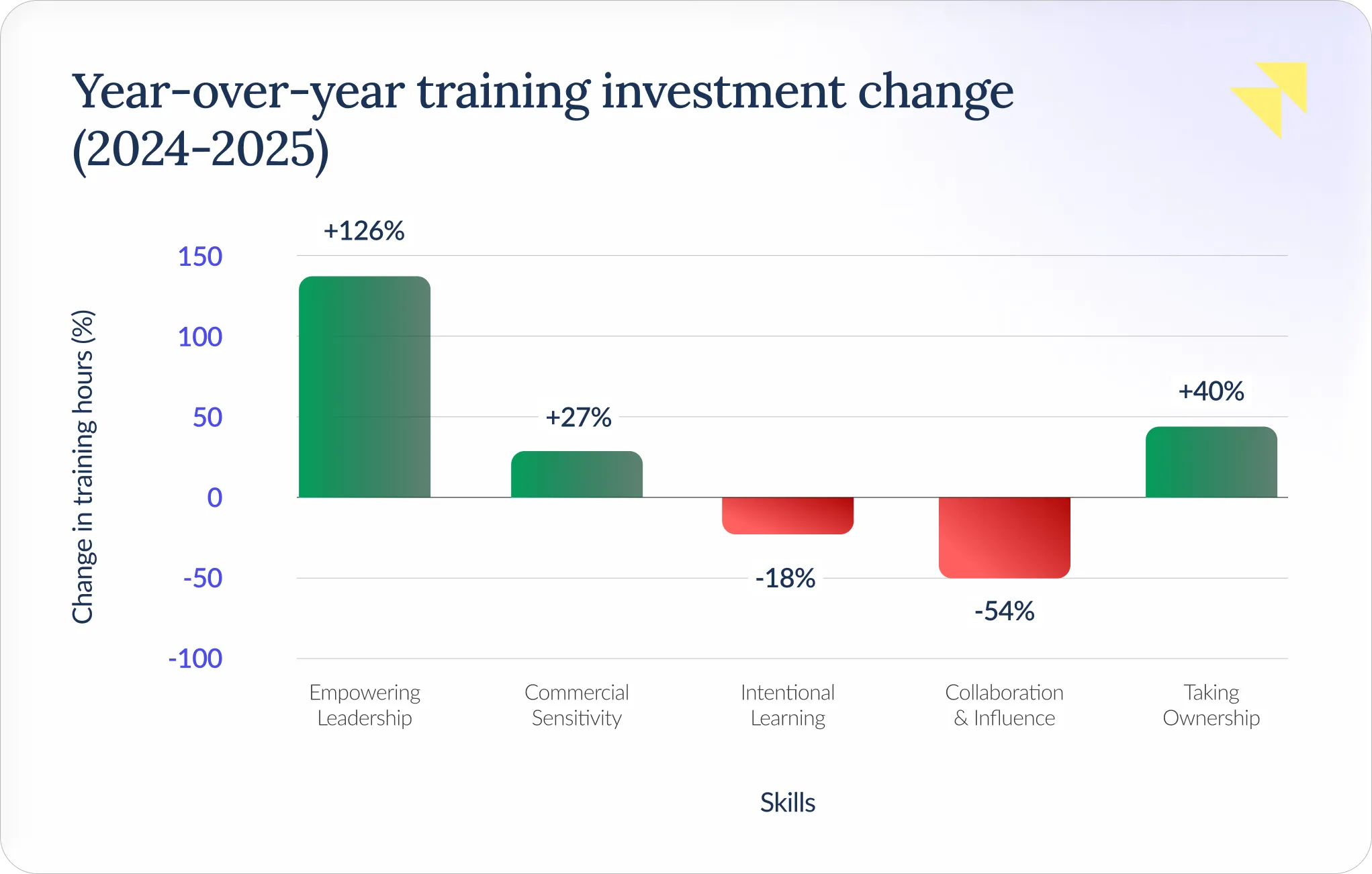
Empowering leadership training investment has grown continuously for three years and now accounts for more than half of all training hours, surging another 126% from 2024 to 2025.

The panel explored why organizations keep accelerating this investment, and the answer lies in how much the manager's role has fundamentally changed:
“There is no playbook. We've got to build it as we go,” as explained by Perry Timms.
He argued that what organizations need is a shift from "know it all" to "learn it all" management: leaders who admit uncertainty, create space for their teams to contribute, and measure their success by what their team can do, not what they personally control.
However, in practice, making this shift stick is harder than it sounds.
Tamar Kaplan-Salomon, who leads talent and learning strategy at Just Eat Takeaway.com, faced a challenge that will feel familiar to many L&D professionals: managers genuinely wanted to develop new skills, but consistently had to deprioritize learning when delivery pressure hit.
Working with Lepaya, her team designed a leadership training program focused on the human side of management: coaching, feedback, impactful communication, and well-being. To make sure managers actually showed up, participation was made mandatory. Managers could choose which two out of four modules to complete, but were asked to base that choice on where they had the most room to grow rather than what felt most comfortable.
“We told them, speak with your manager about the topic where you can grow the most. Not what you like the most, but where you can genuinely improve,” Tamar explained.
.webp)
After the program, managers reported both applying new skills and feeling more confident doing so. As Tamar noted, knowing a skill and feeling capable of using it are two different things, and it's the second one that determines whether learning actually changes behavior.
For the first time since Lepaya began tracking upskilling data, taking ownership entered the top five trained skills, growing 40% year-over-year in training investment. This skill refers to the ability to proactively spot opportunities, make decisions independently, and move things forward without waiting for direction or approval.
Taking ownership has always been valued, but what's changed is that organizations are now treating it as something that needs to be deliberately built, and the reason connects directly to the leadership trends above.
As management layers thin out and teams become more distributed, the support structures that once helped people navigate uncertainty have largely disappeared. Fewer managers means fewer touchpoints, and individuals need to exercise more judgment on their own.
Missy Strong, Senior Lead - People Experience at Pigment, has built this expectation into how her company operates from day one:
“When people come in, we want them to think like a founder,” she said.
Every new joiner's onboarding includes a walkthrough not just of what the company's goals are, but of the philosophy and values behind them. The goal is to close the psychological distance between individual decisions and company direction as early as possible, so people can act with confidence rather than waiting for permission.
AI is adding both opportunity and complexity to this. Individual contributors can now build, automate, and problem-solve at a scale that used to require entire teams. But that expanded capability demands stronger judgment about when and how to use it.
As Missy put it: “Taking ownership really comes down to three things: focus, efficiency, and your control of output. And the organizational design choice you make is either going to enable those things or kill them.”
Most organizations are actively using AI for productivity, but not all are at the stage where AI is structurally embedded in how work gets done. The gap between those two stages is where the real challenge lies.
The panel pushed back on the assumption that more AI training is what closes it. The mistake Missy sees most often is organizations treating awareness as adoption: running prompt engineering workshops for hundreds of people, tracking how often employees use AI tools, and calling it an enablement strategy.
Instead, three things emerged from the conversation as what actually moves organizations forward:
1. Critical thinking over tool fluency
Tamar argued for what she called a “curiosity umbrella”: AI literacy matters, but employees also need the mindset to scrutinize outputs, question accuracy, and decide when AI is actually useful for the task at hand. Mandating AI usage without building critical thinking around it creates speed without quality.
2. Role-specific application
Adoption sticks when AI is embedded in real workflows rather than introduced through generic training. The shift happens when employees can see clearly what AI means for their specific role, not for everyone in the organization.
3. Experimentation as a structured practice
Perry's framing was that the capability organizations most need to build is experimentation itself: contained environments where teams can test ideas, make mistakes safely, and accumulate real evidence about what works. “Give people a great piece of work where they've got to test their critical thinking, where they can make mistakes and learn in real time,” he said.
AI will raise the floor for every organization. But the ceiling is still determined by the human capabilities built on top of it, and that's where the real work is.

We offer a scalable employee training solution. It lets you continuously upskill your people.
Book a call



Review by:
L&D must shift from being seen as a cost center to a strategic business enabler by aligning learning initiatives with company goals, using data-driven narratives to secure executive buy-in, and demonstrating measurable impact on productivity, revenue, and retention.
Close skill gaps, accelerate growth, and future-proof your workforce.




.webp)
%2520(1).webp)

.webp)