

Explore the data from 196 global companies and uncover the key skills trends for the year ahead.
Download


.webp)
In the past year, organizations had to navigate a workplace that looked fundamentally different from just a few years ago. Management layers were disappearing as companies pursued flatter structures. Remote and hybrid work had become permanent features rather than temporary experiments. AI tools were democratizing capabilities once reserved for specialists, putting powerful technology in everyone's hands.
In this environment, a surprising capability has emerged as business-critical. Based on analysis of 27,746 learners across 196 global enterprises, Lepaya's The State of Skills 2026 report reveals taking ownership has broken into the top five most-trained skills for the first time, with training investment growing 40% from 2024 to 2025.
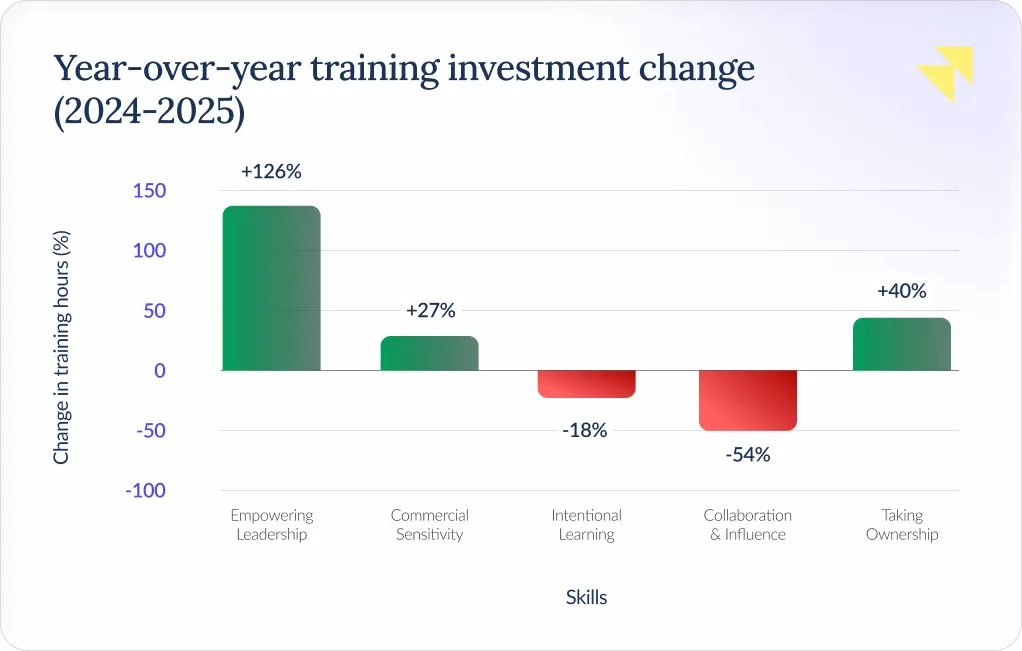
What's driving this shift? And more importantly, what does it mean for how organizations should develop their workforce in 2026 and beyond?
Taking ownership upskilling focuses on enabling employees to proactively identify opportunities, solve problems independently, increase their impact, and collaborate effectively without constant oversight. Training can include skills such as taking initiative, managing stakeholders, thinking creatively, or leading change.
But what makes ownership different from traditional "accountability" or "responsibility" upskilling? The distinction matters:
Responsibility means completing assigned tasks. Accountability means answering for results. Ownership means taking initiative on the work itself: spotting problems before they escalate, proposing solutions without being asked, and driving outcomes without waiting for direction.
The skills that enable this independence cannot be developed through on-the-job experience alone; they require deliberate training and practice.
“Work itself is becoming less about task completion and more about judgment.
The value people bring now lies in how they interpret information, connect dots, and decide what matters. You can’t meaningfully separate “doing the work” from “owning the work” anymore.” - Missy Strong, Senior Lead - People Experience at Pigment
The 40% increase in taking ownership training reflects three workplace shifts that have made self-directed accountability a business-critical priority.
Between May 2022 and May 2025, the number of managers at public companies declined by 6.1%. Major organizations, including Meta, Intel, Google, and Amazon reduced management layers to enable faster decisions and lower overhead costs.
This "Great Flattening"changes daily workflows. With fewer layers between executives and individual contributors, employees must understand their scope of responsibility and take initiative without supervisor direction. The informal escalation paths that once existed through multiple management tiers have disappeared, requiring employees to develop new capabilities for autonomous operation.
“When there are fewer managers assigning work or acting as decision bottlenecks, ownership has to live within teams and individuals.
Accountability doesn’t disappear; it moves closer to where decisions are actually made.” - Missy Strong, Senior Lead - People Experience at Pigment
With fewer than 10% of employees preferring fully on-site work, the informal coordination that happened spontaneously in offices has vanished. Hallway conversations that once resolved confusion quickly, casual check-ins that flagged problems early, and spontaneous collaboration across teams now require deliberate effort.
Remote work offers significant benefits in flexibility and autonomy. However, it also demands that employees proactively communicate, clarify boundaries, and take initiative without relying on physical proximity to colleagues and managers. The shift from implicit to explicit coordination requires different skills.
AI tools have made previously specialized capabilities accessible to non-specialists. Employees can now handle coding, design, data analysis, and content creation tasks that once required dedicated experts. This democratization creates opportunities to add value and drive productivity beyond core job responsibilities.
However, realizing this potential requires ownership skills. Employees must independently identify where AI can help, experiment with new tools, and take initiative without waiting for permission or formal training. The technology provides capability, but human ownership determines whether that capability creates value.
When hierarchies flatten, teams distribute, and AI expands what individuals can accomplish, ownership cannot flow through traditional reporting lines.
This demands a strategic response from HR and L&D teams:
Ownership skills cannot flourish in environments designed for top-down control. HR and L&D must work with business leaders to redesign roles that genuinely require autonomous decision-making, then provide the training and support that enables employees to succeed in those roles.
“Organizations are starting to rethink work design, not just roles. Instead of asking “who should do this?”, they’re asking “how should this work exist at all?” That naturally favours people who can take ownership of systems, processes, and outcomes — not just job descriptions.” - Missy Strong, Senior Lead - People Experience at Pigment
As companies continue flattening hierarchies, ownership upskilling becomes essential rather than a nice-to-have. Organizations should plan these investments in parallel, not sequentially. Removing management layers without developing ownership skills creates chaos rather than agility.
The rise of ownership training aligns with evolving workforce expectations. Employees increasingly want autonomy, meaning, and the ability to influence outcomes. They are motivated less by narrowly defined roles and more by impact. This creates an opportunity for HR to meet both business requirements and talent expectations simultaneously.
“Expectations have changed. People increasingly want autonomy, meaning, and the ability to influence outcomes.
They’re less motivated by narrowly defined roles and more by impact. Ownership isn’t just an organisational need it’s also what many employees now expect from good work.” - Missy Strong, Senior Lead - People Experience at Pigment
Employees will only take ownership when they feel safe making decisions and potentially making mistakes. Leaders must explicitly communicate boundaries, which decisions need approval and which can be made autonomously, and reinforce that thoughtful risk-taking is valued.
The rise of ownership training signals a broader transformation in talent management strategies. Organizations that invest strategically in these skills today are building the foundation for agile, resilient teams that can navigate uncertainty without constant direction tomorrow.

We offer a scalable employee training solution. It lets you continuously upskill your people.
Book a call

.webp)
Review by:
Engagement in learning requires personalization, strategic messaging, storytelling, and manager buy-in, with organizations needing to evolve their approach to maintain learner motivation and demonstrate measurable impact.
Close skill gaps, accelerate growth, and future-proof your workforce.




.webp)
.png)

.png)