

Discover how Europe's fastest growing companies are preparing for AI adoption.
Download now




AI has become a leading boardroom priority. 92% of companies plan to increase investment in AI - with total worldwide spend estimated to reach $2.5 trillion in 2026.
But despite substantial investment, many organizations are struggling to translate AI ambitions into business value. Only 5% of GenAI projects achieve return-on-investment and just 1% of organizations claim to have reached full AI maturity.
What is holding organizations back from realizing the full potential of AI?
To explore how HR and L&D Directors can successfully prepare organizations for new technologies, Pascal Struijk, Product Lead at Lepaya, sat down with employee wellbeing platform OpenUp to share his perspective on leadership, capability building, and the psychological realities of AI integration.
Across global organisations, dedicated task forces are managing AI use cases, risk, and governance. With generative AI tools becoming increasingly available to employees, on paper, the conditions for increased productivity exist.
Yet the expected value is not materialising at scale.
Organisations are discovering that technology access isn’t the barrier to unlocking AI’s value. It stalls because the layer of leadership responsible for translating tech strategies into teams’ day-to-day work is underprepared.
Leaders are being asked to decide which AI use cases are worth pursuing, how will teams adopt them, and turn experimentation into business performance. This is why middle managers are the target group that should be upskilled first to maximize the value of AI.
Many executive teams have AI as a number 1 topic on the agenda. Most companies have made generative AI available to the workforce and created a dedicated task force that works on AI use cases.
But where is general leadership in the equation? Beyond individual productivity gains, how does HR make sure that entire teams, domains and departments start benefiting from AI? It has to be a company-wide initiative.
That's why HR teams are increasingly asking, ‘how can we develop leaders’ capabilities to drive AI adoption at scale?’ This is what will make organizations move from AI-aware to AI enabled. Most attention goes to executives, task forces, and individual employees. But the multiplier is middle managers. So the real question is what steps should organizations take to prepare these managers for the AI era?
Pascal Struijk, Product Lead at Lepaya
With middle managers heavily influencing whether AI moves from individual productivity gains to business value, they need new skill sets to work with AI.
These skills included a combination of business judgment, human leadership, AI literacy, product awareness and ethical decision-making to navigate new technologies.
One of the skills that I believe leaders should be very good at is product thinking. There are 15 to 20 potential AI use cases per team. Many will never lead to ROI. Leaders need to understand the outcome, the impact and the risks associated with each AI tool.
That also means that they need skills in analytical thinking and business acumen. But dealing with AI use cases requires them to manage other stakeholders. Therefore, leaders need capabilities in empathy and taking charge. As you can see, it's a rich skill set.
Pascal Struijk, Product Lead at Lepaya
With 32% of workers worried that AI will impact their long-term careers, leaders are also responsible for psychological safety to increase team performance, encourage experimentation and build trust.
What I often see is top-down communication on the AI topic. For example, executive leadership and task forces instruct employees on the ways of working with AI.
The challenge for leaders is to change this and develop the skills to transparently communicate with their team in a way that maximizes adoption and builds psychological safety.
Pascal Struijk, Product Lead at Lepaya
For HR and L&D teams, the scale of AI investment will demand company-wide learning initiatives to successfully connect tech to productivity gains. This means identifying the right skill sets for AI use cases, understanding the available technology and developing the right talent groups that have the most impact on AI adoption.
HR needs to first familiarize themselves with the risks and opportunities of each AI model that’s available to their teams.
Then HR needs to look at the design of the upskilling programs themselves. Once you understand the AI tech in your organization, how can you train middle managers with the skills I mentioned earlier to really take the lead with AI?
Another key point is that AI capability is going to keep moving. It will require HR to continuously survey and train the necessary skills.The first step, however, is going to be the biggest. Once HR starts successfully upskilling leaders, the next steps will become easier.
Pascal Struijk, Product Lead at Lepaya
As AI evolves, adoption will be decided in the middle of the organisation - not at the top nor by technology alone. The organisations scaling AI the fastest will have the highest concentration of leaders who can guide teams through ambiguity and understand the potential of available tech.
The leadership skills required to translate technology into value will expand into judgement, ethical decision-making, and the ability to scale AI adoption in teams.
HR and L&D has to be the driving force behind building an AI-enabled workforce. With the right leadership development programs, they can ensure that experimentation is safe and AI is consistently linked to measurable business outcomes.

We offer a scalable employee training solution. It lets you continuously upskill your people.
Book a call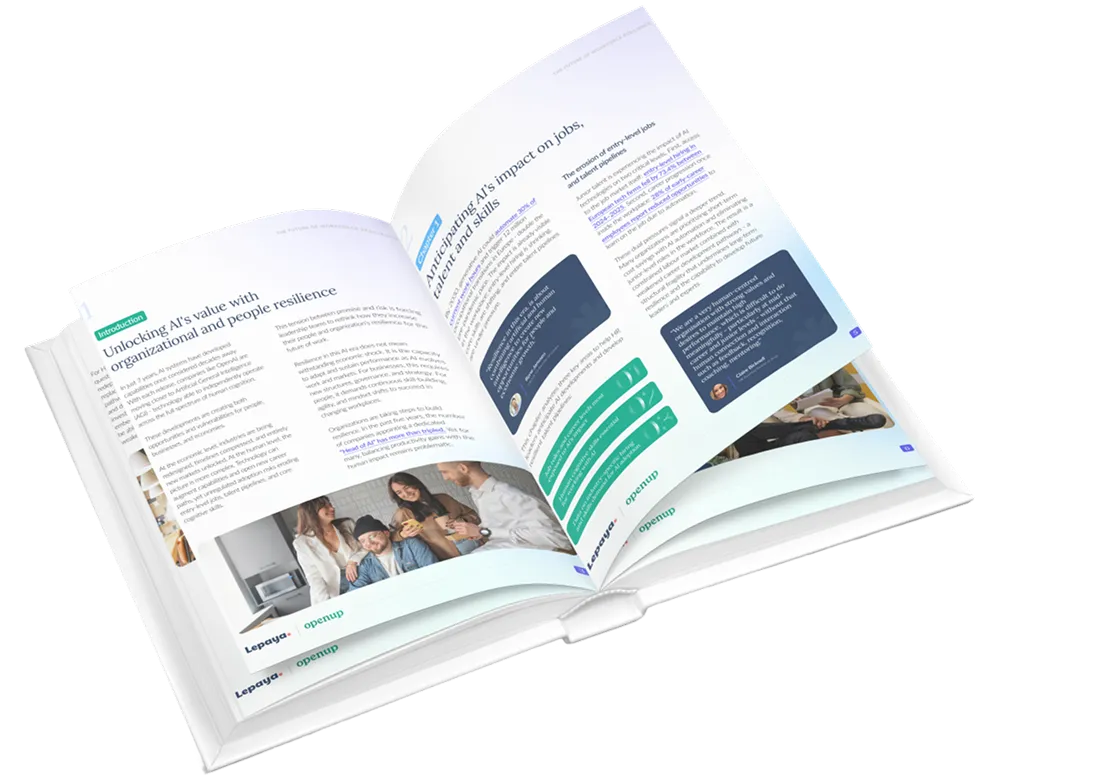

.webp)
Review by:
Discover how Sakura Finetek Europe successfully designed and implemented a Leadership Foundation Program for new managers during organizational transformation, focusing on clear objectives, stakeholder buy-in, and measurable behavioral outcomes to secure their leadership pipeline.
Close skill gaps, accelerate growth, and future-proof your workforce.




.webp)


.webp)