

Explore the data from 196 global companies and uncover the key skills trends for the year ahead.
Download



.webp)
In a year marked by economic uncertainty and technological disruption, an unexpected trend has emerged in corporate learning and development: commercial sensitivity training has entered the spotlight, securing its place among the top five most trained skills of 2025.
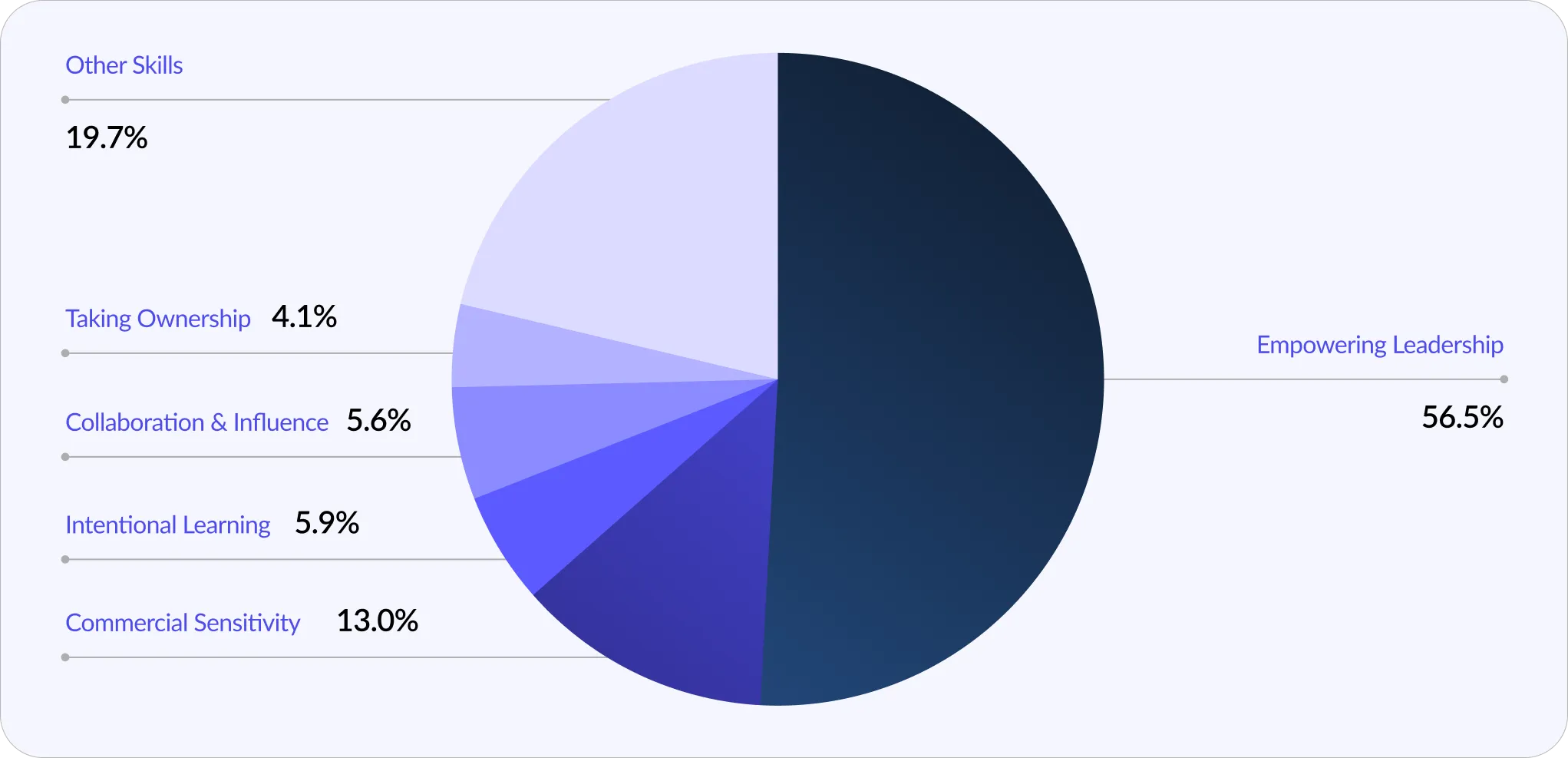
Based on the data analysis of 196 industry-leading companies, Lepaya's The State of Skills 2026 report revealed a 27% increase in commercial sensitivity training investment hours from 2024 to 2025, reflecting a shift in how organizations view their path to growth.
Instead of retreating into defensive positions or waiting for market conditions to improve, companies are actively building their commercial capabilities to pursue new opportunities. But what's driving this significant investment in sales capabilities, and what does it tell us about the changing nature of business growth?
In recent years, the traditional sales landscape has undergone a dramatic transformation. As AI and digital tools become more and more popular, modern buyers now conduct extensive research and complete 70% of their buying journey independently before engaging with sales representatives. Digital channels have transformed how customers discover and evaluate products, while AI-powered tools provide them with sophisticated insights and comparisons. Meanwhile, traditional sales techniques that once relied on controlling information flow have lost their effectiveness as customers become more informed and empowered.
However, this technological transformation hasn't diminished the importance of soft skills needed for sales, but rather the opposite. While AI and automation can enhance sales processes, the ability to build relationships, understand complex customer needs, and craft tailored solutions remains fundamentally human. This realization is pushing organizations to increase their investment in sales training, recognizing this human element as a key differentiator that will sharpen their competitive edge, and help drive revenue in a challenging global economy.
“AI works best as a scalpel, not a sledgehammer. Many reps will point it at their entire sales process, automating every touchpoint until the human connection disappears.
The real pros will use it to cut out the busywork and protect the parts of selling only humans can do — and in the future, sales leaders will measure those moments just as closely as activity metrics, with clear rules for where AI isn’t allowed to replace a person.” Ashleigh Early, Chief Executive Officer at Other Side of Sales Consulting.
In an era where customers are more informed and digitally savvy than ever, commercial training has also evolved beyond traditional selling techniques to prepare professionals for more complex challenges. Value-based selling has emerged as a cornerstone of this evolution - an approach that ensures value is added at every step of the customer journey, moving beyond transactional relationships to focus on genuine customer outcomes.
To support this transformation, today’s commercial training methods encompass a range of capabilities designed to ensure sales professionals can adapt to changing buyer behaviors while building sustainable client relationships. The focus has shifted from traditional closing techniques and product knowledge to effective sales techniques that help professionals provide deeper value in a marketplace where basic information is readily available through digital channels. This includes understanding customer challenges, articulating unique value propositions, incorporating data-driven approaches for strategic account planning, and developing consultative capabilities that position sales professionals as trusted business advisors to their clients.
This shift in training requirements is also driving organizations to increase their investment in sales development, recognizing that success in modern markets demands well-rounded sales professionals who can combine analytical insights with strategic consultative skills.
"We see a clear correlation between the fear of a recession and the level of investment in commercial sensitivity programs: once, mostly B2B, companies notice that their topline results might be put under pressure, they start considering investing in sales programs," explains Pascal Struijk, Product Lead at Lepaya
"That is also what we witness here. In industries like manufacturing, banking & insurance, and consulting, the investments went up. The most common request was: “Please help us grow our share of wallet with our customers by helping us to up- and cross-sell”. For this reason, we run many existing business expansion programs. It is interesting to see that the focus of these programs is less on new business. We can clearly notice that companies are betting more on AI here," he adds in.
While many companies respond to market uncertainties and budget constraints with cost-cutting measures, others are tackling financial challenges by boosting sales performance through targeted training programs.
Fagus GreCon, a market leader in the development and manufacturing of measuring equipment and fire protection systems, is an excellent example of how strategic sales training can drive better outcomes. By enhancing sales effectiveness, the company not only balances out higher costs but also boosts employee satisfaction and retention—achieving more with the same investment.
Dr. Uli Hilbers, Head of Sales and Market Development at Fagus GreCon, shares:
"Sales success can be planned, and it requires the application of a promising methodology. At Fagus GreCon, we’ve embraced the Value Selling methodology, which emphasizes understanding customer needs and tailoring solutions to address them in a more targeted and attractive way.
To support this, we’ve launched a company-wide sales training initiative across Germany, France, the UK, the US, Brazil, and China, focusing on standardizing our sales process while enhancing effectiveness and customer satisfaction. The impact has been clear—feedback from our trained employees has been overwhelmingly positive, and we sustain this momentum through regular coaching and topic refreshers. By equipping our teams with these capabilities, we are building a strong foundation for continued success."
The future of commercial training will be defined by a strategic balance between technological advancement and human capabilities. While AI and digital tools continue to transform the sales landscape, the focus is shifting toward developing sales teams who can maximize these technological advantages while strengthening their core commercial capabilities.
As technology handles more routine tasks, professionals will need to excel at the uniquely human aspects of sales: building relationships, understanding clients’ needs, and crafting creative solutions to complex challenges. At the same time, they will also need to enhance their technical proficiency to leverage data-driven insights and boost productivity.
The surge in commercial sensitivity upskilling in 2025 represents more than just a response to current market conditions; it's a strategic investment in future success. By fostering a balanced approach to sales excellence, companies are building resilient commercial teams ready to capitalize on emerging opportunities, positioning themselves to thrive in the evolving business landscape of 2026 and beyond.

We offer a scalable employee training solution. It lets you continuously upskill your people.
Book a call
.webp)
“AI works best as a scalpel, not a sledgehammer. Many reps will point it at their entire sales process, automating every touchpoint until the human connection disappears. The real pros will use it to cut out the busywork and protect the parts of selling only humans can do — and in the future, sales leaders will measure those moments just as closely as activity metrics, with clear rules for where AI isn’t allowed to replace a person.”


Close skill gaps, accelerate growth, and future-proof your workforce.




.webp)
.webp)

.png)
.webp)