

Use Lepaya's skills gap analysis tool to uncover the critical skills your teams require.
Start now



• Global companies are seeking solutions for impactful change without breaking talent.
• Shopify implemented Chaos Monkey in response to productivity challenges, shutting down communication channels to increase efficiency.
• Chaos Monkey, while effective in testing resilience, can cause unpredictability and stress in the workforce.
• Instead of sudden disruption, companies can focus on skills training to build resilience and empower leaders to support their teams.
• Data shows that collaboration, leadership, resilience, and ownership are key skills for global companies to develop in 2023.
Chaos Monkey 2023 proves global companies are still looking for a solution to trigger impactful change without breaking their talent in 2023.
Shopify took an unprecedented course of action. In January 2023, they cancelled all meetings with more than two people – for an entire fortnight. They shut down slack channels and wiped chat history in what Shopify would describe as ‘managed chaos’.
They were right to act. With extreme turbulence in 2023 – a recession, inflation and remote work – large companies are searching for new ways to design robust and nimble operations.
Shopify had previous operational challenges. Last July it laid off 10% of its talents in response to over-hiring and a depleted e-commerce market. But their problems don’t stop there.
Meeting and slack channel overloads were stifling their talent’s productivity. After all, time, efficiency and employee output determine business revenue. Therefore, Shopify shutdown all communication channels. COO Kaz Nejatian explained in an email to staff the logic behind management’s decision:
“We are going fast and chaotic…Intentional chaos is more than OK, and it’s part of working and thriving at Shopify…We’ve forced our async work into Slack – it’s bloated, noisy, and distracting. We have endless channel updates mixed with broad announcements and pineapple on pizza debates.”
How do you trigger scalable, positive and sustainable change when systems malfunction at large organizations? Do we go fast and chaotic with a shutdown, or is there another solution to install resilience in our global teams?
Chaos monkey is an engineering tool that stimulates failures in production systems to test their resilience. Used by Netflix, it shuts down systems at random to make them more robust and effective when they recover. It’s essentially a fire drill to train talent to react and adapt to unforeseen situations.
Shopify deemed chaos monkey as the answer to productivity killers. In simple terms, they restricted communication to increase production and forced talent to adopt a low meeting culture. The sudden disruption was designed to make employees recover quicker and develop resilience to turbulence at a widespread organizational level.
Is there a negative impact of chaos monkey on a workforce?
Its main pernicious feature is unpredictability. The unforeseen disruption is liable to cause distrust with management and immediate stress on people as the brain craves habitual actions when experiencing discomfort. This stress increases mental pressures and evokes an underlying paranoia, especially for those with mental health difficulties, or remote workers who become isolated without communication channels.
How do you make your workforce more nimble and robust to impact your business for the long-term without breaking your talent? Is there a much steadier approach as opposed to immediate chaos?
Rather than shutting down communication platforms and stripping our people of resources, why don’t we make our people more robust by giving them the tools they need?
Think about the skills and resources that enable your people at every level of the organization to be efficient, productive and to perform. Remember that with remote work trending, the pressure to communicate with colleagues across global teams is mounting and enabling talent to collaborate ensures efficient co-working to produce results.
This may seem like a daunting task, but consider starting your leaders because they have the capabilities to support your global teams. By empowering leaders, we don’t rupture communication, but rather strengthen the relationship between management and their teams. And large organizations can provide the tools to standardize quality leadership skills to nurture a productive and stable environment.
In this way, leaders empower their teams with the right skills and create stability, trust and growth to deal with forecasted turbulence in 2023.
We have the data to help large organizations solve their widespread challenges this year. Based on 78,551 hours of skills training from 162 companies, global businesses can focus on skills that impact their revenue goals while building a resilient workforce.
Starting from a wide overview, the top trained skill in 2022 was Collaboration and Influence – a total of 24,547 hours (31%). With leadership skills ranked second. From this, we see that top global organizations are building teams of effective communicators led by empowered leaders.
However, most of the 162 companies trained Resilience and Taking Ownership skills and this is the upcoming skill for 2023. Meaning that as companies adapt to new workforce trends and changes, they’re focused on building resilient teams with the right leaders to make their organizations successful in 2023.
But there’s more data on these 162 companies to consider.
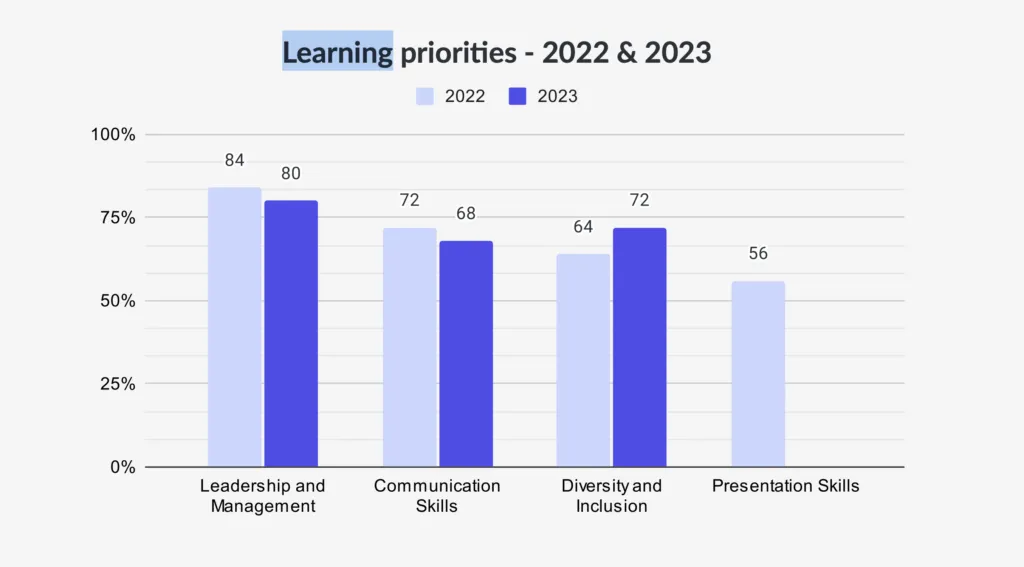
Data from State of Skills
We’re starting to see an upward trend in increasing L&D budgets. This is because global companies are realizing they have to place more value on upskilling in 2023. However, the budget increase within most companies is insufficient to tackle such large-scale challenges this year. Therefore, multinational companies should take that next step by increasing their global budget to upskill their talent at scale.
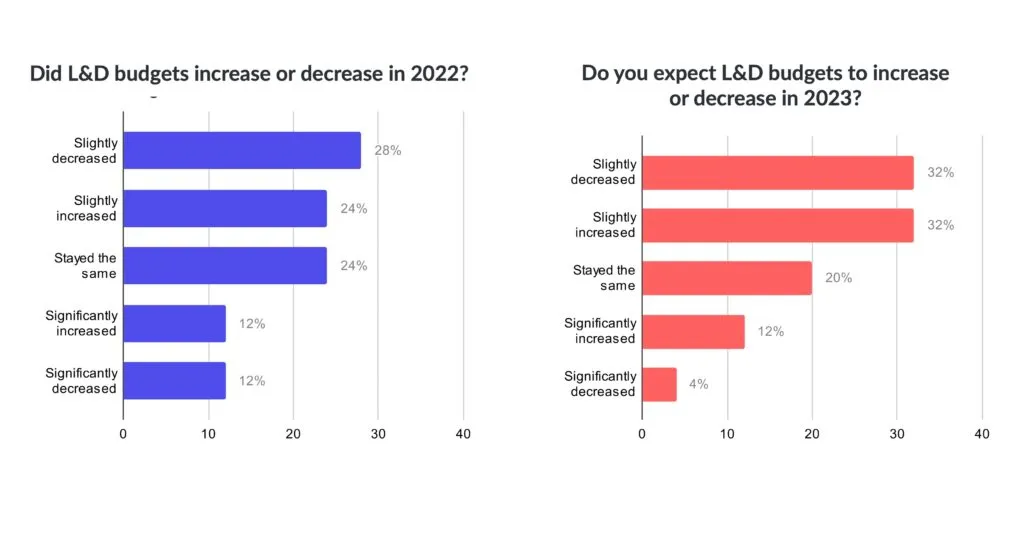
Data from State of Skills
This isn’t an attack on Shopify. Chaos Monkey proves that large organizations are seeking a solution to a serious challenge in 2023: how do you evoke positive and sustainable change at scale to impact your business in turbulent times?
Chaos Monkey is one tactic, but how can you make your talent more productive without piling on more pressure with such sudden disruption?
Train your talent to communicate and collaborate better and ensure the right leaders are in place to support them.
Global companies can’t rely on shutting down systems to become more robust. Our people aren’t systems – they’re humans. There’s enough stress on your people with changing work modes and reliance on communication channels to connect with global teams. Let’s focus on what we can give our people to succeed, not what we take away from them.
Global companies can rely on skills training to build resilience and allow their people to thrive amidst the intensity of change and turbulence. It’s a longer process, but a sustainable one. This is precisely why resilience and ownership is the upcoming skill to train for 2023.
Be brave and be one of the few global organizations to take that first step to upskill your people at scale and transform your business in 2023 with sustainable growth.
Download our State of Skills report here to gain full insights into the data that matters to your business revenue in 2023.

We offer a scalable employee training solution. It lets you continuously upskill your people.
Book a call
.webp)

.webp)
Review by:
AI advances like ChatGPT-5 are transforming the workforce, but not without risks. With entry-level roles disappearing and human cognition declining through overreliance on AI, leaders must prioritize skill resilience and talent pipelines to sustain long-term performance.
Review by:
Senior leadership and boardroom teams invest heavily in commercial strategies to win market shares. Yet the most important and honest information driving strategy circulates in teams underneath, never making it to the table where decisions are made.Jeroen Kraaijenbrink, Executive Coach and Strategy Consultant at Kraaijenbrink Advisory, has spent years working on what he calls the honesty gap. We sat down with him to understand what the honesty gap actually is, where it lives in organizations, and why fixing it requires a leadership shift.How do you define the honesty gap?There's a narrow definition and a broad one. The broad one is: we have created organizations and systems where it's barely possible to be honest to yourself, about yourself, and honest to other people.Honesty isn't just lying. It's integrity, being authentically connected to other people and being aware of your own emotions and your own biases.The honesty gap, in a narrow sense, is the fact that truth and information don’t travel vertically upwards in a company. It's often hard to speak openly to your manager because it’s become rational not to. Many people have the experience: 'I've tried it once but then I was punished for it, or was ignored, so let it be, never mind.' That's the fascinating part: it's not good for people, it's not good for organizations and yet we somehow keep this system intact.Is it less about individual dishonesty and more about a collective culture?A lot of the most important information going through your company is between people and in conversations. You need to find a way to have an honest conversation, where the things that matter get on the meeting table, not just in the informal circuit. And I think that's pretty rare.A more systematic definition is that we're not using the collective intelligence of a company enough. We can radically improve it because we’ve made it rational to hide the truth and to keep things to yourself. A lot of it may not be intentional, but the very fact that someone is in a position above you automatically creates this tension: 'What do I show? What don't I show? Because my next performance appraisal is coming up.'Where does the honesty gap typically show up first, and who owns the problem?It starts with leaders. Solving it needs one leader at the top, the CEO at least, being open and reflective enough to admit that there is an honesty gap and that they are part of it. That's the self-reflection you need for any improvement and any change. Like in coaching: you need to be aware that there is stuff to improve. You don't need to be a perfect leader, but you need to be open enough to admit that there is an issue.You talk about the 'persona trap', what is that?You're stuck in a persona where you perform in a certain way within your company. You have a role, a position, a reputation, and that locks you into specific behaviors. The worse the match between who you are as a person and how you need to show up in your organization, the more inner conflict that’s created. Especially at the top, it’s a problem for many executives. They're supposed to be the people who know it all and be decisive. While if you're honest, you don't necessarily know everything, you’re uncertain and have anxieties.The inner core of the honesty gap is breaking the performance, breaking the acting you feel you must do. If you've put yourself in a role of being the strong, decisive, number-oriented leader, that's how you have to behave. But most people don't feel very comfortable in that kind of role because it's not who they are.Can you fix the honesty gap through individual coaching alone or does the system have to change?Part of it is a personal change, part of it is a system change. You can be on your own and be very authentic, but if the system doesn't change at all, you’ll struggle to break the honesty gap.What you need to do is work on the people, the culture, and the system. Ideally that has to include the top, because otherwise it stays at the level of the person being coached. If it's a team lead or a mid-manager, that person can partly create an island in the organization, a safe space for their team and their department. But still, the appraisal systems, objectives, and culture are company-wide. Why is this so hard to shift, even when leaders recognize the problem?We have normalized this idea that you have to be strategic in what you tell and what you show. You have to show up in a certain role at work. It's also the result of how we have separated work from life, which is a very unnatural thing. It's from the industrial age, because for any other species, work is life. But now there’s a split between work, with all the routines in companies, and then your private life. There's just one you, you're the same person at home as you are at work. The good news is that the honesty gap can be closed. While many companies have unintentionally created environments where people hesitate to speak openly, organizations prioritizing trust, authenticity, and psychological safety can unlock a competitive advantage. When employees feel safe to share concerns, ideas, and perspectives, collective intelligence grows, decision-making improves, and stronger relationships emerge across every level of the business.
Close skill gaps, accelerate growth, and future-proof your workforce.




.webp)

.png)