

Implement a structured onboarding plan and develop high-impact leaders from day one.
Download now



.webp)
• The buddy system is crucial for successful employee onboarding, creating well-tuned teams and boosting productivity.
• Benefits of a buddy system include building relationships, increasing productivity, improving job satisfaction, providing insights, and enhancing learning experiences.
• Implementing a buddy system involves pairing employees with similar interests, doing regular check-ins, monitoring progress, making the right matches, and providing impactful training.
• Being a good buddy at work requires understanding company culture, effective communication, responsibility for onboarding, availability, and a commitment to developing leadership skills.
• The buddy system is a good idea for creating a happy, inclusive, and productive workforce, reducing turnover rates, and enhancing the onboarding experience for new employees.
TL;DR: A buddy system pairs new hires with experienced colleagues during onboarding. When done well, it cuts time-to-productivity, reduces early turnover, and makes new employees feel at home from day one. This article covers what a buddy system is, seven concrete benefits, how buddy programs differ from mentoring and manager check-ins, and a five-step implementation guide.
The buddy system is a staple element of a successful employee onboarding process. It’s one of the most powerful tools for creating teams whose members are perfectly tuned and at ease with each other. Ideally, it boosts productivity at the workplace, increases the feeling of well-being among your staff, and reduces high turnover costs.
However, to reap the benefits of it, it’s essential to truly understand what a buddy system is and why buddy programs are important. In this article, we’ll cover questions like “What is a buddy system?”, “What are the benefits of a buddy system?”, and “How to implement a buddy program in the workplace?”
A buddy system is the practice of pairing a new hire with a more seasoned employee: someone who helps them get familiar with the organizational structure, culture, and processes during their first weeks or months on the job – sometimes even longer. For new hires, starting a new job can be a nerve-racking experience as it is, so having a friendly face around to show them the ropes helps them fit into their new role smoothly.
However, a work buddy is more than a nice colleague who knows exactly which lunchroom serves the best coffee and how the printer works. It's someone who answers all types of questions, shares knowledge, motivates, gives guidance, and introduces the new hire to the rest of the team.

So, how do buddy programs work exactly? For new employees, the information overload can feel overwhelming during their first weeks in a new work environment. With an onboarding buddy assigned to them on their first day, someone will immediately feel welcome, less anxious, and more comfortable in their new function. This experienced member of staff will help them onboard on four levels:
Before looking at the benefits, it helps to be clear on what a buddy system is not. These three roles are often conflated in onboarding discussions, but they serve genuinely different needs:
Buddy
Mentor
Manager 1:1
A buddy program doesn't replace good management or structured mentoring; it sits alongside both, covering the peer-connection layer that neither can fully provide.
Having a buddy system at work has many benefits. Below, we’ll state the seven most notable advantages of a buddy program.
The buddy system is an efficient way to build valuable relationships between co-workers, which matters enormously for employee experience and retention rates. Poor relationships and a lack of engagement at work are among the main causes of early departure. When new hires have a companion they can trust and talk to from day one, they'll feel connected with the organization much faster.
Speed to productivity is often a concern for both the company and the new hire. Businesses want a quick return on investment once they hire a new employee, while new hires feel the tension between wanting to perform and needing time to learn the job and get to know the company.
A study conducted by Microsoft showed that 97% of new hires who met with their buddy 8 times or more in their first 90 days of working there indicated their buddy helped them to quickly boost productivity in their role. Why? Because their buddy made the settling process so much easier. Being comfortable in your new surroundings and being able to adjust to the corporate culture quickly increases confidence and motivation; thus, productivity levels rise.
The same study conducted by Microsoft also indicated that after their first week on the job, new hires with onboarding buddies were 23% more satisfied with their onboarding than those without. After 90 days, this number improved, showing 36% more satisfaction in new hires with buddies compared to those without. Providing your employees with a companion in your organization from the get-go ensures their job satisfaction and reduces turnover.
At Lepaya, we asked some of our recent hires how our internal buddy system benefited them. One recurring theme was that because Lepaya matches people across the organization, it gives new hires insights into different roles.
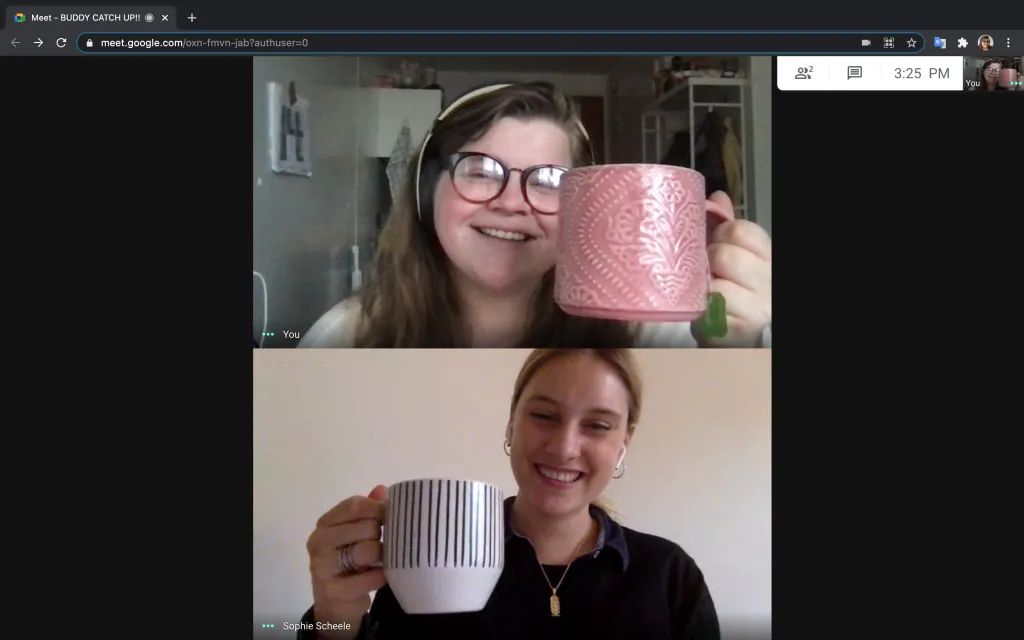
The buddy system used here motivates our employees to succeed. In one case, two interns met to share thoughts on research they were conducting within Lepaya, motivating and inspiring them with fresh ideas. (You can see them below, catching up!)
Using a buddy system is not just a useful tool to improve your onboarding processes, but it is also useful for peer learning. For example, at Lepaya, we use buddy programs in most of our training, both virtually and face-to-face. Using a buddy system, employees can practice what they’ve learned in traditional classroom sessions. They set goals during training and complete e-learning content with their allocated buddy to hone their new skills in real life.
By using a buddy system in our learning programs, we encourage learners to not only interact and bond but also to motivate and support one another throughout their learning journey. Learning together ensures an active learning experience and a deeper understanding of what they will learn. A buddy system also helps new staff to develop their skills and boost their confidence through social interaction. Learning from peers is a great, informal way to tap into the expertise and knowledge that is already present in an organization, and it can work both horizontally and vertically.
As of today, about one-third of employees prefer fully remote work, and less than 10% prefer to work on-site. For new hires onboarding into a distributed team, without hallway conversations or spontaneous lunch invitations, having a designated buddy becomes even more important. It's often the only consistent human contact that isn't a formal meeting or a structured check-in.
According to research, 69% of employees are more likely to stay with a company for at least three years when they experience great onboarding. For remote and hybrid employees in particular, peer connection is one of the hardest things to build, and one of the biggest drivers of whether someone stays.
Being an onboarding buddy is a genuine development opportunity. The role builds structured communication, active listening, and the kind of informal mentoring that prepares people for management. Employees who take on the buddy role tend to develop stronger organizational awareness and stronger cross-team relationships - benefits that last well beyond the onboarding window.
Framing the role that way, as a growth opportunity, not just a courtesy, is also one of the most effective ways to attract strong buddy candidates internally.
There are plenty of good reasons to introduce a buddy system into your organization. But how does it work in practice? Where to start? By following these five steps, you can implement a buddy program that not only benefits new staff but also your business as a whole.
The quality of a buddy program depends almost entirely on whether the pairing feels natural. Shared interests outside the immediate job function help: if two people both run, both have a background in education, or both are new to the city, that common ground makes the first conversation easier.
Cross-department pairings tend to perform better than same-team matches for broad cultural integration. Same-department pairings work well when the new hire needs fast functional orientation. Running both simultaneously, one peer buddy for culture, one departmental buddy for role-specific knowledge, is worth testing if you have the capacity.
Buddy meetings work best when they have a light rhythm, perhaps a 30-minute check-in in week one, weekly after that for the first month, then fortnightly. Giving pairs a short list of suggested conversation prompts for the first few meetings reduces the awkwardness of having a designated friendship without making it feel transactional.
The pair should own the relationship from there. Over-structuring buddy programs makes them feel like another performance process, which kills the informal trust that makes them work.
The onboarding team should run short surveys with new hires at the one-month, three-month, and six-month marks, asking specifically whether the buddy relationship was useful and in what ways. Asking the buddy too is important: some people are not suited to the role and benefit from knowing that early.
This data tells you where the program is working, where pairings are mismatched, and whether your buddy recruitment and training are producing the right profile.
Satisfaction scores are useful leading indicators, but the metric that justifies the investment is retention. Track 90-day and 12-month retention separately for cohorts with buddy programs versus those without. If your program is running well, you should see a meaningful gap: companies with structured onboarding see up to 82% higher new hire retention and over 70% higher productivity.
An effective and fun learning experience is crucial for new bees to get adjusted. Lepaya uses interactive learning to engage your (new) employees and make their learning experience fun, memorable, and effective. Whether they are learning virtually with our interactive bites or at in-person training, they will interact with the trainers, actors, and their colleagues throughout the process. Lepaya thinks along with you to ensure your organization gets the right training at the right time.
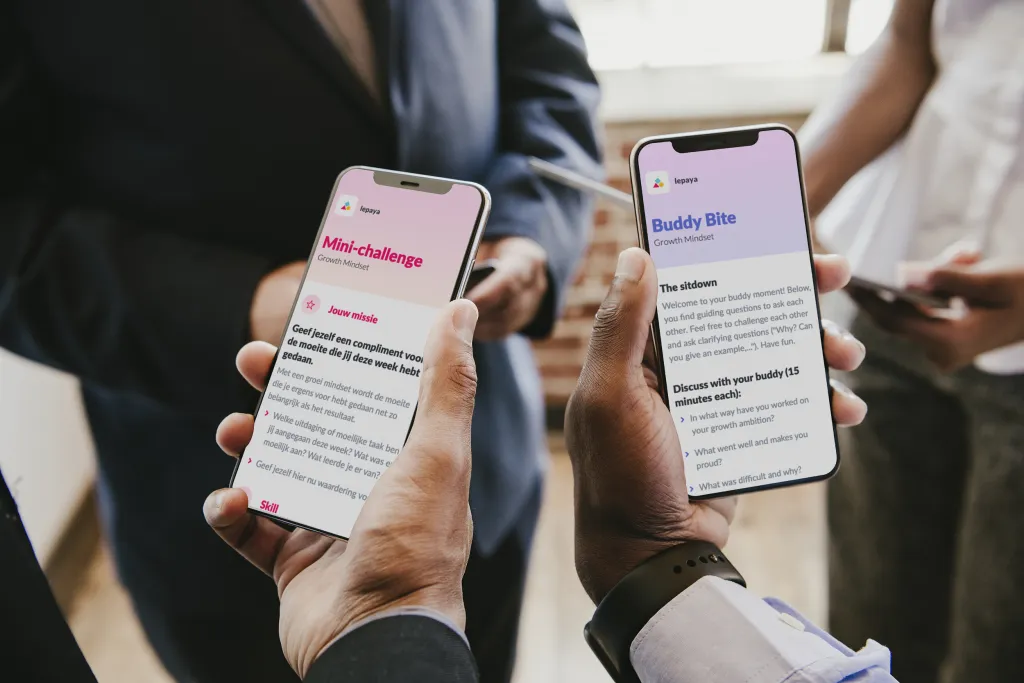
A work buddy is so much more than just a friendly colleague. It’s somebody who genuinely takes care of a new staff member a number of times, supports them, encourages them, and makes them feel part of the family.
Sounds easy? Make no mistake: being a work buddy takes time and effort, and that person should definitely possess a certain number of characteristics, skills, and qualities to make it a success.
In other words, when implementing a buddy system in the workplace, make sure to choose potential buddies wisely and manage expectations from all sides. You might want to invest in buddy training to guarantee they have all the right tools to do the job – and truly enjoy it!
So what makes a great buddy candidate?
Being a buddy is mutually beneficial. It’s not just the new hire who can benefit from this relationship. Serving as an onboarding buddy provides an opportunity to demonstrate and develop leadership and management skills.
Aiming for a happy, inclusive, and productive workforce? Looking for a way to get the most out of your onboarding strategy and reduce high turnover rates?
As you may have found out by now, the buddy system is a great way to achieve those goals. It’s an essential element of a successful employee onboarding experience and should be a high priority for any company, big or small. When executed well, it will not only help new employees get adjusted easily, but it’s also a proven way to retain talent at your organization, to boost productivity, and create an effective, fun learning experience for everyone involved.

We offer a scalable employee training solution. It lets you continuously upskill your people.
Book a call
.webp)

.webp)
Review by:
AI advances like ChatGPT-5 are transforming the workforce, but not without risks. With entry-level roles disappearing and human cognition declining through overreliance on AI, leaders must prioritize skill resilience and talent pipelines to sustain long-term performance.
Close skill gaps, accelerate growth, and future-proof your workforce.




.webp)
.webp)

