Discover how Europe's fastest growing companies are preparing for AI adoption.
Download now



.webp)
Chief Human Resource Officers face new challenges in building organizational resilience. Geopolitical instability, demographic complexity, and the rise of agentic AI are reshaping how companies operate and what modern HR leadership requires.
At Lepaya’s recent “People and Strategy” event, over 30 senior HR and business leaders came together to discuss and solve today’s most pressing workforce challenges.
During the event, Caroline Tervoort-Visser — former CHRO and now Partner of the KPMG Advisory — sat down with Annee Spijkervert, Chief Commercial Officer at Lepaya, to explore how organizations can navigate transformation.
In this interview, they discussed the most relevant workforce challenges facing HR, if AI agents can independently run organizations and which critical human skills are required to work with AI.
I began my career in strategy consulting and worked on several HR-related assignments. I quickly realized how broad and interconnected the HR function is across every part of the organization. What drew me in was the ability to shape culture, influence processes, and ultimately make a meaningful impact on people’s professional lives.
Change readiness and workforce productivity are top priorities across all levels of the organization.
For example, we’re now navigating a complex demographic landscape - four, sometimes five generations in the same workforce. Younger generations were raised with the mindset of “changing the world,” not “rebuilding the economy after a crisis,” which creates a more existential outlook compared to more senior generations.
At the same time, geopolitical tensions are reshaping global supply chains and altering relationships between the US and Europe. Our interdependency on each other means that unexpected decisions can have sudden, far-reaching consequences.
Then there’s agentic AI, which is reshaping organizations in very different ways. For instance in financial services, it’s driving internal restructuring. Whereas in healthcare, its impact is more about enabling staff by reducing administrative burdens.
The experiment explores an important question for the future of work: What if AI agents could independently run a company with no people?
We built a basic organizational structure, assigned roles to AI agents, and asked them to come up with a business plan. They proposed starting an art webshop. The agents were extremely efficient: they don’t get sick, they operate 24/7, they attend simultaneous meetings, and they can even be scripted to act proactively.
However, the experiment also exposed limitations. For example, the CEO agent was scripted to consult with the strategy officer. When it unexpectedly interacted with the legal counsel, it reused the same script with only minor adjustments which raised reliability and ethical concerns.
The core takeaway is that humans are uniquely capable of managing chaos and ambiguity. AI agents are built on statistical systems; they struggle when reality deviates from patterns.
For me, this is what defines the human–AI relationship. While AI agents can handle tasks autonomously, humans need to stay “on the loop” rather than “in the loop”, providing oversight to guide decisions and ensure reliability without compromising the agents’ efficiency.
Critical thinking and emotional intelligence are becoming more important than technical hard skills. People still need a foundational understanding of how AI works just as we once had to learn how to use the internet, but when repetitive tasks disappear, what remains is judgment, interpretation, and human connection.
My advice to HR leaders is to start introducing AI tools early to reduce fear and build confidence. While also ensuring that your leaders “lead” the change and understand the AI technology being introduced. If you don’t understand the technologies your people are using nor the outputs they’re producing, you can’t effectively evaluate their work and ensure the required quality of their output.

We offer a scalable employee training solution. It lets you continuously upskill your people.
Book a call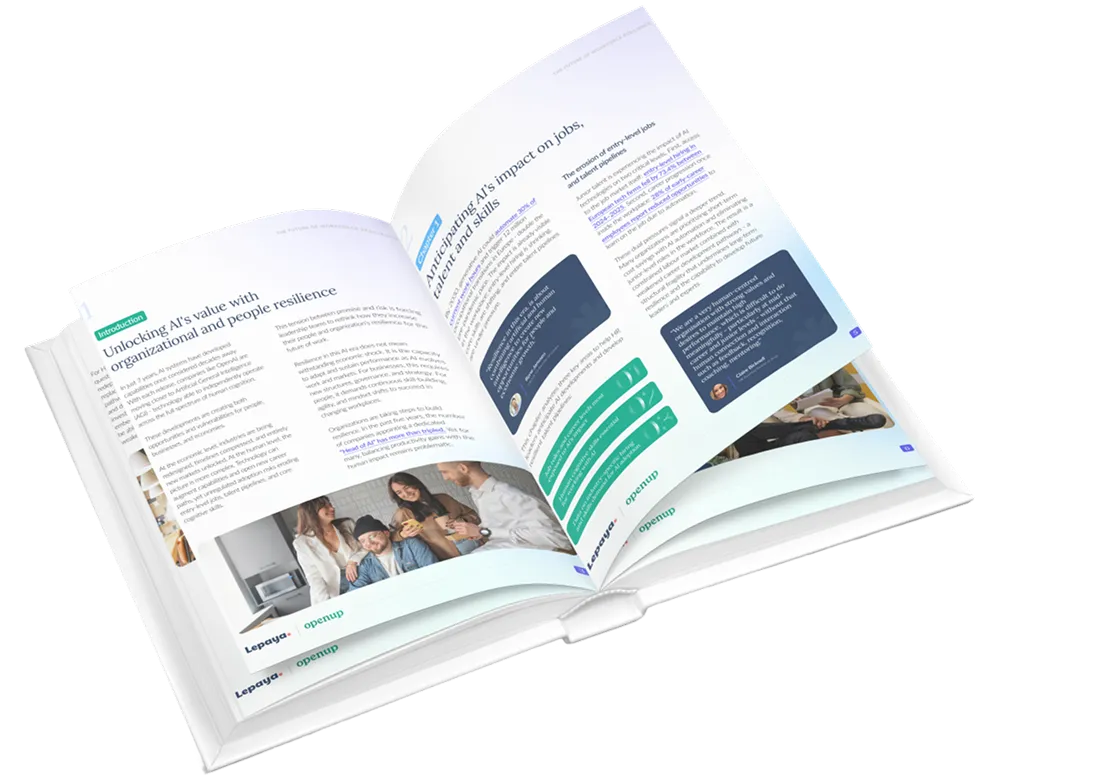

.webp)
Review by:
The EU Pay Transparency Directive is reshaping performance reviews. In this article, Raymond Lansheuvel, Lepaya’s Head of Benelux, reveals how managers can prepare for pay conversations with confidence.
.webp)
Review by:
We sat down with Makoto Makabe to explore how the company transformed its leadership development strategy, overcame internal resistance, and built a scalable, globally aligned framework.
Close skill gaps, accelerate growth, and future-proof your workforce.




.webp)